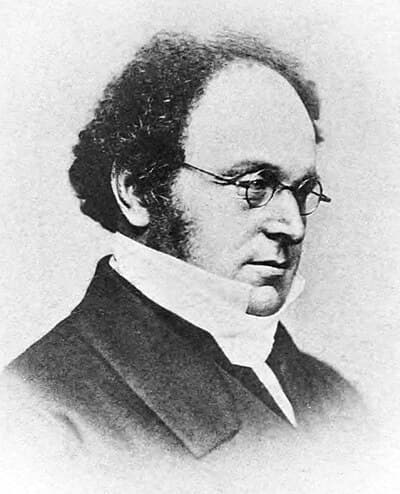
Augustus De Morgan
Augustus De Morgan was a prominent British mathematician and logician whose work laid foundational principles in the fields of logic and mathematics. He is best known for formulating De Morgan's laws, which articulate the relationships between logical conjunction, disjunction, and negation. His insights into these logical operations have had a lasting impact, influencing various branches of mathematics, including set theory and probability theory. Additionally, De Morgan coined the term 'mathematical induction' and provided a formal framework for its application, which has become a critical component in mathematical proofs and reasoning. Beyond his contributions to mathematics, De Morgan was an advocate for the teaching of mathematics and logic, emphasizing their importance in education. His legacy extends into modern disciplines such as computer science, where his logical principles continue to be applied. De Morgan's work not only advanced mathematical thought in his time but also paved the way for future developments in logic and computational theory, solidifying his place as a key figure in the evolution of mathematical logic.
Famous Quotes
View all 3 quotes“I am perfectly convinced that I have both seen, and heard in a manner which should make unbelief impossible, things called spiritual which cannot be taken by a rational being to be capable of explanation by imposture, coincidence, or mistake.”
“Lagrange , in one of the later years of his life, imagined that he had overcome the difficulty ( of the parallel axiom ). He went so far as to write a paper, which he took with him to the Institute, and began to read it. But in the first paragraph something struck him that he had not observed: he muttered: ' Il faut que j'y songe encore ', and put the paper in his pocket.' [ I must think about it again ].”
“The moving power of mathematical invention is not reasoning but imagination.”
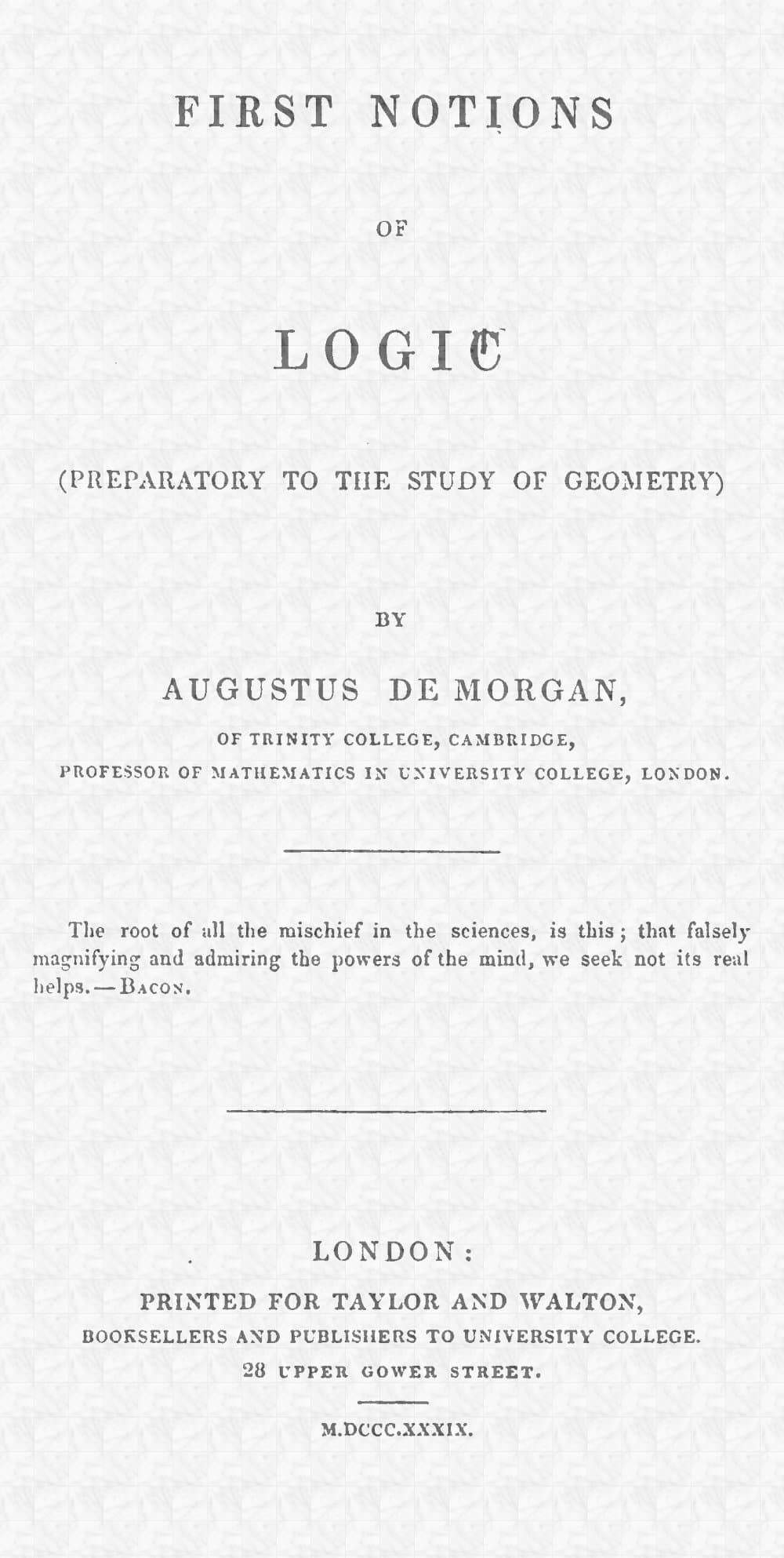
Books from the author








Link to this page
Add a free, dofollow link to Lex on your blog, forum, syllabus, or reading list.

<a href="https://lex-books.com/author/augustus-de-morgan"><img src="https://lex-books.com/badges/read-on-lex.svg" alt="Augustus De Morgan on Lex" width="160" height="40"></a>[](https://lex-books.com/author/augustus-de-morgan)[url=https://lex-books.com/author/augustus-de-morgan][img]https://lex-books.com/badges/read-on-lex.svg[/img][/url]Augustus De Morgan on Lex: https://lex-books.com/author/augustus-de-morgan