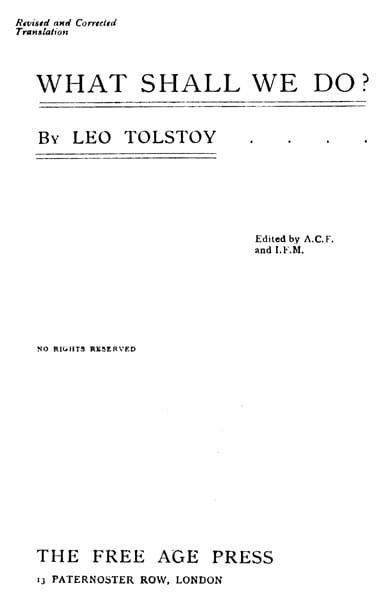
What Shall We Do?
In 1882, Tolstoy arrived in Moscow and witnessed something that would shatter his conscience. The city, bursting with wealth and resources, was surrounded by human beings living in conditions so degrading they seemed impossible in a civilized society. Beggars cluttered the streets, the homeless froze in doorways, and a law prohibiting begging had done nothing but drive suffering further into the shadows. Tolstoy could not look away. He sat with these forgotten people. He listened to their stories. He asked himself the question that would consume him: What shall we do? What follows is not a distant sociological treatise but a reckoning. Tolstoy grapples with the unbearable contradiction between his own comfort and the misery surrounding him. He examines the structures that create poverty and the moral obligations of those who benefit from them. This is Tolstoy at his most personal, most raw, confronting his own complicity in a system built on exploitation. It is a challenge to every reader: can you read this and remain unchanged?
Editions

X-Ray
“I sit on a man's back choking him and making him carry me, and yet assure myself and others that I am sorry for him and wish to lighten his load by all means possible… except by getting off his back.””
— Leo Tolstoy
“All the wounds of society, the wounds of poverty, of vice, of ignorance”
— Leo Tolstoy
“Money, in itself, is evil. And therefore he who gives money gives evil. ””
— Leo Tolstoy
“Great and real affairs are always simple and modest.And so it is with the most important affair before us: the solution of the terrible contradictions amid which we live.And the things that solve those contradictions are these modest, imperceptible, apparently ridiculous acts: serving oneself, doing physical labour for ourselves and if possible for others - which we rich people have to do if we understand the misfortune, wrongfulness, and danger of the position into which we have fallen.””
— Leo Tolstoy
“There can only be two tests of the utility of one man's activity for another: the external, consisting in the recognition of this utility by him who is benefited, and the internal, a desire to benefit another which lies at the root of the activity of him who confers the benefit.””
— Leo Tolstoy
Link to this book
Add a free, dofollow link to Lex on your blog, forum, syllabus, or reading list.

<a href="https://lex-books.com/book/what-shall-we-do-0e298520-9b14-4c79-8c8e-264d3871f474"><img src="https://lex-books.com/badges/read-on-lex.svg" alt="Read What Shall We Do? by Leo Tolstoy free on Lex" width="160" height="40"></a>[](https://lex-books.com/book/what-shall-we-do-0e298520-9b14-4c79-8c8e-264d3871f474)[url=https://lex-books.com/book/what-shall-we-do-0e298520-9b14-4c79-8c8e-264d3871f474][img]https://lex-books.com/badges/read-on-lex.svg[/img][/url]Read What Shall We Do? by Leo Tolstoy free on Lex: https://lex-books.com/book/what-shall-we-do-0e298520-9b14-4c79-8c8e-264d3871f474Cite this book
Reading this edition for a paper or guide? Copy a citation.
Tolstoy, Leo. What Shall We Do?. Lex, lex-books.com/book/what-shall-we-do-0e298520-9b14-4c79-8c8e-264d3871f474.Tolstoy, L. (n.d.). What Shall We Do?. Lex. https://lex-books.com/book/what-shall-we-do-0e298520-9b14-4c79-8c8e-264d3871f474Tolstoy, Leo. What Shall We Do?. Lex. https://lex-books.com/book/what-shall-we-do-0e298520-9b14-4c79-8c8e-264d3871f474.