The Seven Who Were Hanged
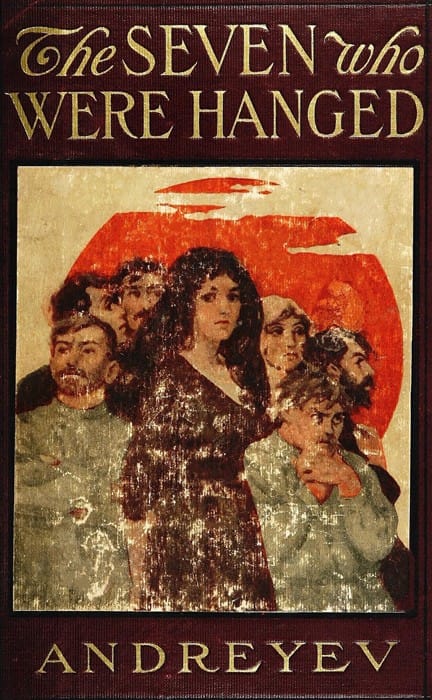
They are not yet dead, but they are no longer alive. In this haunting 1908 novella, Leonid Andreyev maps the psychology of the condemned with terrifying precision. Seven prisoners wait in their cells: revolutionaries whoPlot against the state, a peasant who killed a man, a young woman whose crime remains her own. Beyond the prison walls, a government minister receives word of an assassination plot against him, forcing him to confront the same question that haunts his prisoners: what does it mean to face a violent death you cannot escape? Andreyev's genius lies in his refusal to simplify. The revolutionaries are not martyrs, the minister is not a villain. Each character journeys toward their fate differently: some find strange freedom, some descend into madness, some discover unexpected joy in their final days. The result is a devastating meditation on state violence, on the line between victim and executioner, and on what remains of the human when death is certain. This is not horror in the pulpy sense, but something far more unsettling: a clear-eyed examination of what it means to know your ending is coming.
Editions
X-Ray
“Why did he not cry? He must have forgotten even that he had a voice.””
— Leonid Andreyev
“It seemed to him that he was walking along the highest mountain-ridge, which was narrow like the blade of a knife, and on one side he saw Life, on the other side”
— Leonid Andreyev
“Death was not there as yet, but life was there no longer,”
— Leonid Andreyev
“What do those people think? That there is nothing more terrible than death. They themselves have invented Death, they are themselves afraid of it, and they try to frighten us with it.””
— Leonid Andreyev
“Literature, which I have the honor to serve, is dear to me just because the noblest task it sets before itself is that of wiping out boundaries and distances.””
— Leonid Andreyev
“It was strange to think that so much humane painstaking care and exertion was being introduced into the business of hanging people; that the most insane deed on earth was being committed with such an air of simplicity and reasonableness.””
— Leonid Andreyev
“Life and Death moved simultaneously, and until the very end Life remained life, to the most ridiculous and insipid trifles.””
— Leonid Andreyev
“And he was tortured not by the fact that Death was visible, but that both Life and Death were visible at the same time.””
— Leonid Andreyev
“But, as is sometimes the case with good people, he was perhaps liked more for this little foible than for his good qualities.””
— Leonid Andreyev
Link to this book
Add a free, dofollow link to Lex on your blog, forum, syllabus, or reading list.

<a href="https://lex-books.com/book/the-seven-who-were-hanged-07bb2bc3-85c5-48e7-9cac-b87310fca7b0"><img src="https://lex-books.com/badges/read-on-lex.svg" alt="Read The Seven Who Were Hanged by Leonid Andreyev free on Lex" width="160" height="40"></a>[](https://lex-books.com/book/the-seven-who-were-hanged-07bb2bc3-85c5-48e7-9cac-b87310fca7b0)[url=https://lex-books.com/book/the-seven-who-were-hanged-07bb2bc3-85c5-48e7-9cac-b87310fca7b0][img]https://lex-books.com/badges/read-on-lex.svg[/img][/url]Read The Seven Who Were Hanged by Leonid Andreyev free on Lex: https://lex-books.com/book/the-seven-who-were-hanged-07bb2bc3-85c5-48e7-9cac-b87310fca7b0Cite this book
Reading this edition for a paper or guide? Copy a citation.
Andreyev, Leonid. The Seven Who Were Hanged. Lex, lex-books.com/book/the-seven-who-were-hanged-07bb2bc3-85c5-48e7-9cac-b87310fca7b0.Andreyev, L. (n.d.). The Seven Who Were Hanged. Lex. https://lex-books.com/book/the-seven-who-were-hanged-07bb2bc3-85c5-48e7-9cac-b87310fca7b0Andreyev, Leonid. The Seven Who Were Hanged. Lex. https://lex-books.com/book/the-seven-who-were-hanged-07bb2bc3-85c5-48e7-9cac-b87310fca7b0.