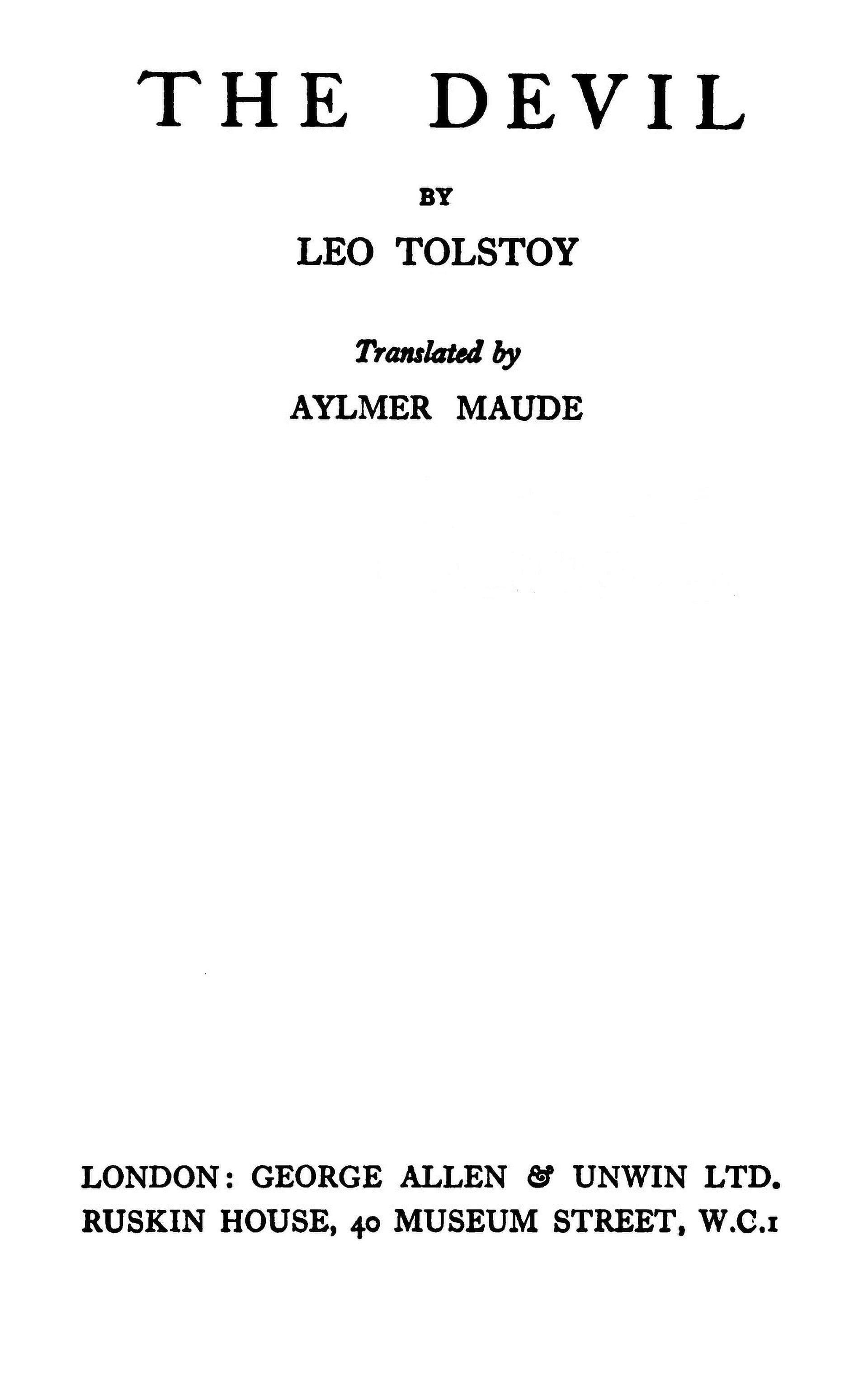
The Devil
1911
In the quiet rot of provincial Russia, Eugene Irtenev has built a life of duty and respectability. He manages his estate with rigor, he honors his marriage to the delicate Lise who adores him, and he believes himself a man of virtue. Then Stepanida arrives, a peasant woman whose very presence seems to ignite something animal and uncontrollable in him. Tolstoy traces Eugene's descent into obsession with surgical precision: the obsessive thoughts that intrude at dinner, the secret meetings, the web of lies that slowly poisons his marriage, the guilt that offers no relief. This is not romantic tragedy but something far more disturbing: a portrait of a man who sees his own corruption clearly and cannot stop it. Written in the final years of Tolstoy's life and published posthumously, The Devil represents the master at his most personal and provocative. It asks the question he wrestled with throughout his later years: what happens when the body betrays the spirit, and virtue becomes impossible.
Editions
X-Ray
“The most mentally deranged people are certainly those who see in others indications of insanity they do not notice in themselves.””
— Leo Tolstoy
“And indeed, if Evgeny Irtenev was mentally ill, then all people are just as mentally ill, and the most mentally ill are undoubtably those who see signs of madness in others that they do not see in themselves.””
— Leo Tolstoy
“It is generally supposed that Conservatives are usually old people, and that those in favour of change are the young. That is not quite correct. Usually, Conservatives are young people: those who want to live but who do not think about how to live, and have not time to think, and therefore take as a model for themselves a way of life that they have seen.””
— Leo Tolstoy
“The doctor arrived towards dinnertime and said, of course, that although recurring phenomena might well elicit apprehension, nonetheless there was, strictly speaking, no positive indication, yet since neither was there any contraindication, it might, on the one hand, be supposed, but on the other hand it might also be supposed. And it was therefore necessary to stay in bed, and although I don't like prescribing, nevertheless take this and stay in bed.””
— Leo Tolstoy
“Nothing does harm if one`s mind is at peace.””
— Leo Tolstoy
“To settle the matter in his own mind was one thing but to carry it out was another.””
— Leo Tolstoy
“Tout était si beau, joyeux et pur dans la maison ; mais dans son âme tout était laid, sale, horrible.””
— Leo Tolstoy
“But really, why should you distress yourself? Whoever stirs up the past”
— Leo Tolstoy
“It is generally supposed the Conservatives are usually old people, and that those in favour of change are the young. That is not quite correct. Usually Conservatives are young people: those who want to live but who do not think about how to live, and have not time to think, and therefore take as a model for themselves a way of life that they have seen.””
— Leo Tolstoy
Link to this book
Add a free, dofollow link to Lex on your blog, forum, syllabus, or reading list.

<a href="https://lex-books.com/book/the-devil-06ff84a2-0eb9-44a0-ae6d-7b1ce3b075be"><img src="https://lex-books.com/badges/read-on-lex.svg" alt="Read The Devil by Leo Tolstoy free on Lex" width="160" height="40"></a>[](https://lex-books.com/book/the-devil-06ff84a2-0eb9-44a0-ae6d-7b1ce3b075be)[url=https://lex-books.com/book/the-devil-06ff84a2-0eb9-44a0-ae6d-7b1ce3b075be][img]https://lex-books.com/badges/read-on-lex.svg[/img][/url]Read The Devil by Leo Tolstoy free on Lex: https://lex-books.com/book/the-devil-06ff84a2-0eb9-44a0-ae6d-7b1ce3b075beCite this book
Reading this edition for a paper or guide? Copy a citation.
Tolstoy, Leo. The Devil. Lex, lex-books.com/book/the-devil-06ff84a2-0eb9-44a0-ae6d-7b1ce3b075be.Tolstoy, L. (1911). The Devil. Lex. https://lex-books.com/book/the-devil-06ff84a2-0eb9-44a0-ae6d-7b1ce3b075beTolstoy, Leo. The Devil. Lex. https://lex-books.com/book/the-devil-06ff84a2-0eb9-44a0-ae6d-7b1ce3b075be.