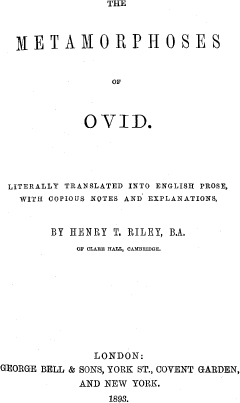
The Metamorphoses of Ovid, Books I-VII
1735
The Metamorphoses of Ovid, Books I-VII
1735
Translated by Henry T. (Henry Thomas) Riley
Before mythology was safe, before the gods learned to behave, there was Ovid. The Metamorphoses is not a textbook of ancient myths but a ferocious, sensual, darkly funny reimagining of every transformation story the ancient world knew. In dactylic hexameters that sing and sting, Ovid takes the creation of the world and watches it curdle: from the perfect Golden Age through the slow rot of Iron, where trickery and lust and petty divine vengeance rule. Here are the stories that haunt Western imagination: Daphne's laurel born from her desperate flight, Phaethon flaming across the sky before his terrible fall, Pyramus and Thisbe bleeding into the mulberry, Arachne weaving a tapestry that costs her humanity. Ovid writes about metamorphosis as both literal change and psychological truth, where desire becomes punishment and the gods' appetites leave mortals broken and beautiful. Books I-VII carry us from Chaos to the age of heroes, from Deucalion's stones to Perseus slaying Medusa, a world where anything can become anything else, where survival means adaptation, where the body is always temporary. This is mythology without the distance of scholarship: raw, immediate, often shocking, occasionally hilarious, always seductively alive.
Editions
X-Ray
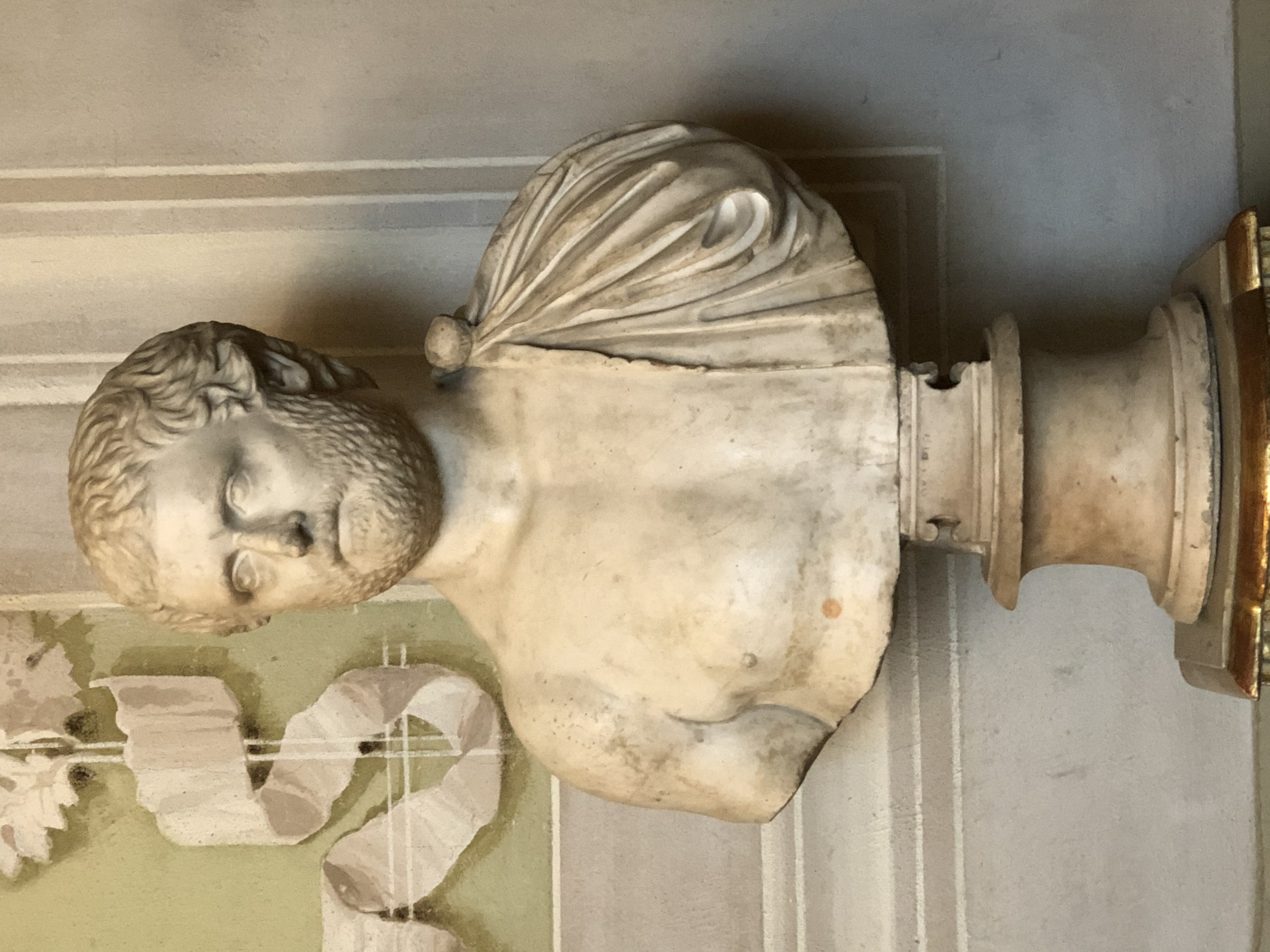
The Roman poet who compiles and retells these mythological narratives of transformation.
The king of the gods, often the instigator of transformations through his desires, wrath, or interventions.
Queen of the gods, frequently driven by jealousy and revenge against Jupiter's mortal lovers and their offspring.
The god of the sun, music, prophecy, and healing, often involved in tragic love stories and acts of vengeance.
About The Metamorphoses of Ovid, Books I-VII
Chapter Summaries
- Book I, Fable I
- The Deity divides Chaos into four elements, assigning inhabitants to each. Man is created from earth and water, followed by the four Ages. The Giants aspire to heaven, are slain by Jupiter, and a new impious race springs from their blood.
- Book I, Fable II
- God shapes the universe into a globe, creating seas, plains, mountains, and climates. Stars are placed in the firmament, and various creatures inhabit the earth, water, and air. Finally, man is formed by Prometheus and animated by Minerva.
- Book I, Fable III
- This fable describes the Golden Age, a time of innocence, justice, and perpetual spring, where the earth spontaneously produced food, and humans lived in peace without laws or warfare.
Key Themes
- Transformation (Metamorphosis)
- This is the overarching theme of the entire work, where characters, gods, and even landscapes undergo physical changes. These transformations are often a direct consequence of divine intervention, punishment, reward, or intense emotional states, serving as a narrative device to explore the fluidity of identity and the interconnectedness of all things.
- Divine Power and Caprice
- The gods in Ovid's work wield immense power, often using it impulsively or selfishly. Their desires, jealousies, and whims frequently dictate the fates of mortals and other deities, leading to both wondrous and tragic transformations, highlighting the arbitrary nature of divine justice and the vulnerability of mortals.
- Love and Desire
- Love, in its many forms—unrequited, forbidden, passionate, jealous—is a powerful catalyst for change. From Apollo's pursuit of Daphne to Narcissus's self-obsession, love often leads to suffering, loss, and ultimately, transformation, demonstrating its profound and sometimes destructive influence on individuals.
Characters
- Ovid(narrator)
- The Roman poet who compiles and retells these mythological narratives of transformation.
- Jupiter(protagonist)
- The king of the gods, often the instigator of transformations through his desires, wrath, or interventions.
- Juno(antagonist)
- Queen of the gods, frequently driven by jealousy and revenge against Jupiter's mortal lovers and their offspring.
- Apollo(protagonist)
- The god of the sun, music, prophecy, and healing, often involved in tragic love stories and acts of vengeance.
- Daphne(victim)
- A nymph who transforms into a laurel tree to escape Apollo's unwanted advances.
- Io(victim)
- A priestess of Juno, ravished by Jupiter and transformed into a cow to hide her from Juno's wrath, eventually restored and worshipped as Isis.
Link to this book
Add a free, dofollow link to Lex on your blog, forum, syllabus, or reading list.

<a href="https://lex-books.com/book/the-metamorphoses-of-ovid-books-i-vii-ff2c0c40-de80-4104-869a-0dc96f5b8f44"><img src="https://lex-books.com/badges/read-on-lex.svg" alt="Read The Metamorphoses of Ovid, Books I-VII by Ovid free on Lex" width="160" height="40"></a>[](https://lex-books.com/book/the-metamorphoses-of-ovid-books-i-vii-ff2c0c40-de80-4104-869a-0dc96f5b8f44)[url=https://lex-books.com/book/the-metamorphoses-of-ovid-books-i-vii-ff2c0c40-de80-4104-869a-0dc96f5b8f44][img]https://lex-books.com/badges/read-on-lex.svg[/img][/url]Read The Metamorphoses of Ovid, Books I-VII by Ovid free on Lex: https://lex-books.com/book/the-metamorphoses-of-ovid-books-i-vii-ff2c0c40-de80-4104-869a-0dc96f5b8f44Cite this book
Reading this edition for a paper or guide? Copy a citation.
Ovid. The Metamorphoses of Ovid, Books I-VII. Lex, lex-books.com/book/the-metamorphoses-of-ovid-books-i-vii-ff2c0c40-de80-4104-869a-0dc96f5b8f44.Ovid (1735). The Metamorphoses of Ovid, Books I-VII. Lex. https://lex-books.com/book/the-metamorphoses-of-ovid-books-i-vii-ff2c0c40-de80-4104-869a-0dc96f5b8f44Ovid. The Metamorphoses of Ovid, Books I-VII. Lex. https://lex-books.com/book/the-metamorphoses-of-ovid-books-i-vii-ff2c0c40-de80-4104-869a-0dc96f5b8f44.