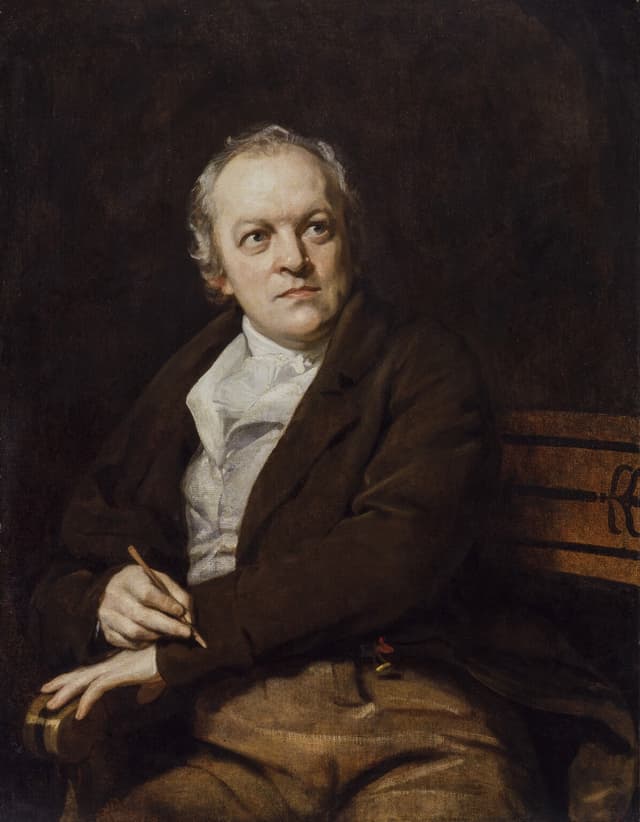
William Blake
William Blake was an English poet, painter, and printmaker whose innovative works have established him as a pivotal figure in the Romantic movement. Living in London for most of his life, Blake created a rich body of poetry and visual art that explored profound themes of imagination, spirituality, and human existence. His so-called 'prophetic works' are characterized by their symbolic depth and philosophical undercurrents, though they were largely unrecognized during his lifetime. Critics have noted that Blake's poetry, despite its merits, remains one of the least read bodies of work in the English language, a testament to his unique and often misunderstood vision. Blake's artistic philosophy was deeply intertwined with his theistic beliefs, which diverged from mainstream Christianity. He was known for his hostility toward organized religion and was influenced by the revolutionary ideals of his time. His collaboration with his wife, Catherine Boucher, was crucial to his artistic output, as she assisted him in printmaking and coloring his works. Blake's legacy is marked by his singularity; he defied categorization and was described by contemporaries as a 'glorious luminary.' His influence has grown posthumously, inspiring generations of artists and writers who recognize the depth and originality of his contributions to both poetry and visual art.
Famous Quotes
View all 19 quotes“To see a World in a Grain of Sand And a Heaven in a Wild Flower, Hold Infinity in the palm of your hand And Eternity in an hour.””
“A truth that's told with bad intentBeats all the lies you can invent.””
“It is easier to forgive an enemy than to forgive a friend.””
Books from the author






Link to this page
Add a free, dofollow link to Lex on your blog, forum, syllabus, or reading list.

<a href="https://lex-books.com/author/william-blake"><img src="https://lex-books.com/badges/read-on-lex.svg" alt="William Blake on Lex" width="160" height="40"></a>[](https://lex-books.com/author/william-blake)[url=https://lex-books.com/author/william-blake][img]https://lex-books.com/badges/read-on-lex.svg[/img][/url]William Blake on Lex: https://lex-books.com/author/william-blake