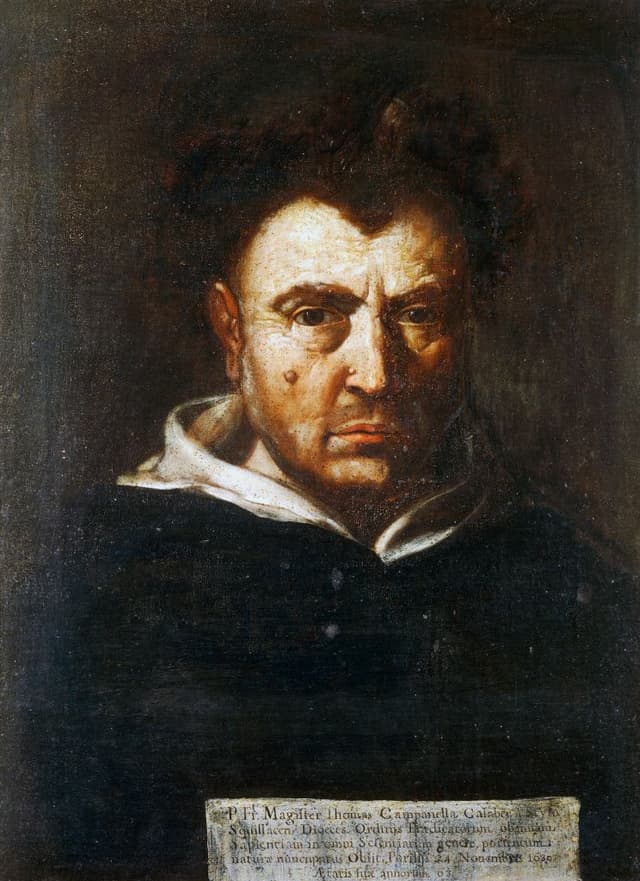
Tommaso Campanella
Tommaso Campanella was an influential Italian Dominican friar, philosopher, and poet whose life was marked by conflict with the authorities of his time. Born Giovanni Domenico Campanella, he faced persecution for his radical ideas, notably being prosecuted for heresy by the Roman Inquisition in 1594 and later imprisoned for nearly three decades due to accusations of conspiracy against Spanish rule in Calabria. During his long imprisonment, Campanella produced some of his most important works, including his seminal text, The City of the Sun, which envisioned an egalitarian theocratic society where communal property and social harmony prevailed. Campanella's writings reflect a deep engagement with the philosophical and theological debates of the Renaissance, blending elements of astrology, mysticism, and social critique. His vision of a utopian society has inspired subsequent generations of thinkers and writers, making him a significant figure in the history of political philosophy and utopian literature. Despite the challenges he faced, Campanella's legacy endures, as his ideas continue to provoke thought about governance, society, and the potential for human cooperation.
Famous Quotes
View all 2 quotes“Man lives in a double world: according to the mind he is contained by no physical space and by no walls, but at the same time he is in heaven and on earth, in Italy, in France, in America, wherever the mind's thrust penetrates and extends by understanding, seeking, mastering. But indeed according to the body he exists not, except in only so much space as is least required, held fast in prison and in chains to the extent that he is not able to be in or to go to the place attained by his intellect and will, nor to occupy more space than defined by the shape of his body; while with the mind he occupies a thousand worlds.”
“To learn what I know I have burned more midnight oil than you have drunk wine.”
Books from the author

Link to this page
Add a free, dofollow link to Lex on your blog, forum, syllabus, or reading list.

<a href="https://lex-books.com/author/tommaso-campanella"><img src="https://lex-books.com/badges/read-on-lex.svg" alt="Tommaso Campanella on Lex" width="160" height="40"></a>[](https://lex-books.com/author/tommaso-campanella)[url=https://lex-books.com/author/tommaso-campanella][img]https://lex-books.com/badges/read-on-lex.svg[/img][/url]Tommaso Campanella on Lex: https://lex-books.com/author/tommaso-campanella