
Thomas Dekker
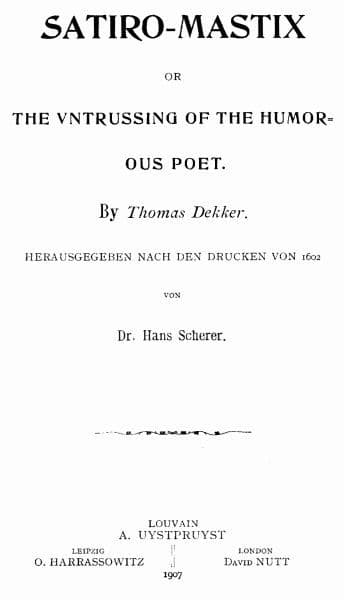
Thomas Dekker was a prominent English playwright and pamphleteer during the late Elizabethan and early Jacobean periods. He was known for his versatility in writing, producing a wide array of works that encompassed comedies, tragedies, and city pageants. Dekker's plays, such as 'The Roaring Girl' and 'The Shoemaker's Holiday,' showcased his keen observation of social life and his ability to blend humor with poignant commentary on the human condition. His collaboration with other playwrights, including John Webster and Philip Massinger, further enriched the theatrical landscape of his time. Among his notable works, 'Satiro-Mastix' stands out as a satirical response to the prevailing theatrical norms, while 'The Noble Spanish Soldier' and 'Witch of Edmonton' reflect the complexities of morality and social issues. Dekker's writing often highlighted the struggles of the lower classes, providing a voice to the marginalized in society. His unique blend of realism and fantasy, along with his innovative use of language, contributed significantly to the development of English drama. Dekker's legacy endures through his influence on subsequent generations of playwrights and his role in shaping the theatrical traditions of England during a pivotal era in its literary history.
Famous Quotes
View all 16 quotes“To awaken each morning with a smile brightening my face; to greet the day with reverence for the opportunities it contains; to approach my work with a clean mind; to hold ever before me, even in the doing of little things, the Ultimate Purpose toward which I am working; to meet men and women with laughter on my lips and love in my heart; to be gentle, kind, and courteous through all the hours; to approach the night with weariness that ever woos sleep and the joy that comes from work well done -- this is how I desire to waste wisely my days.””
“Long hair will make thee look dreafully to thine enemies, and manly to thyfriends: it is, in peace, an ornament; in war, a strong helmet; it...deadens the leaden thump of a bullet: in winter, it is a warm nightcap; in summer,a cooling fan of feathers.””
“Do but consider what an excellent thing sleep is...that golden chain that ties health and our bodies together. Who complains of want? of wounds? of cares? of great men's oppressions? of captivity? whilst he sleepeth? Beggars in their beds take as much pleasure kings: can we therefore surfeit on this delicate Ambrosia? Can we drink too much of that whereof to taste too little tumbles us into a churchyard, and to use it but indifferently throws us into Bedlam? No, no, look upon Endymion, the moon's minion, who slept three score and fifteen years, and was not a hair the worse for it.””
Books from the author



Link to this page
Add a free, dofollow link to Lex on your blog, forum, syllabus, or reading list.

<a href="https://lex-books.com/author/thomas-dekker"><img src="https://lex-books.com/badges/read-on-lex.svg" alt="Thomas Dekker on Lex" width="160" height="40"></a>[](https://lex-books.com/author/thomas-dekker)[url=https://lex-books.com/author/thomas-dekker][img]https://lex-books.com/badges/read-on-lex.svg[/img][/url]Thomas Dekker on Lex: https://lex-books.com/author/thomas-dekker