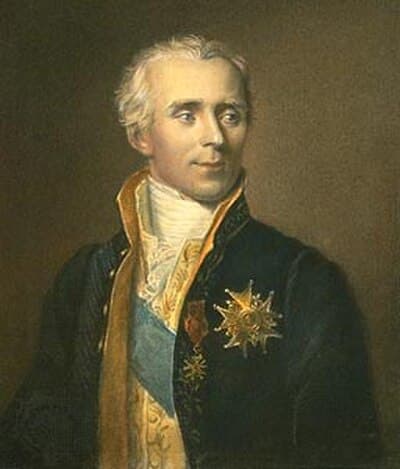
Pierre Simon, marquis de Laplace
Pierre Simon, marquis de Laplace, was a prominent French mathematician and astronomer whose work laid the groundwork for modern scientific thought. Born in a peasant family, he rose to prominence through his groundbreaking contributions to celestial mechanics and probability theory. His most notable work, 'Mécanique Céleste,' translated the principles of Newtonian physics into a comprehensive mathematical framework, revolutionizing the understanding of planetary motion and gravitational forces. Laplace's formulation of the Laplace transform and his work on the stability of the solar system were pivotal in advancing both mathematics and astronomy. In addition to his contributions to science, Laplace was a key figure in the development of statistical mathematics, particularly through his work on the theory of probability. His treatise 'Théorie Analytique des Probabilités' established foundational concepts that are still in use today. Laplace's influence extended beyond his lifetime, as his methods and theories shaped the fields of statistics, physics, and astronomy, making him a central figure in the scientific revolution of the Enlightenment. His legacy endures in the continued relevance of his mathematical techniques and the principles he established, marking him as one of the great minds of his era.
Famous Quotes
View all 1 quotes“Give me the positions and velocities of all the particles in the universe, and I will predict the future.””
Books from the author

Link to this page
Add a free, dofollow link to Lex on your blog, forum, syllabus, or reading list.

<a href="https://lex-books.com/author/pierre-simon-marquis-de-laplace"><img src="https://lex-books.com/badges/read-on-lex.svg" alt="Pierre Simon, marquis de Laplace on Lex" width="160" height="40"></a>[](https://lex-books.com/author/pierre-simon-marquis-de-laplace)[url=https://lex-books.com/author/pierre-simon-marquis-de-laplace][img]https://lex-books.com/badges/read-on-lex.svg[/img][/url]Pierre Simon, marquis de Laplace on Lex: https://lex-books.com/author/pierre-simon-marquis-de-laplace