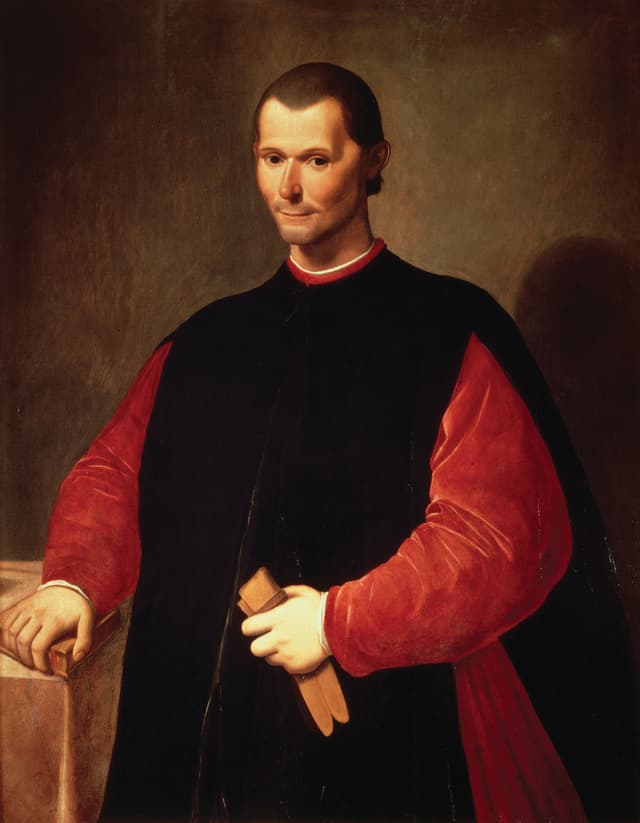
Niccolò Machiavelli
Niccolò Machiavelli was a prominent Florentine diplomat, philosopher, and historian during the Italian Renaissance. Born into a politically active family in Florence, he became deeply involved in the tumultuous politics of his time, serving as a diplomat and advisor to the Republic of Florence. His experiences in political affairs greatly influenced his writings, particularly his most famous work, The Prince, which he composed around 1513. This treatise offered pragmatic advice on political leadership and statecraft, advocating for a realistic, sometimes ruthless approach to governance that starkly contrasted with the idealistic views of his predecessors. The Prince was not published until 1532, five years after Machiavelli's death, but it quickly became a foundational text in political theory and is often regarded as the first modern work of political philosophy. Machiavelli's significance extends beyond The Prince; his other notable works, such as Discourses on Livy and The Mandrake, reflect his deep understanding of human nature and the complexities of power. His candid exploration of political ethics and the mechanics of power has sparked debate and controversy, leading to the term 'Machiavellian' being used to describe cunning and unscrupulous political behavior. Machiavelli's legacy as the father of modern political science endures, influencing generations of political thinkers, leaders, and strategists, and his insights remain relevant in discussions of power and morality in politics today.
Famous Quotes
View all 19 quotes“The first method for estimating the intelligence of a ruler is to look at the men he has around him.””
“The lion cannot protect himself from traps, and the fox cannot defend himself from wolves. One must therefore be a fox to recognize traps, and a lion to frighten wolves.””
Books from the author








Link to this page
Add a free, dofollow link to Lex on your blog, forum, syllabus, or reading list.

<a href="https://lex-books.com/author/niccolò-machiavelli"><img src="https://lex-books.com/badges/read-on-lex.svg" alt="Niccolò Machiavelli on Lex" width="160" height="40"></a>[](https://lex-books.com/author/niccolò-machiavelli)[url=https://lex-books.com/author/niccolò-machiavelli][img]https://lex-books.com/badges/read-on-lex.svg[/img][/url]Niccolò Machiavelli on Lex: https://lex-books.com/author/niccolò-machiavelli