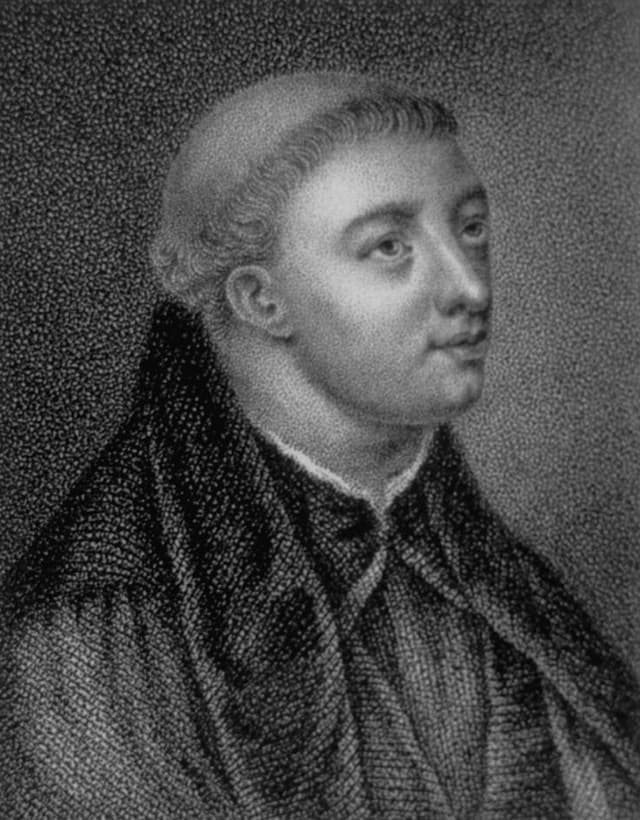
John Lydgate
John Lydgate was an influential English monk and poet, born in Lidgate, Suffolk, around 1370. His extensive body of work, comprising approximately 145,000 lines of poetry, showcases his mastery of various genres established by Geoffrey Chaucer, with the notable exception of the fabliau. Lydgate's most significant contributions include the 'Troy Book,' a monumental translation of Guido delle Colonne's account of the Trojan War, commissioned by Prince Henry, who would later become Henry V. This epic work, spanning over 30,000 lines, marked a departure from Chaucer's narratives, offering a more expansive and detailed retelling of chivalric themes. Additionally, Lydgate's 'The Siege of Thebes' serves as a shorter exploration of epic poetry, while his 'Fall of Princes' stands as a substantial reflection on the nature of fortune and downfall, drawing inspiration from Boccaccio's 'De Casibus Virorum Illustrium.' Lydgate's literary significance lies not only in his prolific output but also in his role as a bridge between medieval and early Renaissance literature. His works contributed to the evolution of English poetry, enriching the narrative tradition and expanding the thematic scope of the time. Through his elaborate storytelling and moral reflections, Lydgate left a lasting legacy that influenced subsequent generations of poets and writers, solidifying his place in the canon of English literature.
Famous Quotes
View all 2 quotes“You can please some of the people all of the time, you can please all of the people some of the time, but you can’t please all of the people all of the time”.””
“You can satisfy some of the people all the time, and all of the people some of the time, but you cannot satisfy all of the people all the time””
Books from the author






Link to this page
Add a free, dofollow link to Lex on your blog, forum, syllabus, or reading list.

<a href="https://lex-books.com/author/john-lydgate"><img src="https://lex-books.com/badges/read-on-lex.svg" alt="John Lydgate on Lex" width="160" height="40"></a>[](https://lex-books.com/author/john-lydgate)[url=https://lex-books.com/author/john-lydgate][img]https://lex-books.com/badges/read-on-lex.svg[/img][/url]John Lydgate on Lex: https://lex-books.com/author/john-lydgate