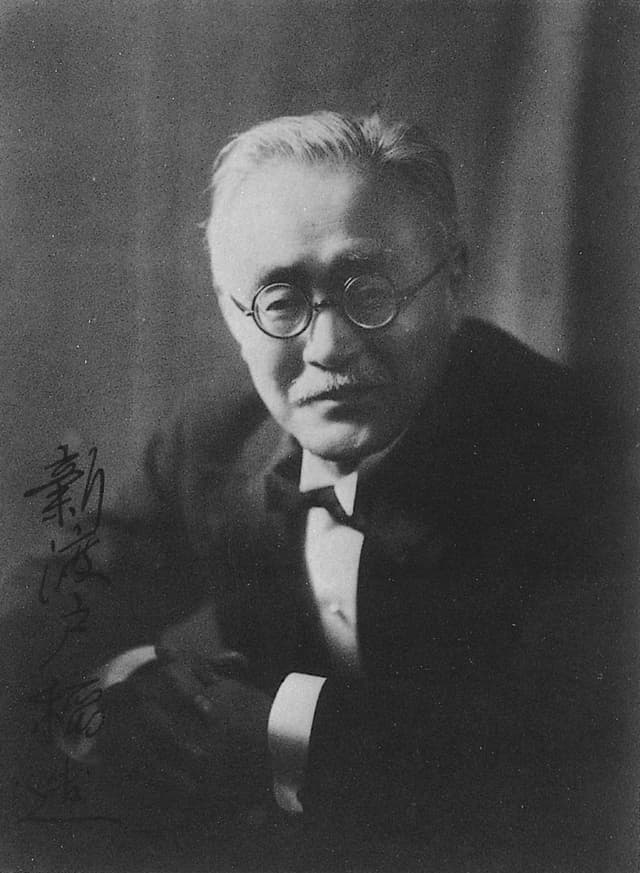
Inazo Nitobe
Inazo Nitobe was a multifaceted Japanese agronomist, diplomat, and writer whose contributions spanned academia and international relations. Educated at Sapporo Agricultural College under the guidance of William S. Clark, he later pursued further studies in the United States, focusing on agricultural policy. Upon returning to Japan, Nitobe held prestigious academic positions at several universities, including Sapporo Agricultural College and Kyoto Imperial University, where he influenced a generation of students. His role as deputy secretary general of the League of Nations marked him as a significant figure in early 20th-century diplomacy, advocating for peace and international cooperation. Beyond his diplomatic and academic endeavors, Nitobe was a pioneer in women's education in Japan, playing a crucial role in establishing institutions such as the Tsuda Eigaku Juku and serving as the first president of Tokyo Woman's Christian University. His writings, including the notable work 'Bushido: The Soul of Japan,' explored the ethical and philosophical underpinnings of Japanese culture, although his views on colonialism and the Korean people have sparked controversy. Nitobe's legacy lies in his efforts to bridge Eastern and Western thought, as well as his commitment to education and women's rights, making him a complex figure in Japan's modernization and international engagement.
Famous Quotes
View all 2 quotes“We know from what failings our virtue springs.”
“Masamuné expressed it well in his oft-quoted aphorism—"Rectitude carried to excess hardens into stiffness; Benevolence indulged beyond measure sinks into weakness.”
Books from the author






Link to this page
Add a free, dofollow link to Lex on your blog, forum, syllabus, or reading list.

<a href="https://lex-books.com/author/inazo-nitobe"><img src="https://lex-books.com/badges/read-on-lex.svg" alt="Inazo Nitobe on Lex" width="160" height="40"></a>[](https://lex-books.com/author/inazo-nitobe)[url=https://lex-books.com/author/inazo-nitobe][img]https://lex-books.com/badges/read-on-lex.svg[/img][/url]Inazo Nitobe on Lex: https://lex-books.com/author/inazo-nitobe