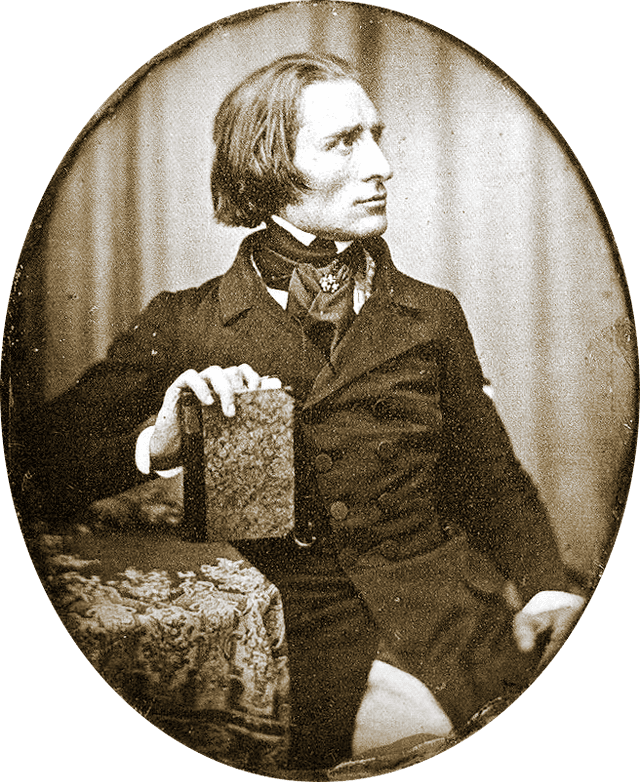
Franz Liszt
Franz Liszt was a Hungarian composer, virtuoso pianist, conductor, and teacher who emerged as a leading figure in the Romantic music movement. His early life was marked by prodigious talent, receiving instruction from notable musicians such as Carl Czerny and Antonio Salieri. By the 1830s and 1840s, Liszt had established himself as a celebrated concert pianist, captivating audiences across Europe with his extraordinary technical skill and charisma. This phenomenon, known as 'Lisztomania,' made him a cultural icon, unmatched by his contemporaries in popularity and influence. Liszt's contributions to music were vast and varied, encompassing a wide range of compositions that included symphonic poems, piano concertos, and numerous piano works that remain staples of the repertoire today. He was instrumental in promoting the works of other composers, including Hector Berlioz and Richard Wagner, and he coined terms such as 'transcription' and 'paraphrase' to describe his innovative arrangements. As a key figure in the New German School, Liszt played a pivotal role in the evolution of programmatic music and harmonic exploration, leaving a lasting legacy that shaped the course of Western classical music well beyond his lifetime.
Famous Quotes
View all 3 quotes“Sorrowful and great is the artist's destiny.”
“Music is the heart of life." She speaks love; "without it, there is no possible good and with it everything is beautiful.”
“For the virtuoso, musical works are in fact nothing but tragic and moving materializations of his emotions; he is called upon to make them speak, weep, sing and sigh, to recreate them in accordance with his own consciousness. In this way he, like the composer, is a creator, for he must have within himself those passions that he wishes to bring so intensely to life.”
Books from the author





Link to this page
Add a free, dofollow link to Lex on your blog, forum, syllabus, or reading list.

<a href="https://lex-books.com/author/franz-liszt"><img src="https://lex-books.com/badges/read-on-lex.svg" alt="Franz Liszt on Lex" width="160" height="40"></a>[](https://lex-books.com/author/franz-liszt)[url=https://lex-books.com/author/franz-liszt][img]https://lex-books.com/badges/read-on-lex.svg[/img][/url]Franz Liszt on Lex: https://lex-books.com/author/franz-liszt