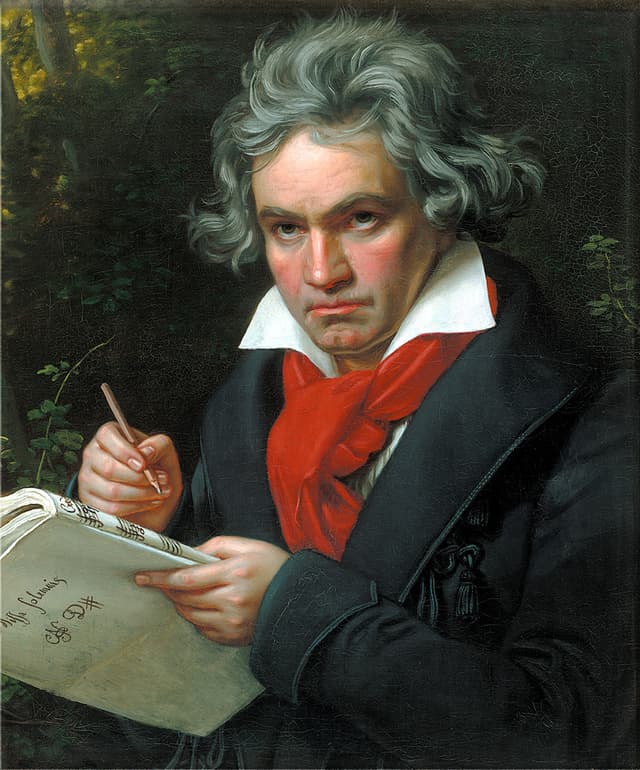
Ludwig van Beethoven
Ludwig van Beethoven was a German composer and pianist, widely regarded as one of the most significant figures in Western music history. His career marked a pivotal transition from the Classical period to the Romantic era, and his compositions remain among the most performed in the classical repertoire. Born in Bonn, Beethoven displayed prodigious musical talent from an early age, receiving rigorous training from his father and later from Christian Gottlob Neefe. He moved to Vienna at the age of 21, where he studied under Joseph Haydn and quickly established himself as a virtuoso pianist and composer. His early works, including the set of piano trios that earned him his first opus number, laid the groundwork for his innovative style. Beethoven's middle period, characterized by a heroic and individualistic approach, coincided with his increasing deafness, which began around 1798. Despite this profound challenge, he composed monumental works such as the Third Symphony, known as the 'Eroica,' and the Fifth Symphony, both of which showcased his groundbreaking use of form and emotional depth. His late period further pushed the boundaries of musical expression, culminating in masterpieces like the Ninth Symphony, which features the famous 'Ode to Joy.' Beethoven's legacy is marked not only by his extraordinary compositions but also by his resilience in the face of personal adversity, as reflected in his poignant letters, including the 'Heiligenstadt Testament.' His influence on subsequent generations of composers and musicians remains unparalleled, solidifying his status as a towering figure in the world of classical music.
Famous Quotes
View all 3 quotes“Music is ... A higher revelation than all Wisdom & Philosophy”
“Don’t only practice your art, but force your way into its secrets, for it and knowledge can raise men to the divine.”
“Plaudite, amici, comedia finita est. (Applaud, my friends, the comedy is over.) [ Said on his deathbed ]”
Books from the author





Link to this page
Add a free, dofollow link to Lex on your blog, forum, syllabus, or reading list.

<a href="https://lex-books.com/author/ludwig-van-beethoven"><img src="https://lex-books.com/badges/read-on-lex.svg" alt="Ludwig van Beethoven on Lex" width="160" height="40"></a>[](https://lex-books.com/author/ludwig-van-beethoven)[url=https://lex-books.com/author/ludwig-van-beethoven][img]https://lex-books.com/badges/read-on-lex.svg[/img][/url]Ludwig van Beethoven on Lex: https://lex-books.com/author/ludwig-van-beethoven