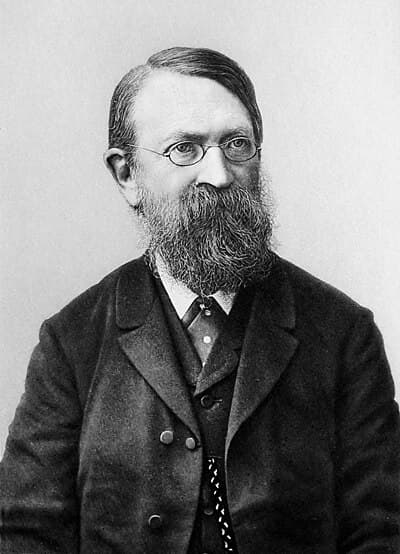
Ernst Mach
Ernst Mach was an influential Austrian physicist and philosopher known for his groundbreaking work in the field of shock waves and his philosophical contributions to science. He is best remembered for defining the Mach number, a dimensionless quantity that compares the speed of an object to the speed of sound, which has become a fundamental concept in aerodynamics and fluid dynamics. His empirical approach to physics emphasized the importance of observation and experience, challenging the established Newtonian framework of space and time. This critical stance not only advanced the understanding of physical phenomena but also laid the groundwork for future developments in theoretical physics. As a philosopher, Mach's ideas significantly impacted the development of logical positivism and American pragmatism. His critiques of traditional notions of absolute space and time anticipated key elements of Albert Einstein's theory of relativity, marking him as a pivotal figure in the transition from classical to modern physics. Mach's legacy endures through his contributions to both science and philosophy, influencing generations of thinkers and scientists who followed in his footsteps.
Famous Quotes
View all 3 quotes“But we must not forget that all things in the world are connected with one another and depend on one another, and that we ourselves and all our thoughts are also a part of nature. It is utterly beyond our power to measure the changes of things by time. Quite the contrary, time is an abstraction, at which we arrive by means of the change of things; made because we are not restricted to any one definite measure, all being interconnected. A motion is termed uniform in which equal increments of space described correspond to equal increments of space described by some motion with which we form a comparison, as the rotation of the earth. A motion may, with respect to another motion, be uniform. But the question whether a motion is in itself uniform, is senseless. With just as little justice, also, may we speak of an “absolute time” --- of a time independent of change. This absolute time can be measured by comparison with no motion; it has therefore neither a practical nor a scientific value; and no one is justified in saying that he knows aught about it. It is an idle metaphysical conception.”
“Knowledge and error flow from the same mental sources; only success can tell one from the other.”
“To us investigators, the concept 'soul' is irrelevant and a matter for laughter.”
Books from the author

Link to this page
Add a free, dofollow link to Lex on your blog, forum, syllabus, or reading list.

<a href="https://lex-books.com/author/ernst-mach"><img src="https://lex-books.com/badges/read-on-lex.svg" alt="Ernst Mach on Lex" width="160" height="40"></a>[](https://lex-books.com/author/ernst-mach)[url=https://lex-books.com/author/ernst-mach][img]https://lex-books.com/badges/read-on-lex.svg[/img][/url]Ernst Mach on Lex: https://lex-books.com/author/ernst-mach