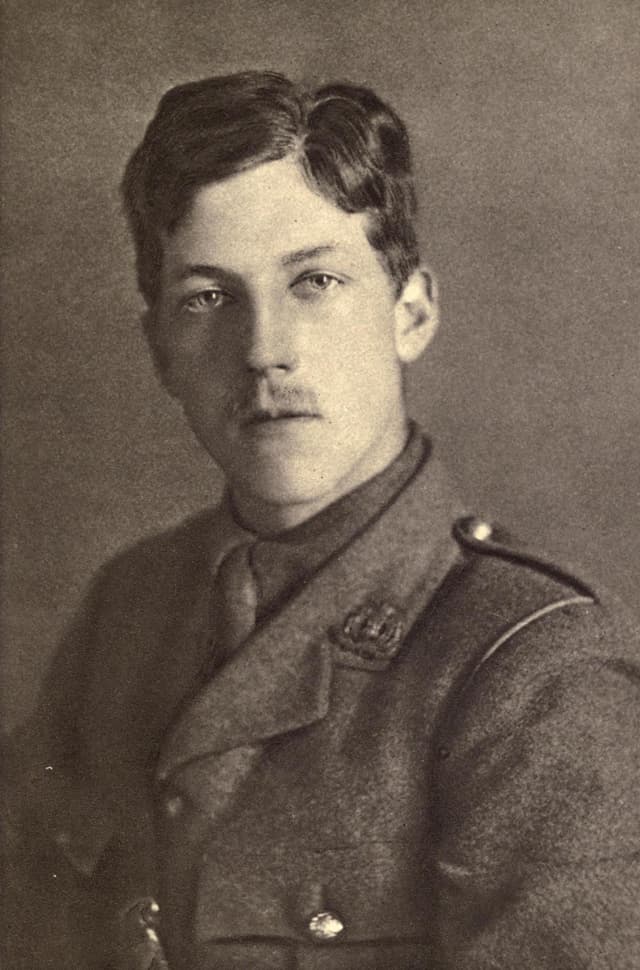
Charles Hamilton Sorley
Charles Hamilton Sorley was a Scottish war poet and British Army officer, whose life and work were tragically cut short during World War I. Born in 1895, Sorley displayed literary talent from an early age, attending the prestigious Marlborough College and later studying at the University of Cambridge. His poetry, characterized by its poignant reflections on the horrors of war and the loss of youth, emerged as a significant voice among the war poets of his time. Notable works such as 'Men Who March Away' and 'The Song of the Mud' captured the stark realities of combat and the emotional turmoil faced by soldiers, blending personal experience with broader themes of sacrifice and mortality. Sorley's contributions to war literature were marked by a unique blend of lyrical beauty and stark realism, setting him apart from his contemporaries. His untimely death at the Battle of Loos in 1915 at the age of 20 left a profound impact on the literary world, as he became a symbol of the lost generation of young men who perished in the conflict. Posthumously published collections of his poetry, including 'Marlborough and Other Poems,' have ensured his legacy endures, influencing future generations of poets and writers who grapple with the complexities of war and its aftermath.
Famous Quotes
View all 3 quotes“When You See Millions of the Mouthless Dead" When you see millions of the mouthless dead Across your dreams in pale battalions go, Say not soft things as other men have said, That you'll remember. For you need not so. Give them not praise. For, deaf, how should they know It is not curses heaped on each gashed head? Nor tears. Their blind eyes see not your tears flow. Nor honour. It is easy to be dead. Say only this, "They are dead." Then add thereto, "Yet many a better one has died before." Then, scanning all the o'ercrowded mass, should you Perceive one face that you loved heretofore, It is a spook. None wears the face you knew. Great death has made all his for evermore.”
“England is seen at its worst when it has to deal with men like Wilde. In Germany Wilde and Byron are appreciated as authors: in England they still go pecking about their love-affairs. Anyone who calls a book ‘immoral’ or 'moral’ should be caned. A book by itself can be neither. It is only a question of the morality or immorality of the reader. But the English approach all questions of vice with such a curious mixture of curiosity and fear that it’s impossible to deal with them.”
“(...) I only know That when I have a son of mine, He shan't be made to droop and pine, Bound down and forced by rule and rod To serve a God who is no God. But I'll put custom on the shelf And make him find his God himself. Perhaps he'll find him in a tree, Some hollow trunk, where you can see. Perhaps the daisies in the sod Will open out and show him God. Or will he meet him in the roar Of breakers as they beat the shore? Or in the spiky stars that shine? Or in the rain (where I found mine)? Or in the city's giant moan? - A God who will be all his own. To whom he can address a prayer And love him, for he is so fair, And see with eyes that are not dim And build a temple to meet for him.”
Books from the author




Link to this page
Add a free, dofollow link to Lex on your blog, forum, syllabus, or reading list.

<a href="https://lex-books.com/author/charles-hamilton-sorley"><img src="https://lex-books.com/badges/read-on-lex.svg" alt="Charles Hamilton Sorley on Lex" width="160" height="40"></a>[](https://lex-books.com/author/charles-hamilton-sorley)[url=https://lex-books.com/author/charles-hamilton-sorley][img]https://lex-books.com/badges/read-on-lex.svg[/img][/url]Charles Hamilton Sorley on Lex: https://lex-books.com/author/charles-hamilton-sorley