What to Do? Thoughts Evoked by the Census of Moscow
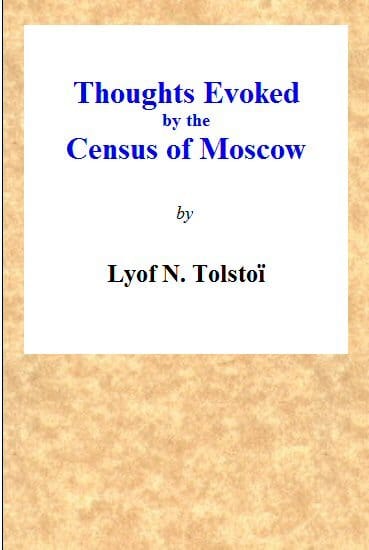
What to Do? Thoughts Evoked by the Census of Moscow
Translated by Isabel Florence Hapgood
In the winter of 1882, Leo Tolstoy joined volunteers conducting the Moscow census. What he found shattered his conscience. Walking the frozen streets of one of Europe's wealthiest cities, the author who gave the world War and Peace confronts a different kind of war: the silent battle between opulence and destitution happening on every corner. He encounters beggars whose desperation differs fundamentally from the rural poor he knew, and he is forced to reckon with his own comfortable assumptions about charity, compassion, and social obligation. The essay traces his evolution from troubled observer to active participant, wrestling with questions that have no easy answers: What do we owe the poor? Does individual charity perpetuate the very system that creates poverty? Why do we look away? Tolstoy offers no neat resolution, only the uncomfortable honesty of a man who looked directly at suffering and refused to look away. It remains a piercing meditation on moral responsibility in the face of inequality, and an indictment of societies that normalize want amid abundance.
Editions
X-Ray
“I sit on a man's back choking him and making him carry me, and yet assure myself and others that I am sorry for him and wish to lighten his load by all means possible… except by getting off his back.””
— Leo Tolstoy
“All the wounds of society, the wounds of poverty, of vice, of ignorance”
— Leo Tolstoy
“Money, in itself, is evil. And therefore he who gives money gives evil. ””
— Leo Tolstoy
“Great and real affairs are always simple and modest.And so it is with the most important affair before us: the solution of the terrible contradictions amid which we live.And the things that solve those contradictions are these modest, imperceptible, apparently ridiculous acts: serving oneself, doing physical labour for ourselves and if possible for others - which we rich people have to do if we understand the misfortune, wrongfulness, and danger of the position into which we have fallen.””
— Leo Tolstoy
“There can only be two tests of the utility of one man's activity for another: the external, consisting in the recognition of this utility by him who is benefited, and the internal, a desire to benefit another which lies at the root of the activity of him who confers the benefit.””
— Leo Tolstoy
Link to this book
Add a free, dofollow link to Lex on your blog, forum, syllabus, or reading list.

<a href="https://lex-books.com/book/what-to-do-thoughts-evoked-by-the-census-of-moscow-f738bad7-4532-46fd-9472-820ee4f875f0"><img src="https://lex-books.com/badges/read-on-lex.svg" alt="Read What to Do? Thoughts Evoked by the Census of Moscow by Leo Tolstoy free on Lex" width="160" height="40"></a>[](https://lex-books.com/book/what-to-do-thoughts-evoked-by-the-census-of-moscow-f738bad7-4532-46fd-9472-820ee4f875f0)[url=https://lex-books.com/book/what-to-do-thoughts-evoked-by-the-census-of-moscow-f738bad7-4532-46fd-9472-820ee4f875f0][img]https://lex-books.com/badges/read-on-lex.svg[/img][/url]Read What to Do? Thoughts Evoked by the Census of Moscow by Leo Tolstoy free on Lex: https://lex-books.com/book/what-to-do-thoughts-evoked-by-the-census-of-moscow-f738bad7-4532-46fd-9472-820ee4f875f0Cite this book
Reading this edition for a paper or guide? Copy a citation.
Tolstoy, Leo. What to Do? Thoughts Evoked by the Census of Moscow. Lex, lex-books.com/book/what-to-do-thoughts-evoked-by-the-census-of-moscow-f738bad7-4532-46fd-9472-820ee4f875f0.Tolstoy, L. (n.d.). What to Do? Thoughts Evoked by the Census of Moscow. Lex. https://lex-books.com/book/what-to-do-thoughts-evoked-by-the-census-of-moscow-f738bad7-4532-46fd-9472-820ee4f875f0Tolstoy, Leo. What to Do? Thoughts Evoked by the Census of Moscow. Lex. https://lex-books.com/book/what-to-do-thoughts-evoked-by-the-census-of-moscow-f738bad7-4532-46fd-9472-820ee4f875f0.