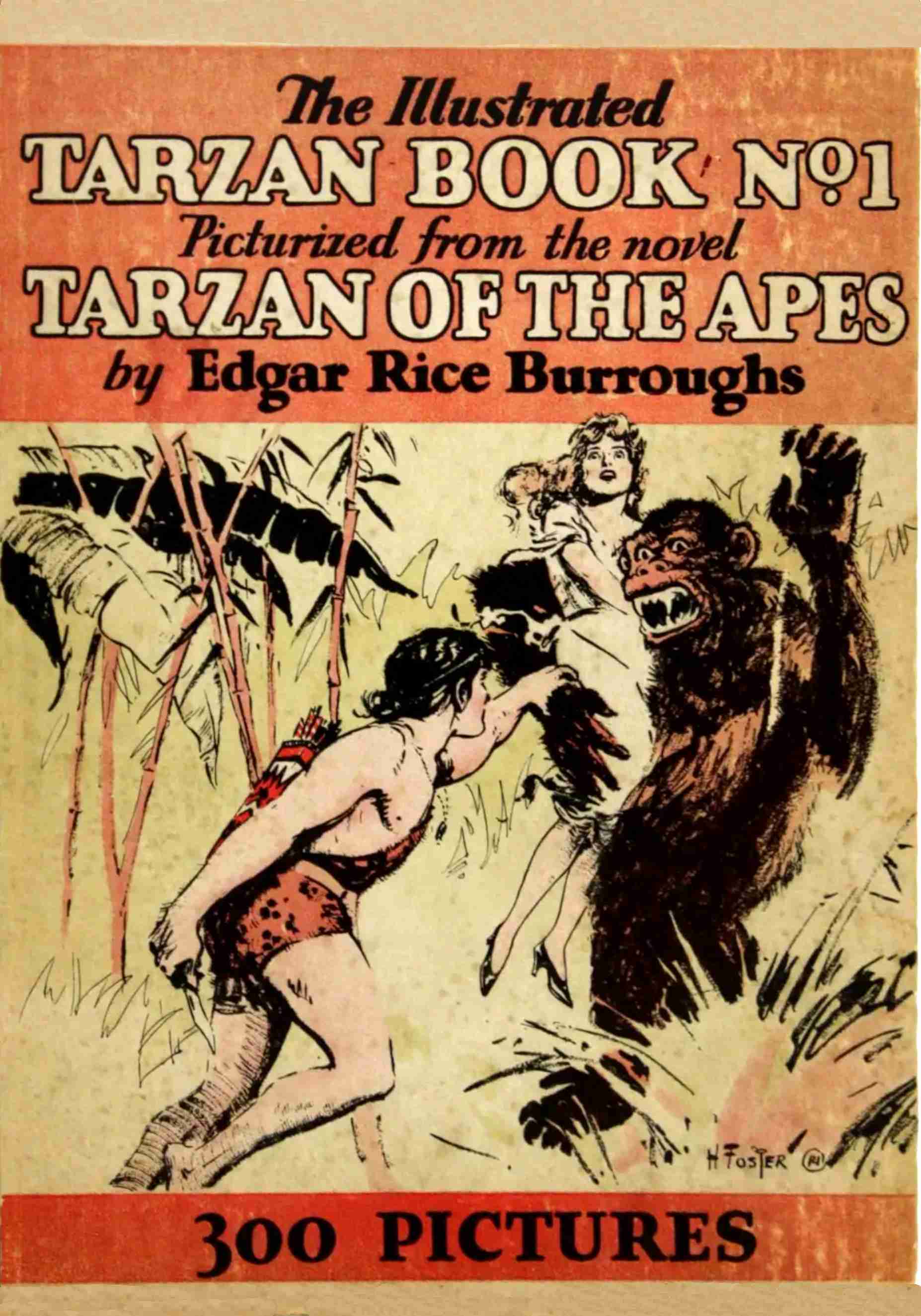
Tarzan of the Apes
1912

A child of English nobility raised by beasts. That's the audacious premise that made Tarzan an icon, and Burroughs executes it with pulp-fueled verve. When John Clayton and his wife are marooned on the African coast after a mutiny, their infant son is left to die, until a great ape discovers him and names him Tarzan. The boy grows into a creature of two worlds: limbs that move like the jungle's, but a face that remains unmistakably human. The novel crackles when Tarzan discovers his heritage, a forgotten chest of books, the word "APES" scrawled on them, and the slow realization that he is not an ape at all. Burroughs writes with kinetic certainty. Tarzan's jungle is a place of constant danger and brutal logic, where strength is the only currency and belonging is earned through blood. The novel asks what happens when instinct and inheritance collide, and the answer is one of literature's most enduring archetypes. For anyone who's ever felt caught between who they are and who they were meant to be.
Editions

X-Ray
“You can't depend on your eyes when your imagination is out of focus.””
— Edgar Rice Burroughs
“THERE were two “Reigns of Terror,” if we would but remember it and consider it; the one wrought murder in hot passion, the other in heartless cold blood; the one lasted mere months, the other had lasted a thousand years; the one inflicted death upon ten thousand persons, the other upon a hundred millions; but our shudders are all for the “horrors” of the minor Terror, the momentary Terror, so to speak; whereas, what is the horror of swift death by the axe, compared with lifelong death from hunger, cold, insult, cruelty, and heart-break? What is swift death by lightning compared with death by slow fire at the stake? A city cemetery could contain the coffins filled by that brief Terror which we have all been so diligently taught to shiver at and mourn over; but all France could hardly contain the coffins filled by that older and real Terror”
— Edgar Rice Burroughs
“You can't reason with your heart; it has its own laws, and thumps about things which the intellect scorns.””
— Edgar Rice Burroughs
“My kind of loyalty was loyalty to one's country, not to its institutions or its officeholders. The country is the real thing, the substantial thing, the eternal thing; it is the thing to watch over, and care for, and be loyal to; institutions are extraneous, they are its mere clothing, and clothing can wear out, become ragged, cease to be comfortable, cease to protect the body from winter, disease, and death.””
— Edgar Rice Burroughs
“Words are only painted fire, a look is the fire itself. She gave that look, and carried it away to the treasury of heaven, where all things that are divine belong.””
— Edgar Rice Burroughs
“whenever the literary german dives into a sentence, this is the last you are going to see of him till he emerges on the other side of his atlantic with his verb in his mouth.””
— Edgar Rice Burroughs
“You can't throw too much style into a miracle.””
— Edgar Rice Burroughs
“His head was an hour-glass; it could stow an idea, but it had to do it a grain at a time, not the whole idea at once.””
— Edgar Rice Burroughs
“How empty is theory in the presence of fact!””
— Edgar Rice Burroughs
Link to this book
Add a free, dofollow link to Lex on your blog, forum, syllabus, or reading list.

<a href="https://lex-books.com/book/tarzan-of-the-apes-01c121d1-ffbf-4979-a782-0120a51ee5d2"><img src="https://lex-books.com/badges/read-on-lex.svg" alt="Read Tarzan of the Apes by Edgar Rice Burroughs free on Lex" width="160" height="40"></a>[](https://lex-books.com/book/tarzan-of-the-apes-01c121d1-ffbf-4979-a782-0120a51ee5d2)[url=https://lex-books.com/book/tarzan-of-the-apes-01c121d1-ffbf-4979-a782-0120a51ee5d2][img]https://lex-books.com/badges/read-on-lex.svg[/img][/url]Read Tarzan of the Apes by Edgar Rice Burroughs free on Lex: https://lex-books.com/book/tarzan-of-the-apes-01c121d1-ffbf-4979-a782-0120a51ee5d2Cite this book
Reading this edition for a paper or guide? Copy a citation.
Burroughs, Edgar Rice. Tarzan of the Apes. Lex, lex-books.com/book/tarzan-of-the-apes-01c121d1-ffbf-4979-a782-0120a51ee5d2.Burroughs, E. R. (1912). Tarzan of the Apes. Lex. https://lex-books.com/book/tarzan-of-the-apes-01c121d1-ffbf-4979-a782-0120a51ee5d2Burroughs, Edgar Rice. Tarzan of the Apes. Lex. https://lex-books.com/book/tarzan-of-the-apes-01c121d1-ffbf-4979-a782-0120a51ee5d2.