Paradise Lost
1667
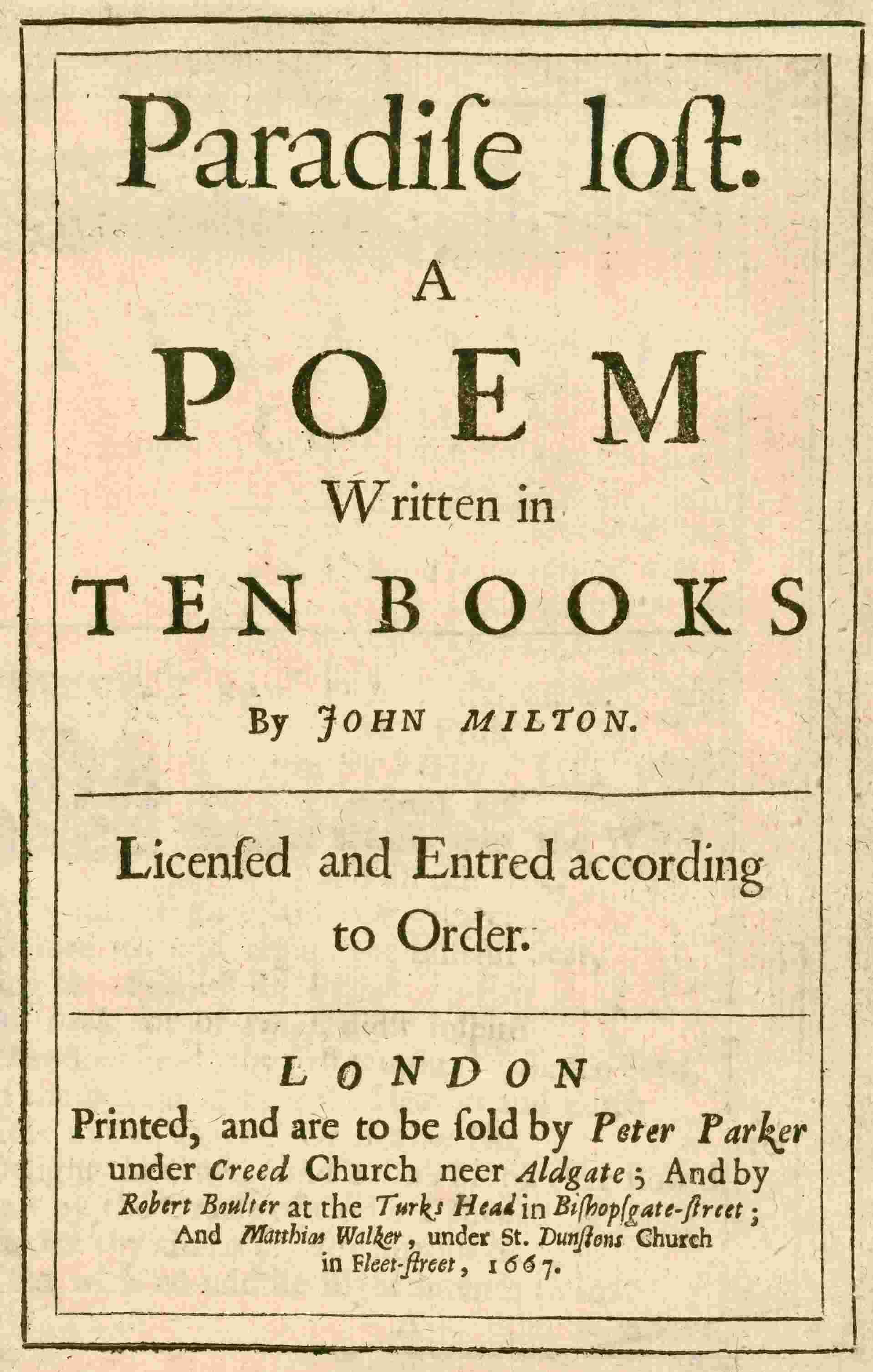
Before Batman, before any literary villain, there was Satan, and in Milton's hands, he became something far more terrifying than a mere adversary. He is brilliant, wounded, raging against a heaven that cast him out, and yet somehow still magnificent. Paradise Lost opens in medias res, with Satan and his rebel angels writhing in Hell after their failed coup, and from this moment of cosmic defeat, the poem unfurls its magnificent argument about free will, obedience, and the nature of evil itself. Milton's real daring lies in making us understand Satan, even as we recognize his damnation. The poem then turns to Eden, to Adam and Eve in their innocent garden, and to the serpent's patient corruption of mankind, rendered with such sensuality and psychological acuity that the Fall feels less like divine punishment than like a tragedy of genuine, devastating choice. This is a work that justified its own subtitle: the "ways of God to men," wrestled with on every page through ten thousand lines of the most muscular blank verse in the English language. It is both a theological argument and a masterpiece of narrative art, its Satan heroic in his defiance and tragic in his self-destruction, its Adam and Eve startlingly human in their curiosity and vulnerability. It ends not in despair but in hope, man expelled, yes, but carrying the promise of redemption. Four centuries later, it remains the foundational text of English literature, the poem against which all others are measured.
Editions
X-Ray
“people can die of mere imagination””
— John Milton
“If gold rusts, what then can iron do?””
— John Milton
“No empty handed man can lure a bird””
— John Milton
“Then you compared a woman's love to Hell, To barren land where water will not dwell, And you compared it to a quenchless fire, The more it burns the more is its desire To burn up everything that burnt can be. You say that just as worms destroy a tree A wife destroys her husband and contrives, As husbands know, the ruin of their lives. ””
— John Milton
“Purity in body and heart May please some--as for me, I make no boast. For, as you know, no master of a household Has all of his utensils made of gold; Some are wood, and yet they are of use.””
— John Milton
“Love will not be constrain'd by mastery.When mast'ry comes, the god of love anonBeateth his wings, and, farewell, he is gone.Love is a thing as any spirit free.””
— John Milton
“Youth may outrun the old, but not outwit.””
— John Milton
“And gladly wolde he lerne, and gladly teche.””
— John Milton
“Whan that Aprill with his shoures sooteThe droghte of March hath perced to the roote,And bathed every veyne in switch licourOf which vertu engendred is the flour;Whan Zephirus eek with his sweete breethInspired hath in every holt and heethThe tendre croppes, and the yonge sonneHath in the Ram his half cours yronne,And smale foweles maken melodye,That slepen al the nyght with open ye(So Priketh hem Nature in hir corages),Thanne longen folk to goon on pilgrimages,And palmeres for to seken straunge strondes,To ferne halwes, kowthe in sondry londes;And specially from every shires endeOf Engelond to Caunterbury they wende,The hooly blisful martir for to seke,That hem hath holpen whan that they were seeke””
— John Milton
About Paradise Lost
Chapter Summaries
- 1
- The poem opens in Hell, where Satan and his fallen angels lie vanquished after their rebellion against God. Satan, still defiant, rallies his legions, including Beelzebub, and delivers a powerful speech, resolving to wage eternal war against Heaven by force or guile. They then construct Pandemonium, their magnificent capital in Hell.
- 2
- The fallen angels hold a council in Pandemonium to debate their next course of action. Moloch advocates for open war, Belial for slothful ease, Mammon for building a new empire in Hell, and Beelzebub (prompted by Satan) proposes corrupting God's new creation, Man. Satan volunteers for this perilous mission, journeying through Chaos to the gates of Hell, where he encounters Sin and Death, his offspring.
- 3
- Milton invokes Holy Light and laments his blindness before shifting to Heaven, where God foresees Satan's plan and Man's fall, affirming free will and promising redemption through the Son. Meanwhile, Satan, disguised as a lesser angel, journeys towards Earth, encountering Uriel, the Regent of the Sun, whom he deceives into directing him towards Paradise.
Key Themes
- Free Will vs. Predestination
- Milton meticulously emphasizes humanity's free will as the cause of the Fall, absolving God of blame. Characters like Adam and Eve are created 'sufficient to have stood, though free to fall,' highlighting their capacity for choice and the moral responsibility that comes with it. God's foreknowledge does not necessitate their actions, but rather foresees them.
- Good vs. Evil
- The poem explores the nature of good and evil through the contrasting figures of God and Satan. Satan's 'Evil be thou my Good' encapsulates his deliberate inversion of divine order, while God's ultimate plan demonstrates how even evil can be turned to greater good through redemption. The Fall itself is the introduction of evil into the human experience.
- Obedience vs. Disobedience
- Obedience to God's single, easy command (not to eat from the Tree of Knowledge) is presented as the ultimate test of faith and love. Disobedience, driven by pride, envy, and a desire for forbidden knowledge, leads to the catastrophic fall of both angels and humans, resulting in loss of bliss and eternal woe.
Characters
- Satan(antagonist)
- The proud and ambitious Archangel who leads a rebellion against God, is cast into Hell, and seeks to corrupt humanity out of envy and revenge.
- God (The Father)(protagonist)
- The omnipotent and omniscient Creator, who presides over Heaven and orchestrates the events of creation, the Fall, and redemption with justice and mercy.
- Son of God (Jesus)(protagonist)
- The divine Word and wisdom of God, who leads the loyal angels in war, creates the universe, and volunteers to sacrifice himself for humanity's redemption.
- Adam(protagonist)
- The first man, created in God's image, who falls from grace by knowingly choosing to eat the forbidden fruit out of love for Eve.
- Eve(protagonist)
- The first woman, created from Adam's rib, who is deceived by Satan and eats the forbidden fruit, initiating humanity's fall.
- Beelzebub(supporting)
- Satan's chief lieutenant, second in power among the fallen angels, who proposes the plan to corrupt mankind.
Link to this book
Add a free, dofollow link to Lex on your blog, forum, syllabus, or reading list.

<a href="https://lex-books.com/book/paradise-lost-a703fa44-5ec2-4f8d-9101-f03cf85b4068"><img src="https://lex-books.com/badges/read-on-lex.svg" alt="Read Paradise Lost by John Milton free on Lex" width="160" height="40"></a>[](https://lex-books.com/book/paradise-lost-a703fa44-5ec2-4f8d-9101-f03cf85b4068)[url=https://lex-books.com/book/paradise-lost-a703fa44-5ec2-4f8d-9101-f03cf85b4068][img]https://lex-books.com/badges/read-on-lex.svg[/img][/url]Read Paradise Lost by John Milton free on Lex: https://lex-books.com/book/paradise-lost-a703fa44-5ec2-4f8d-9101-f03cf85b4068Cite this book
Reading this edition for a paper or guide? Copy a citation.
Milton, John. Paradise Lost. Lex, lex-books.com/book/paradise-lost-a703fa44-5ec2-4f8d-9101-f03cf85b4068.Milton, J. (1667). Paradise Lost. Lex. https://lex-books.com/book/paradise-lost-a703fa44-5ec2-4f8d-9101-f03cf85b4068Milton, John. Paradise Lost. Lex. https://lex-books.com/book/paradise-lost-a703fa44-5ec2-4f8d-9101-f03cf85b4068.