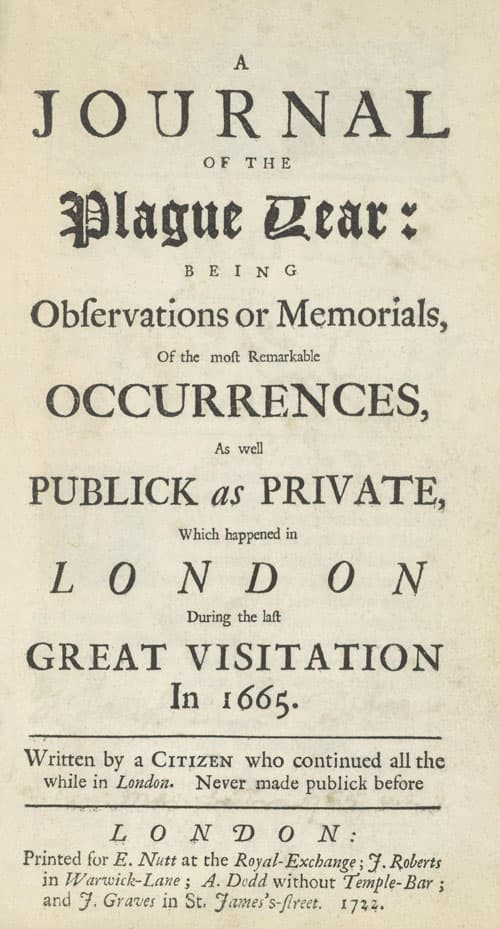
History of the Plague in London
1661
Daniel Defoe was only four years old when the Great Plague swept through London in 1665, killing roughly a quarter of the city's population. Yet sixty years later, he wrote this book as if he'd lived through every agonizing moment of it, and the effect is uncanny: what reads as eyewitness testimony is actually one of literature's most audacious deceptions. The narrator, a humble haberdasher who chose to remain in the city as thousands fled, documents the plague's spread with the precision of a journalist and the emotional weight of a survivor. We watch London transform: shops close, neighbors whisper about deaths in distant parishes, families abandon their homes, and the terrible mathematics of mortality becomes impossible to ignore. The dead-carts prowl the streets at night, their drivers calling for bodies. Houses bear the dreaded cross. What emerges is not merely a chronicle of pestilence but a portrait of human behavior under existential threat: the irrational denial, the desperate prayers, the looting, the heroism, the abandonment. This is historical fiction so convincing it haunted readers for centuries, and its portrait of a city in crisis feels almost uncomfortably relevant today.
Editions
X-Ray
“Wherever God erects a house of prayer, The Devil always builds a chapel there; And 'twill be found upon examination The latter has the largest congregation.””
— Daniel Defoe
“Once ‘free’ in the streets, what then? Fear and panic could destroy the city as much as plague itself. Many of the doctors fled, along with the rich and powerful; quacks preyed on the poor with their neverfail miracle drugs. Churches and conventicles and synagogues were empty. Neighbours informed against each other. People lied to each other – and to themselves. (It’s just a headache. Just a little bruise. I’ll feel better if I go for a walk.) Worse – there were stories of infected people deliberately concealing their telltale ‘tokens’ and going out into the streets trying to infect others.””
— Daniel Defoe
“a near View of Death would soon reconcile Men of good Priciples one to another, and that it is chiefly owing to our easy Scituation in Life, and our putting these Things far from us, that our Breaches are formented, ill Blood continued, Prejudices, Breach of Charity and of Christian Union so much kept and so far carry'd on among us, as it is: Another Plague Year would reconcile all these Differences, a close conversing with Death, or the Diseases that threaten Death, would scum off the Gall from our Tempers, remove the Animosities among us, and bring us to see with differing Eyes, than those which we look'd on Things with before””
— Daniel Defoe
“But I must go back here to the particular incidents which occur to my thoughts of the time of the visitation, and particularly to the time of their shutting up the houses in the first part of their sickness; for before the sickness was come to its height people had more room to make their observations than they had afterward; but when it was in the extremity there was no such thing as communication with one another, as before.””
— Daniel Defoe
“that the infection was propagated insensibly, and by such persons as were not visibly infected, who neither knew whom they infected or who they were infected by.””
— Daniel Defoe
“But it was impossible to make any impression upon the middling people and the working labouring poor. Their fears were predominant over all their passions, and they threw away their money in a most distracted manner upon those whimsies.””
— Daniel Defoe
“I had two important things before me; the one was the carrying on my Business and Shop; which was considerable, and in which was embark’d all my Effects in the World; and the other was the Preservation of my Life in so dismal a Calamity, as I saw apparently was coming upon the whole City; and which however great it was, my Fears perhaps as well as other Peoples, represented to be much greater than it could be.””
— Daniel Defoe
“while, and told them that London was the place by which they, that is, the townsmen of Epping, and all the country round them, subsisted; to whom they sold the produce of their lands, and out of whom they made the rents of their farms; and to be so cruel to the inhabitants of London, or to any of those by whom they gained so much, was very hard; and they would be loath to have it remembered hereafter, and have it told, how barbarous, how inhospitable, and how unkind they were to the people of London when they””
— Daniel Defoe
“I recommend it to the Charity of all good People to look back, and reflect duly upon the Terrors of the Time; and whoever does so will see, that it is not an ordinary Strength that cou'd support it; it was not like appearing in the Head of an Army, or charging a Body of Horse in the Field; but it was charging Death itself on his pale Horse; to stay indeed was to die, and it could be esteemed nothing less.””
— Daniel Defoe
Link to this book
Add a free, dofollow link to Lex on your blog, forum, syllabus, or reading list.

<a href="https://lex-books.com/book/history-of-the-plague-in-london-0a7ca668-30fd-4297-acde-42fc1bef74c4"><img src="https://lex-books.com/badges/read-on-lex.svg" alt="Read History of the Plague in London by Daniel Defoe free on Lex" width="160" height="40"></a>[](https://lex-books.com/book/history-of-the-plague-in-london-0a7ca668-30fd-4297-acde-42fc1bef74c4)[url=https://lex-books.com/book/history-of-the-plague-in-london-0a7ca668-30fd-4297-acde-42fc1bef74c4][img]https://lex-books.com/badges/read-on-lex.svg[/img][/url]Read History of the Plague in London by Daniel Defoe free on Lex: https://lex-books.com/book/history-of-the-plague-in-london-0a7ca668-30fd-4297-acde-42fc1bef74c4Cite this book
Reading this edition for a paper or guide? Copy a citation.
Defoe, Daniel. History of the Plague in London. Lex, lex-books.com/book/history-of-the-plague-in-london-0a7ca668-30fd-4297-acde-42fc1bef74c4.Defoe, D. (1661). History of the Plague in London. Lex. https://lex-books.com/book/history-of-the-plague-in-london-0a7ca668-30fd-4297-acde-42fc1bef74c4Defoe, Daniel. History of the Plague in London. Lex. https://lex-books.com/book/history-of-the-plague-in-london-0a7ca668-30fd-4297-acde-42fc1bef74c4.