The Stormor, a Collection of the Most Remarkable Casualties and Disasters Which Happen'd in the Late Dreadful Tempest, Both by Sea and Land
1704
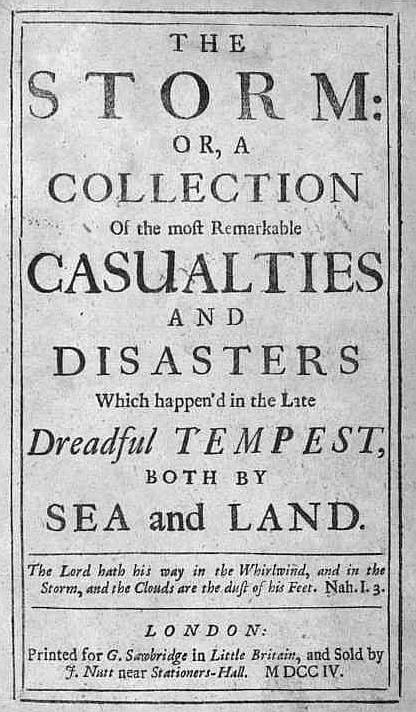
The Stormor, a Collection of the Most Remarkable Casualties and Disasters Which Happen'd in the Late Dreadful Tempest, Both by Sea and Land
1704
Three weeks before Daniel Defoe would publish the novel that would make him immortal, he released something stranger: a work of empirical journalism that reads like the prototype for every disaster report ever written. The Stormor documents the Great Storm of November 1703, the deadliest tempest in English history, which killed thousands, destroyed entire villages, and left ships stranded miles inland. Defoe did not merely observe from a safe distance; he traveled the countryside interviewing survivors, collecting testimonies from sailors, farmers, clergy, and nobles, assembling the first systematic account of a natural disaster in English letters. The result is a gripping, granular record of chaos: churches collapsed, coffins unearthed, the famous spire of Ipswich Church driven through the building's roof like a spear. Yet what elevates The Stormor beyond mere chronicle is Defoe's restless, questioning mind. He interrogates why storms happen, challenges ancient superstitions, cites authorities on wind and weather, and grapples with where nature ends and divine providence begins. It is proto-journalism with a philosopher's conscience, a catalog of catastrophe that refuses to settle for easy answers. For readers of narrative history, this is a rare glimpse of Defoe the investigator, before Defoe the storyteller.
Editions
Link to this book
Add a free, dofollow link to Lex on your blog, forum, syllabus, or reading list.

<a href="https://lex-books.com/book/the-stormor-a-collection-of-the-most-remarkable-casualties-and-disasters-which-h-b37d9d00-5b56-4a6d-b1cb-f8841a17c0f9"><img src="https://lex-books.com/badges/read-on-lex.svg" alt="Read The Stormor, a Collection of the Most Remarkable Casualties and Disasters Which Happen'd in the Late Dreadful Tempest, Both by Sea and Land by Daniel Defoe free on Lex" width="160" height="40"></a>[](https://lex-books.com/book/the-stormor-a-collection-of-the-most-remarkable-casualties-and-disasters-which-h-b37d9d00-5b56-4a6d-b1cb-f8841a17c0f9)[url=https://lex-books.com/book/the-stormor-a-collection-of-the-most-remarkable-casualties-and-disasters-which-h-b37d9d00-5b56-4a6d-b1cb-f8841a17c0f9][img]https://lex-books.com/badges/read-on-lex.svg[/img][/url]Read The Stormor, a Collection of the Most Remarkable Casualties and Disasters Which Happen'd in the Late Dreadful Tempest, Both by Sea and Land by Daniel Defoe free on Lex: https://lex-books.com/book/the-stormor-a-collection-of-the-most-remarkable-casualties-and-disasters-which-h-b37d9d00-5b56-4a6d-b1cb-f8841a17c0f9Cite this book
Reading this edition for a paper or guide? Copy a citation.
Defoe, Daniel. The Stormor, a Collection of the Most Remarkable Casualties and Disasters Which Happen'd in the Late Dreadful Tempest, Both by Sea and Land. Lex, lex-books.com/book/the-stormor-a-collection-of-the-most-remarkable-casualties-and-disasters-which-h-b37d9d00-5b56-4a6d-b1cb-f8841a17c0f9.Defoe, D. (1704). The Stormor, a Collection of the Most Remarkable Casualties and Disasters Which Happen'd in the Late Dreadful Tempest, Both by Sea and Land. Lex. https://lex-books.com/book/the-stormor-a-collection-of-the-most-remarkable-casualties-and-disasters-which-h-b37d9d00-5b56-4a6d-b1cb-f8841a17c0f9Defoe, Daniel. The Stormor, a Collection of the Most Remarkable Casualties and Disasters Which Happen'd in the Late Dreadful Tempest, Both by Sea and Land. Lex. https://lex-books.com/book/the-stormor-a-collection-of-the-most-remarkable-casualties-and-disasters-which-h-b37d9d00-5b56-4a6d-b1cb-f8841a17c0f9.