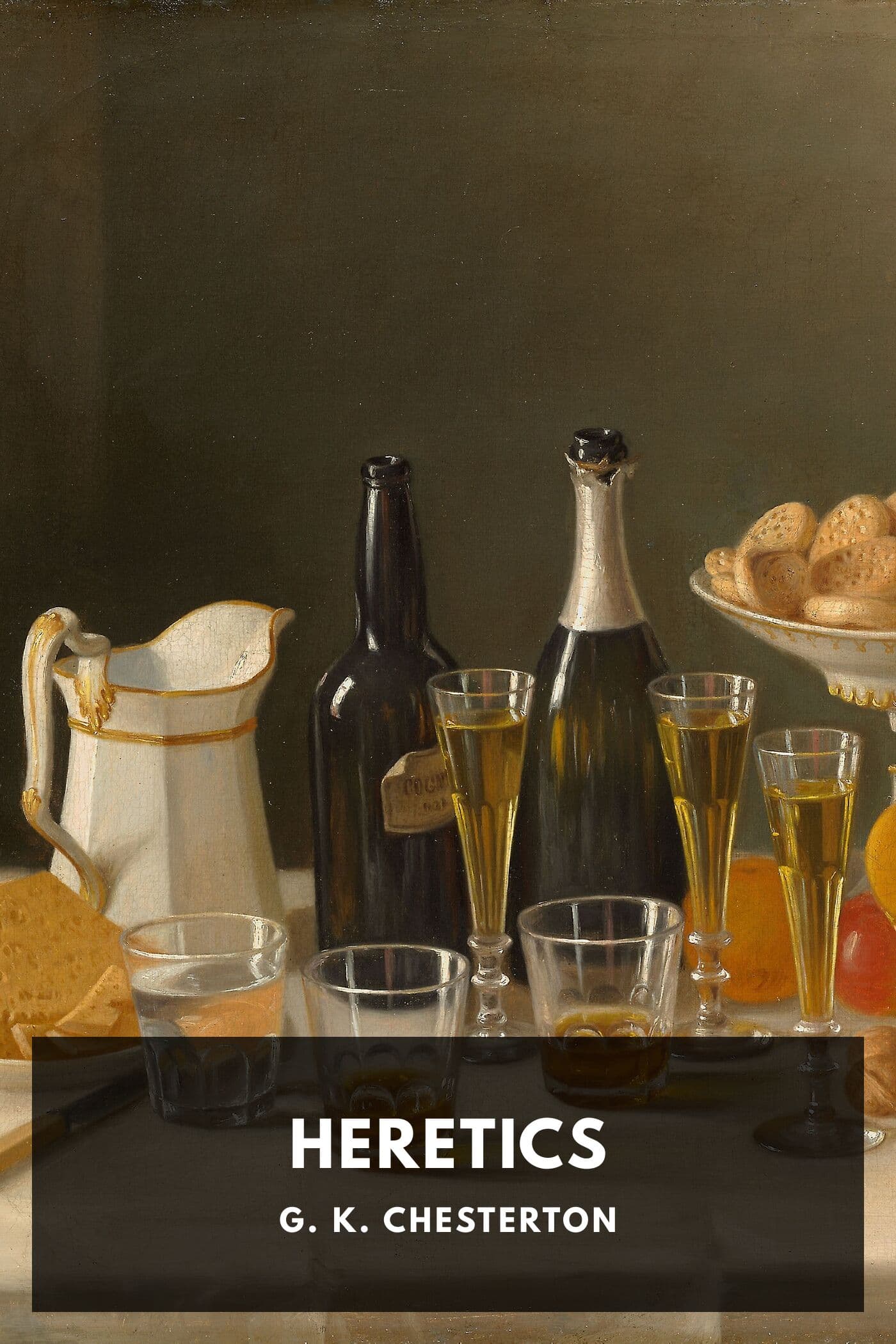
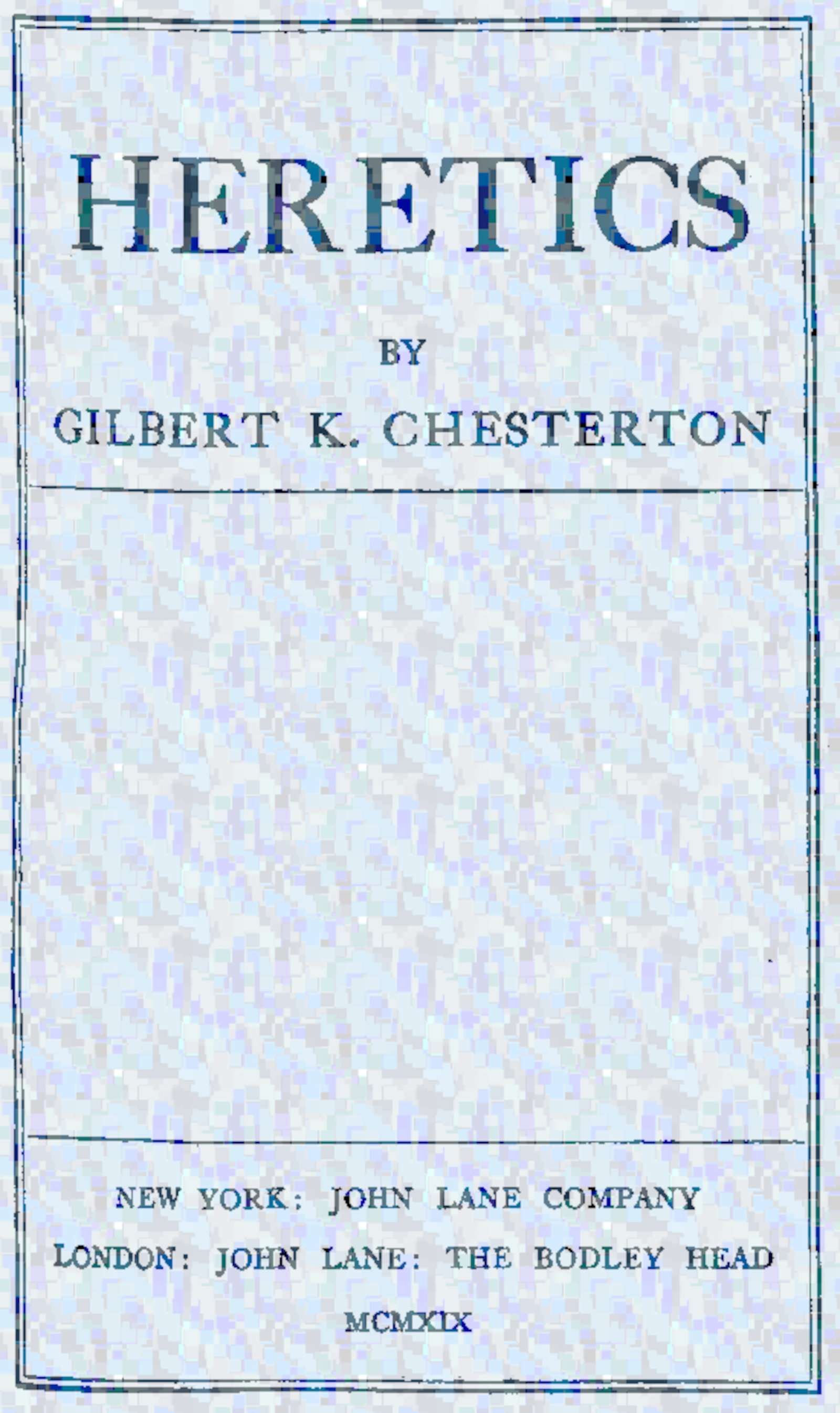
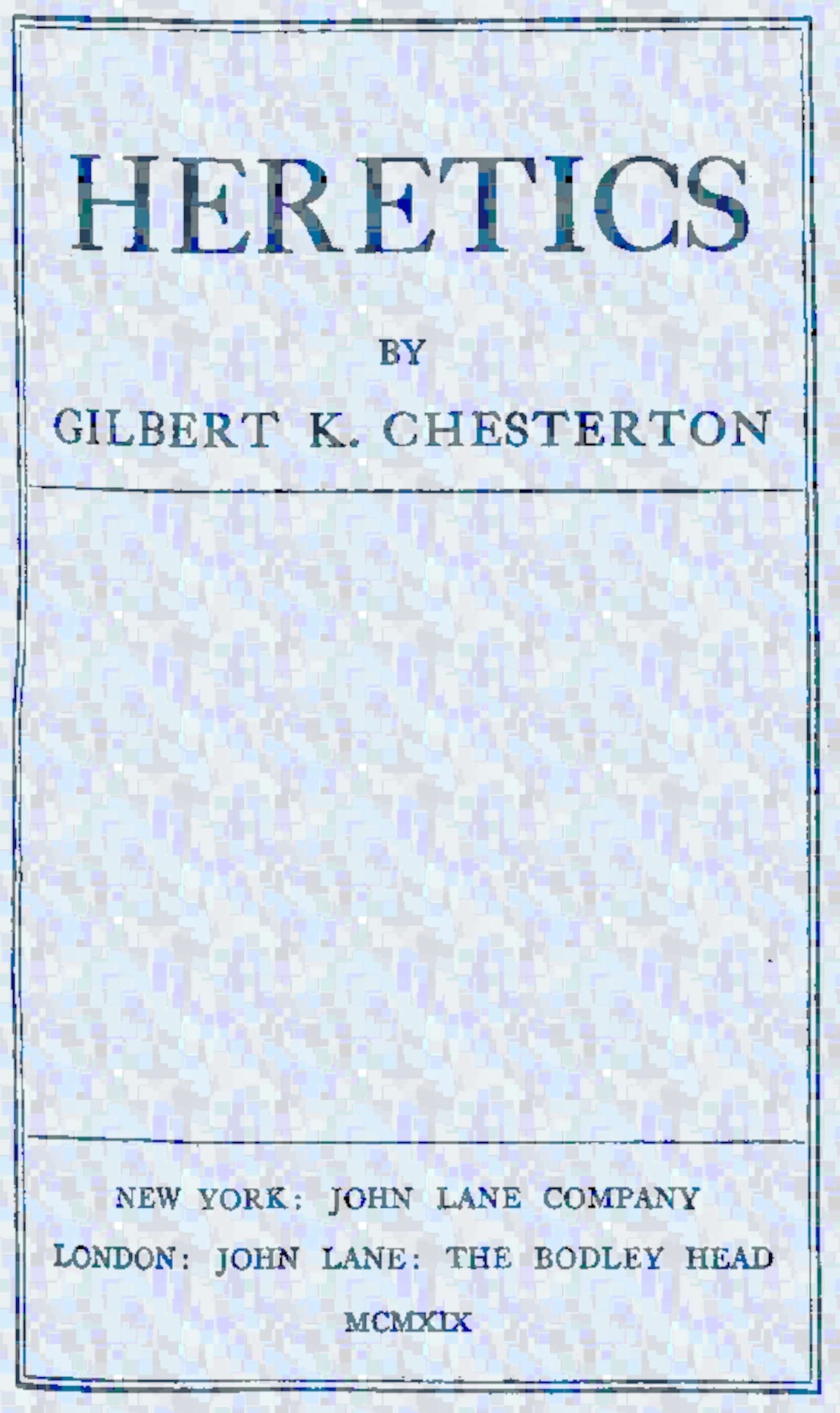
Heretics
Chesterton was the great defender of orthodoxy who got to be funny about it. In these twenty essays, he turns his gaze on the notable figures of his age, Kipling, Wells, Shaw, Whistler, each of whom had traded the big truths for smaller, shinier certainties. His argument is deceptively simple: the heretics of modernity don't reject God so much as reject the very idea of absolute truth, replacing it with whatever feels progressive or fashionable. What makes this book endure is that it reads like it was written yesterday. Chesterton saw our current crop of self-satisfied iconoclasts coming a century away. The wit is genuine, the blows land, and the good humor never curdles into contempt. If you've ever wondered why modern intellectuals sound so confident and say so little, start here.
Editions

X-Ray
“A good novel tells us the truth about its hero; but a bad novel tells us the truth about its author.””
— G. K. Chesterton
“Drink because you are happy, but never because you are miserable.””
— G. K. Chesterton
“Truth, of course, must of necessity be stranger than fiction, for we have made fiction to suit ourselves.””
— G. K. Chesterton
“Truths turn into dogmas the instant that they are disputed. Thus every man who utters a doubt defines a religion. And the scepticism of our time does not really destroy the beliefs, rather it creates them; gives them their limits and their plain and defiant shape. We who are Liberals once held Liberalism lightly as a truism. Now it has been disputed, and we hold it fiercely as a faith. We who believe in patriotism once thought patriotism to be reasonable, and thought little more about it. Now we know it to be unreasonable, and know it to be right. We who are Christians never knew the great philosophic common sense which inheres in that mystery until the anti-Christian writers pointed it out to us. The great march of mental destruction will go on. Everything will be denied. Everything will become a creed. It is a reasonable position to deny the stones in the street; it will be a religious dogma to assert them. It is a rational thesis that we are all in a dream; it will be a mystical sanity to say that we are all awake. Fires will be kindled to testify that two and two make four. Swords will be drawn to prove that leaves are green in summer. We shall be left defending, not only the incredible virtues and sanities of human life, but something more incredible still, this huge impossible universe which stares us in the face. We shall fight for visible prodigies as if they were invisible. We shall look on the impossible grass and the skies with a strange courage. We shall be of those who have seen and yet have believed.””
— G. K. Chesterton
“The supreme adventure is being born. There we do walk suddenly into a splendid and startling trap... When we step into the family, by the act of being born, we do step into a world which is incalculable, into a world which has its own strange laws, into a world which could do without us, into a world we have not made. In other words, when we step into the family we step into a fairy-tale.””
— G. K. Chesterton
“Charity is the power of defending that which we know to be indefensible. Hope is the power of being cheerful in circumstances which we know to be desperate. It is true that there is a state of hope which belongs to bright prospects and the morning; but that is not the virtue of hope. The virtue of hope exists only in earthquake and eclipse. It is true that there is a thing crudely called charity, which means charity to the deserving poor; but charity to the deserving is not charity at all, but justice. It is the undeserving who require it, and the ideal either does not exist at all, or exists wholly for them. For practical purposes it is at the hopeless moment that we require the hopeful man, and the virtue either does not exist at all, or begins to exist at that moment. Exactly at the instant when hope ceases to be reasonable it begins to be useful.””
— G. K. Chesterton
“There is no such thing on earth as an uninteresting subject; the only thing that can exist is an uninterested person.””
— G. K. Chesterton
“The man who lives in a small community lives in a much larger world. He knows much more of the fierce variety and uncompromising divergences of men…In a large community, we can choose our companions. In a small community, our companions are chosen for us. Thus in all extensive and highly civilized society groups come into existence founded upon sympathy, and shut out the real world more sharply than the gates of a monastery. There is nothing really narrow about the clan; the thing which is really narrow is the clique.””
— G. K. Chesterton
“Suppose that a great commotion arises in the street about something, let us say a lamp-post, which many influential persons desire to pull down. A grey-clad monk, who is the spirit of the Middle Ages, is approached upon the matter, and begins to say, in the arid manner of the Schoolmen, "Let us first of all consider, my brethren, the value of Light. If Light be in itself good--" At this point he is somewhat excusably knocked down. All the people make a rush for the lamp-post, the lamp-post is down in ten minutes, and they go about congratulating each other on their unmediaeval practicality. But as things go on they do not work out so easily. Some people have pulled the lamp-post down because they wanted the electric light; some because they wanted old iron; some because they wanted darkness, because their deeds were evil. Some thought it not enough of a lamp-post, some too much; some acted because they wanted to smash municipal machinery; some because they wanted to smash something. And there is war in the night, no man knowing whom he strikes. So, gradually and inevitably, to-day, to-morrow, or the next day, there comes back the conviction that the monk was right after all, and that all depends on what is the philosophy of Light. Only what we might have discussed under the gas-lamp, we now must discuss in the dark.””
— G. K. Chesterton
Link to this book
Add a free, dofollow link to Lex on your blog, forum, syllabus, or reading list.

<a href="https://lex-books.com/book/heretics-7321c6d2-039d-4a4f-b4e8-39ed9e2fc651"><img src="https://lex-books.com/badges/read-on-lex.svg" alt="Read Heretics by G. K. Chesterton free on Lex" width="160" height="40"></a>[](https://lex-books.com/book/heretics-7321c6d2-039d-4a4f-b4e8-39ed9e2fc651)[url=https://lex-books.com/book/heretics-7321c6d2-039d-4a4f-b4e8-39ed9e2fc651][img]https://lex-books.com/badges/read-on-lex.svg[/img][/url]Read Heretics by G. K. Chesterton free on Lex: https://lex-books.com/book/heretics-7321c6d2-039d-4a4f-b4e8-39ed9e2fc651Cite this book
Reading this edition for a paper or guide? Copy a citation.
Chesterton, G. K.. Heretics. Lex, lex-books.com/book/heretics-7321c6d2-039d-4a4f-b4e8-39ed9e2fc651.Chesterton, G. K. (n.d.). Heretics. Lex. https://lex-books.com/book/heretics-7321c6d2-039d-4a4f-b4e8-39ed9e2fc651Chesterton, G. K.. Heretics. Lex. https://lex-books.com/book/heretics-7321c6d2-039d-4a4f-b4e8-39ed9e2fc651.