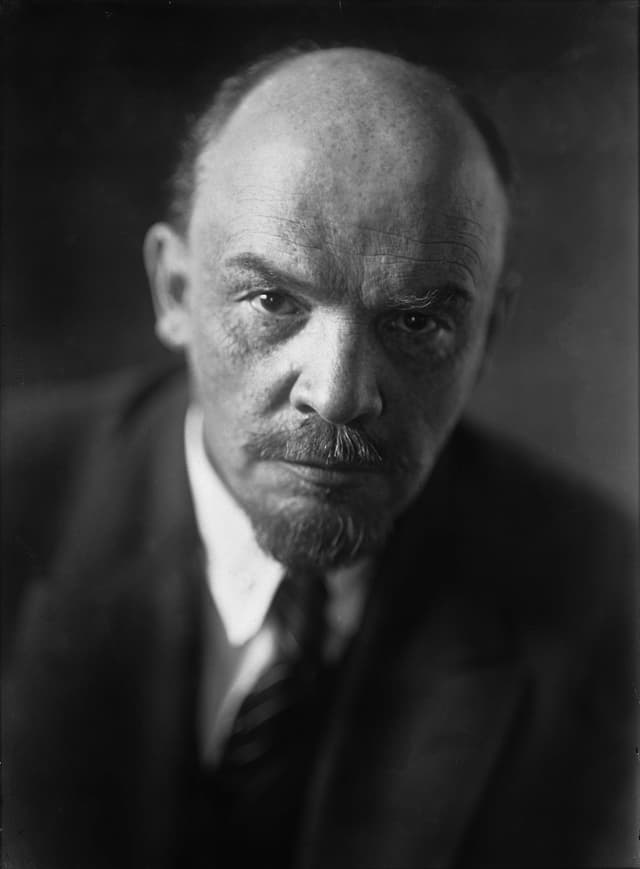
Vladimir Il'ich Lenin
Vladimir Ilyich Lenin, a pivotal figure in 20th-century history, was a Russian revolutionary and political theorist who became the first head of government of Soviet Russia and later the Soviet Union. Born into a middle-class family, Lenin was profoundly influenced by the execution of his brother for plotting against the tsar, which ignited his commitment to revolutionary socialism. After being expelled from Kazan Imperial University for his activism, he earned a law degree and became a prominent Marxist, eventually leading the Bolshevik faction of the Russian Social Democratic Labour Party. His ideological contributions, known as Leninism, emphasized the necessity of a vanguard party to guide the proletariat towards socialism. Lenin's leadership was instrumental during the October Revolution of 1917, which established the world's first communist state. His government implemented sweeping reforms, including the abolition of private land ownership and the nationalization of industry and banks. Despite facing significant challenges, including the Russian Civil War and widespread famine, Lenin adapted his policies, introducing the New Economic Policy in 1921 to stabilize the economy. His tenure was marked by the centralization of power within the Communist Party and the suppression of dissent, notably through the Red Terror. Lenin's death in 1924 precipitated a power struggle that ultimately facilitated Joseph Stalin's rise, shaping the future of the Soviet Union and global communism for decades to come.
Famous Quotes
View all 17 quotes“The Capitalists will sell us the rope with which we will hang them.””
“Capitalists can buy themselves out of any crisis, so long as they make the workers pay””
“Capitalism in its imperialist stage leads directly to the most comprehensive socialisation of production; it, so to speak, drags the capitalists, against their will and consciousness, into some sort of a new social order, a transitional one from complete free competition to complete socialisation. Production becomes social, but appropriation remains private. The social means of production remain the private property of a few. The general framework of formally recognised free competition remains, and the yoke of a few monopolists on the rest of the population becomes a hundred times heavier, more burdensome and intolerable.””
Books from the author



Link to this page
Add a free, dofollow link to Lex on your blog, forum, syllabus, or reading list.

<a href="https://lex-books.com/author/vladimir-ilich-lenin"><img src="https://lex-books.com/badges/read-on-lex.svg" alt="Vladimir Il'ich Lenin on Lex" width="160" height="40"></a>[](https://lex-books.com/author/vladimir-ilich-lenin)[url=https://lex-books.com/author/vladimir-ilich-lenin][img]https://lex-books.com/badges/read-on-lex.svg[/img][/url]Vladimir Il'ich Lenin on Lex: https://lex-books.com/author/vladimir-ilich-lenin