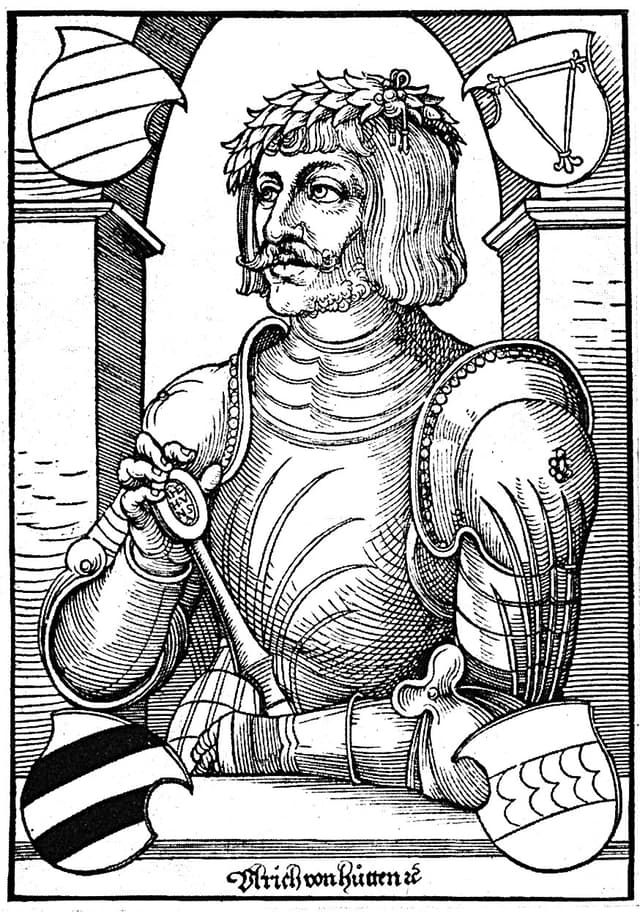
Ulrich von Hutten
Ulrich von Hutten was a German knight, scholar, poet, and satirist, who played a pivotal role in the early stages of the Protestant Reformation. Born into a noble family, he was educated in the humanist tradition, which greatly influenced his writings and thought. By 1519, Hutten emerged as a vocal critic of the Roman Catholic Church, advocating for reform and aligning himself with Martin Luther's ideas. His literary works, including satirical poems and treatises, challenged the religious and political status quo, making him a significant figure in the transition from Renaissance humanism to Protestant reform. Hutten's involvement in the Knights' War alongside Franz von Sickingen marked him as a leader among the knights of the Holy Roman Empire, reflecting his commitment to both social and religious change. His writings, such as 'Epistolae' and 'De laude novae militiae,' not only criticized ecclesiastical corruption but also called for a return to a more authentic Christian faith. Hutten's legacy lies in his role as a bridge between the Renaissance and the Reformation, influencing subsequent generations of reformers and contributing to the broader discourse on freedom of thought and religious expression in Europe.
Famous Quotes
View all 3 quotes“This is treachery, to change faith in accord with shifting fortune. The justice of my cause impelled me to withstand even adverse circumstance.”
“If I seem to you to change my state and alter my condition, I do not change my mind. I try always to be Hutten, never to desert myself, but to walk with equanimity through the unequal scenes of life.”
“Servitude of any sort is distasteful to all men, but especially objectionable is subjection to others in the case of those who ought to rule.”
Books from the author



Link to this page
Add a free, dofollow link to Lex on your blog, forum, syllabus, or reading list.

<a href="https://lex-books.com/author/ulrich-von-hutten"><img src="https://lex-books.com/badges/read-on-lex.svg" alt="Ulrich von Hutten on Lex" width="160" height="40"></a>[](https://lex-books.com/author/ulrich-von-hutten)[url=https://lex-books.com/author/ulrich-von-hutten][img]https://lex-books.com/badges/read-on-lex.svg[/img][/url]Ulrich von Hutten on Lex: https://lex-books.com/author/ulrich-von-hutten