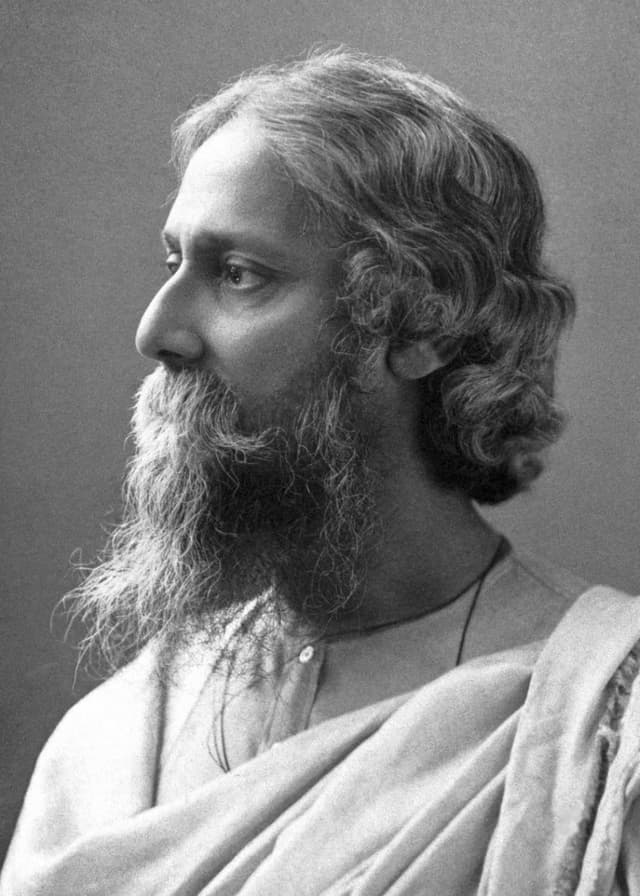
Rabindranath Tagore
Rabindranath Tagore was a Bengali polymath whose contributions spanned poetry, music, art, and philosophy, marking him as a central figure of the Bengal Renaissance. Born into a prominent family in Calcutta, he began writing poetry at a young age, publishing his first significant works under the pseudonym Bhanusimha at just sixteen. His most celebrated collection, Gitanjali, garnered international acclaim and led to his becoming the first non-European Nobel laureate in Literature in 1913. Tagore's lyrical poetry, often infused with themes of spirituality and nature, reshaped Bengali literature and music, establishing a new cultural identity during a time of colonial oppression in India. As a humanist and social reformer, Tagore was an outspoken critic of nationalism and the British Raj, advocating for Indian independence and a broader human connection beyond borders. His artistic legacy extended beyond literature; he founded Visva-Bharati University, promoting education and cultural exchange. Tagore's influence is profound, as he not only enriched Bengali culture but also left an indelible mark on global literature and art, earning him the title 'the Bard of Bengal.' His work continues to inspire generations, embodying a unique blend of traditional and modernist thought that resonates across cultures.
Famous Quotes
View all 20 quotes“Clouds come floating into my life, no longer to carry rain or usher storm, but to add color to my sunset sky.””
“If you cry because the sun has gone out of your life, your tears will prevent you from seeing the stars.””
“Let me not pray to be sheltered from dangers,but to be fearless in facing them. Let me not beg for the stilling of my pain, butfor the heart to conquer it.””
Books from the author


















Link to this page
Add a free, dofollow link to Lex on your blog, forum, syllabus, or reading list.

<a href="https://lex-books.com/author/rabindranath-tagore"><img src="https://lex-books.com/badges/read-on-lex.svg" alt="Rabindranath Tagore on Lex" width="160" height="40"></a>[](https://lex-books.com/author/rabindranath-tagore)[url=https://lex-books.com/author/rabindranath-tagore][img]https://lex-books.com/badges/read-on-lex.svg[/img][/url]Rabindranath Tagore on Lex: https://lex-books.com/author/rabindranath-tagore