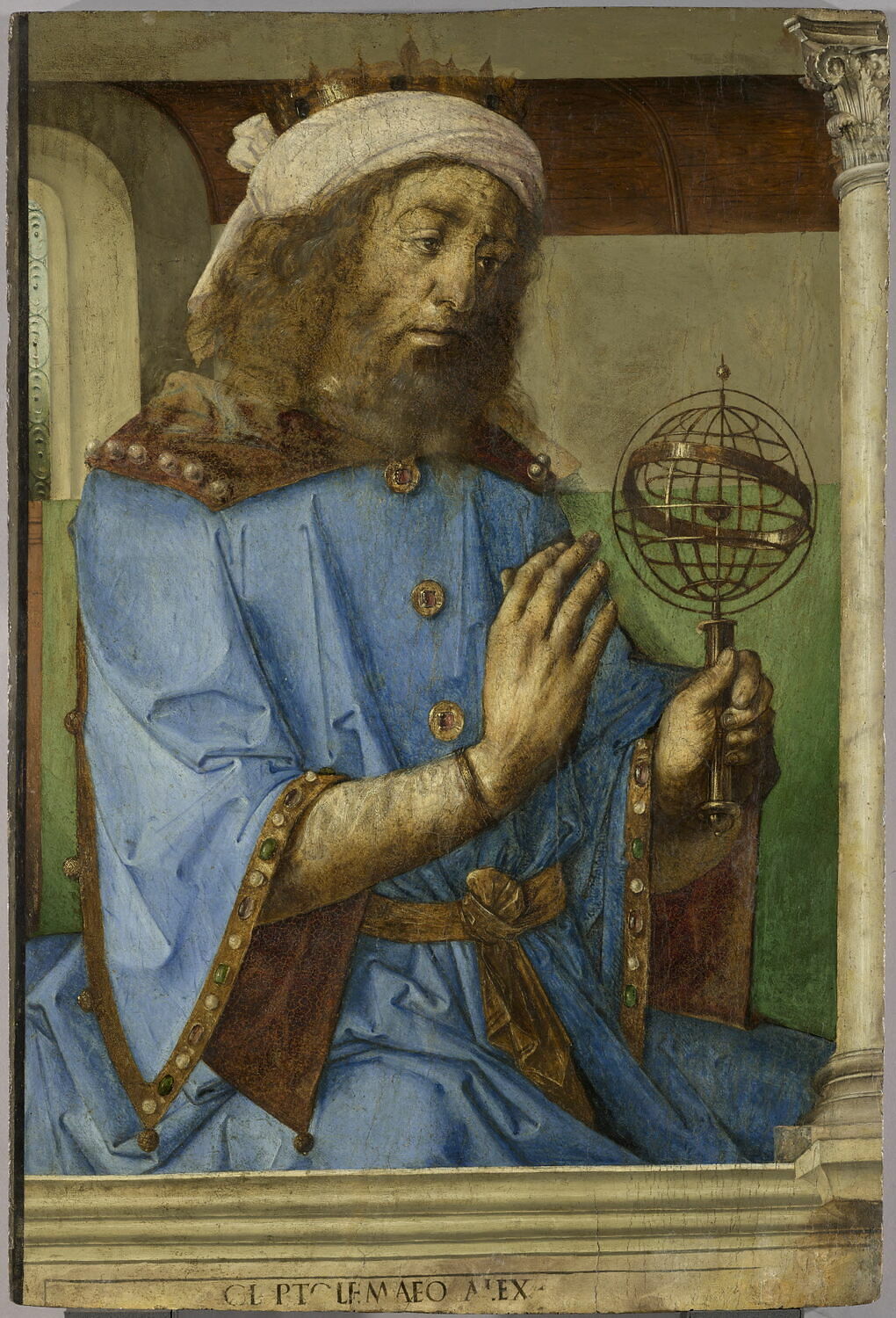
Ptolemy
Ptolemy was a Greco-Roman mathematician, astronomer, and geographer whose works laid foundational principles for various scientific fields. Born in Egypt, he spent much of his life in Alexandria, where he produced his most influential texts, including the 'Almagest,' a comprehensive treatise on astronomy that synthesized and expanded upon the knowledge of his predecessors. In this work, Ptolemy introduced the geocentric model of the universe, which posited that the Earth was at the center of the cosmos, a view that dominated Western astronomy for over a millennium. In addition to his astronomical contributions, Ptolemy's 'Geographia' was a seminal work in the field of geography, providing detailed maps and a systematic approach to cartography that influenced explorers and geographers for centuries. His methods of latitude and longitude, along with his extensive compilation of geographical knowledge, marked a significant advancement in the understanding of the world. Ptolemy's legacy endures through his profound impact on both astronomy and geography, as his theories and methodologies continued to be referenced and built upon well into the Renaissance and beyond.
Famous Quotes
View all 2 quotes“I know that I am mortal by nature, and ephemeral; but when I trace at my pleasure the windings to and fro of the heavenly bodies I no longer touch the earth with my feet: I stand in the presence of Zeus himself and take my fill of ambrosia””
“Mortal as I am, I know that I am born for a day. But when I follow at my pleasure the serried multitude of the stars in their circular course, my feet no longer touch the earth.””
Books from the author








Link to this page
Add a free, dofollow link to Lex on your blog, forum, syllabus, or reading list.

<a href="https://lex-books.com/author/ptolemy"><img src="https://lex-books.com/badges/read-on-lex.svg" alt="Ptolemy on Lex" width="160" height="40"></a>[](https://lex-books.com/author/ptolemy)[url=https://lex-books.com/author/ptolemy][img]https://lex-books.com/badges/read-on-lex.svg[/img][/url]Ptolemy on Lex: https://lex-books.com/author/ptolemy