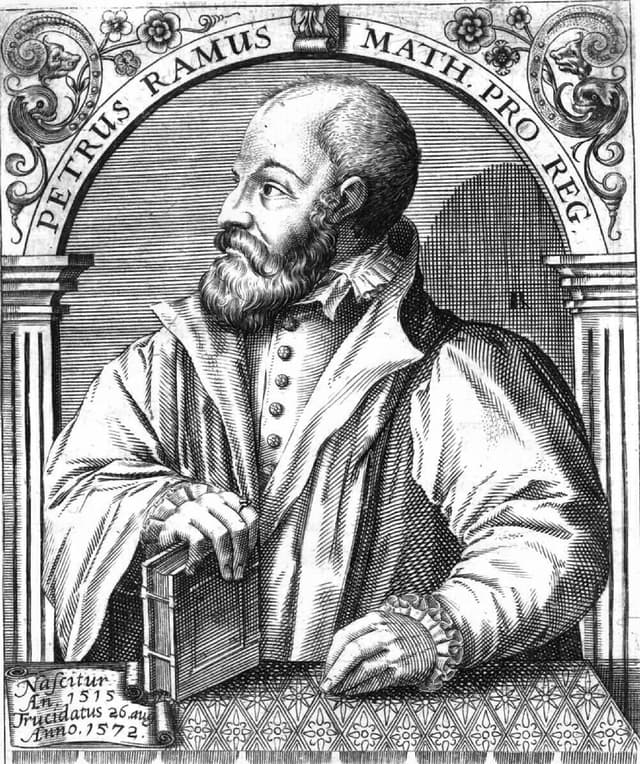
Petrus Ramus
Petrus Ramus, originally known as Pierre de La Ramée, was a prominent French humanist and logician whose work significantly influenced educational reform in the 16th century. He was a key figure in the development of rhetoric and logic, advocating for a more practical approach to education that emphasized critical thinking over traditional scholastic methods. His notable works include 'Dialectique' and 'Rhetorique', where he challenged the Aristotelian framework that dominated academic thought at the time, proposing instead a new system of logic that integrated humanist ideals. Ramus's innovative ideas laid the groundwork for modern educational practices and inspired future generations of thinkers and educators. As a Protestant convert during a period of intense religious conflict in France, Ramus's life was marked by both intellectual achievement and personal peril. He became a victim of the St. Bartholomew's Day massacre in 1572, a tragic event that underscored the violent tensions of the Reformation era. Despite his untimely death, Ramus's legacy endures through his contributions to logic and education, as well as his role in the broader humanist movement that sought to reform society through knowledge and reason.
Famous Quotes
View all 1 quotes“A lineate is a Magnitude more then long. A New forme of doctrine hath forced our Authour to use oft times new words, especially in dividing, that the logicall lawes and rules of more perfect division by a dichotomy, that is into two kindes, might bee held and observed. Therefore a Magnitude was divided into two kindes, to witt into a Line and a Lineate: And a Lineate is made the genus of a surface and a Body. Hitherto a Line, which of all bignesses is the first and most simple, hath been described: Now followeth a Lineate, the other kinde of magnitude opposed as you see to a line, followeth next in order. Lineatum therefore a Lineate, or Lineamentum, a Lineament, (as by the authority of our Authour himselfe, the learned Bernhard Salignacus, who was his Scholler, hath corrected it) is that Magnitude in which there are lines: Or which is made of lines, or as our Authour here, which is more then long: Therefore lines may be drawne in a surface, which is the proper soile or plots of lines; They may also be drawne in a body, as the Diameter in a Prisma: the axis in a spheare; and generally all lines falling from aloft: And therfore Proclus maketh some plaine, other solid lines. So Conicall lines, as the Ellipsis, Hyperbole, and Parabole, are called solid lines because they do arise from the cutting of a body. 2. To a Lineate belongeth an Angle and a Figure. The common affections of a Magnitude were to be bounded, cutt, jointly measured, and adscribed: Then of a line to be right, crooked, touch'd,”
Books from the author




Link to this page
Add a free, dofollow link to Lex on your blog, forum, syllabus, or reading list.

<a href="https://lex-books.com/author/petrus-ramus"><img src="https://lex-books.com/badges/read-on-lex.svg" alt="Petrus Ramus on Lex" width="160" height="40"></a>[](https://lex-books.com/author/petrus-ramus)[url=https://lex-books.com/author/petrus-ramus][img]https://lex-books.com/badges/read-on-lex.svg[/img][/url]Petrus Ramus on Lex: https://lex-books.com/author/petrus-ramus