The Way to Geometry
1569
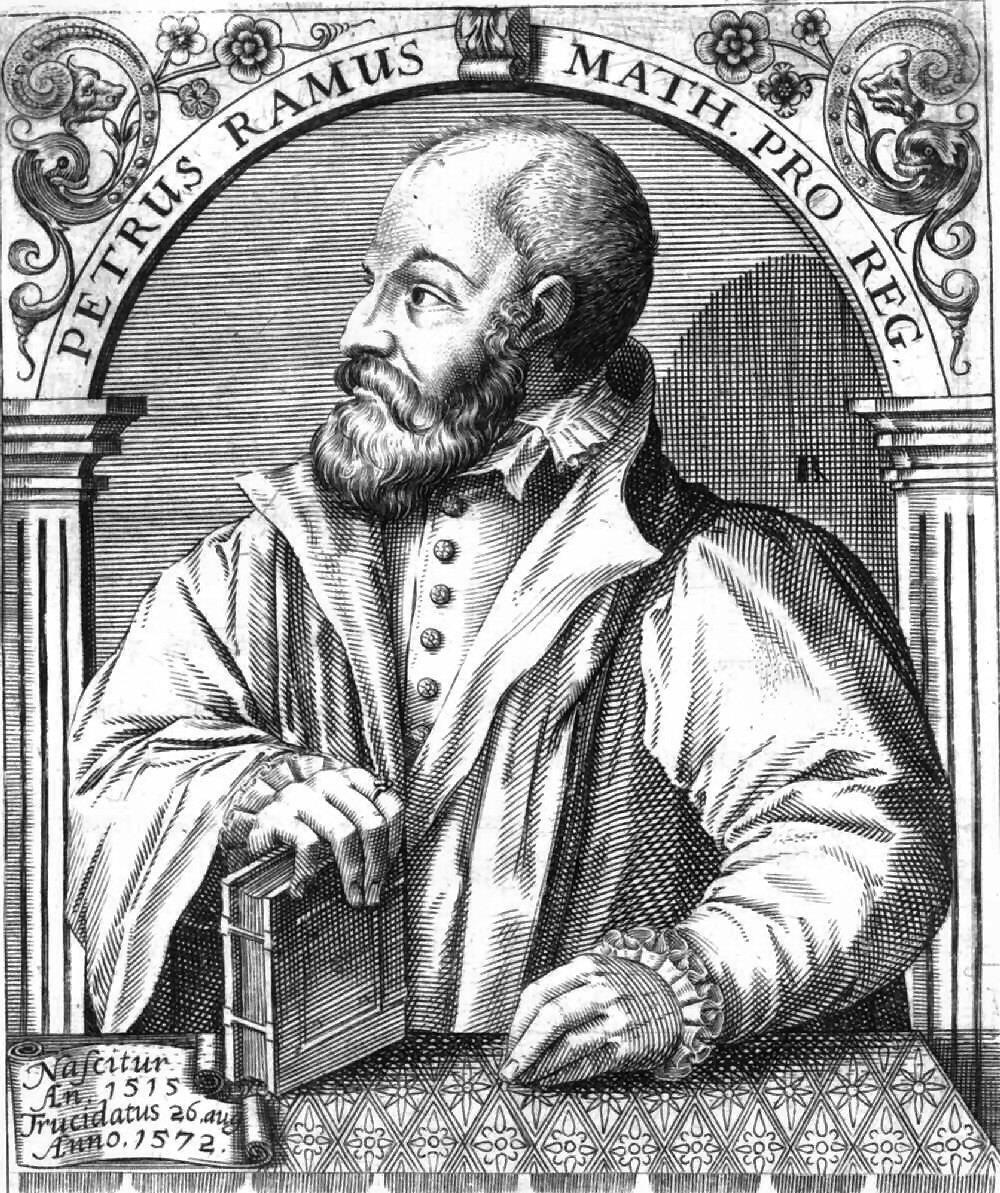
Petrus Ramus was a radical. He challenged the Aristotelian establishment, survived attempts on his life, and ultimately perished in the St. Bartholomew's Day Massacre. His 1569 geometry manual reflects that defiance: a deliberate attack on abstract, unusable math taught in universities, replaced with geometry as working craftsmen actually practiced it. This is not Euclidean proof-building for its own sake. This is measurement for land-surveyors, perspective for painters, navigation for seamen, carpentry for builders. Ramus believed knowledge should serve those who labor with their hands, not just those who contemplate in academic chambers. The book walks through geometric principles with practical examples drawn from dozens of trades, emphasizing what a carpenter needs to measure, what a painter must understand about proportion, what a seaman plots on a chart. Reading it now feels like stepping into a Renaissance workshop: you encounter the mathematical foundations underlying every crafted object, every building, every ship that sailed. It is a historical document that doubles as an argument: that geometry is not a remote abstraction but the invisible infrastructure of the built world.
Editions
X-Ray
“A lineate is a Magnitude more then long. A New forme of doctrine hath forced our Authour to use oft times new words, especially in dividing, that the logicall lawes and rules of more perfect division by a dichotomy, that is into two kindes, might bee held and observed. Therefore a Magnitude was divided into two kindes, to witt into a Line and a Lineate: And a Lineate is made the genus of a surface and a Body. Hitherto a Line, which of all bignesses is the first and most simple, hath been described: Now followeth a Lineate, the other kinde of magnitude opposed as you see to a line, followeth next in order. Lineatum therefore a Lineate, or Lineamentum, a Lineament, (as by the authority of our Authour himselfe, the learned Bernhard Salignacus, who was his Scholler, hath corrected it) is that Magnitude in which there are lines: Or which is made of lines, or as our Authour here, which is more then long: Therefore lines may be drawne in a surface, which is the proper soile or plots of lines; They may also be drawne in a body, as the Diameter in a Prisma: the axis in a spheare; and generally all lines falling from aloft: And therfore Proclus maketh some plaine, other solid lines. So Conicall lines, as the Ellipsis, Hyperbole, and Parabole, are called solid lines because they do arise from the cutting of a body. 2. To a Lineate belongeth an Angle and a Figure. The common affections of a Magnitude were to be bounded, cutt, jointly measured, and adscribed: Then of a line to be right, crooked, touch'd,””
— Petrus Ramus
Link to this book
Add a free, dofollow link to Lex on your blog, forum, syllabus, or reading list.

<a href="https://lex-books.com/book/the-way-to-geometry-bd273e7f-a7ae-4401-8e2e-06c5193df097"><img src="https://lex-books.com/badges/read-on-lex.svg" alt="Read The Way to Geometry by Petrus Ramus free on Lex" width="160" height="40"></a>[](https://lex-books.com/book/the-way-to-geometry-bd273e7f-a7ae-4401-8e2e-06c5193df097)[url=https://lex-books.com/book/the-way-to-geometry-bd273e7f-a7ae-4401-8e2e-06c5193df097][img]https://lex-books.com/badges/read-on-lex.svg[/img][/url]Read The Way to Geometry by Petrus Ramus free on Lex: https://lex-books.com/book/the-way-to-geometry-bd273e7f-a7ae-4401-8e2e-06c5193df097Cite this book
Reading this edition for a paper or guide? Copy a citation.
Ramus, Petrus. The Way to Geometry. Lex, lex-books.com/book/the-way-to-geometry-bd273e7f-a7ae-4401-8e2e-06c5193df097.Ramus, P. (1569). The Way to Geometry. Lex. https://lex-books.com/book/the-way-to-geometry-bd273e7f-a7ae-4401-8e2e-06c5193df097Ramus, Petrus. The Way to Geometry. Lex. https://lex-books.com/book/the-way-to-geometry-bd273e7f-a7ae-4401-8e2e-06c5193df097.