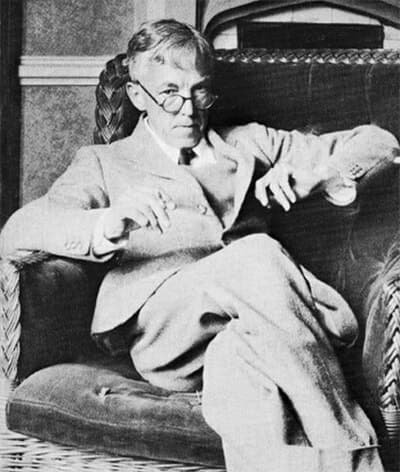
G. H. Hardy
G. H. Hardy was a prominent British mathematician known for his contributions to number theory and mathematical analysis. Born in 1877, he was a leading figure in the early 20th century mathematical community and is perhaps best remembered for his work on the distribution of prime numbers and the Hardy-Weinberg principle in genetics. Hardy's most famous work, 'A Mathematician's Apology,' is a passionate defense of pure mathematics, where he argued that mathematics is a creative art rather than a mere tool for practical applications. This essay not only showcased his mathematical philosophy but also revealed his disdain for what he considered the utilitarian aspects of mathematics, which he felt detracted from its beauty and elegance. Hardy's legacy extends beyond his own mathematical discoveries; he was also a mentor to several notable mathematicians, including Srinivasa Ramanujan, whose work he championed and helped to bring to a wider audience. Hardy's influence on the field of mathematics is profound, as he emphasized the importance of rigor and abstraction, shaping the way mathematics is taught and understood. His belief in the intrinsic value of mathematics continues to inspire mathematicians today, making him a pivotal figure in the history of the discipline.
Famous Quotes
View all 19 quotes“It is not worth an intelligent man's time to be in the majority. By definition, there are already enough people to do that.””
“A mathematician, like a painter or poet, is a maker of patterns. If his patterns are more permanent than theirs, it is because they are made with ideas.””
“Reductio ad absurdum, which Euclid loved so much, is one of a mathematician's finest weapons. It is a far finer gambit than any chess play: a chess player may offer the sacrifice of a pawn or even a piece, but a mathematician offers the game.””
Books from the author




Link to this page
Add a free, dofollow link to Lex on your blog, forum, syllabus, or reading list.

<a href="https://lex-books.com/author/g-h-hardy-2"><img src="https://lex-books.com/badges/read-on-lex.svg" alt="G. H. Hardy on Lex" width="160" height="40"></a>[](https://lex-books.com/author/g-h-hardy-2)[url=https://lex-books.com/author/g-h-hardy-2][img]https://lex-books.com/badges/read-on-lex.svg[/img][/url]G. H. Hardy on Lex: https://lex-books.com/author/g-h-hardy-2