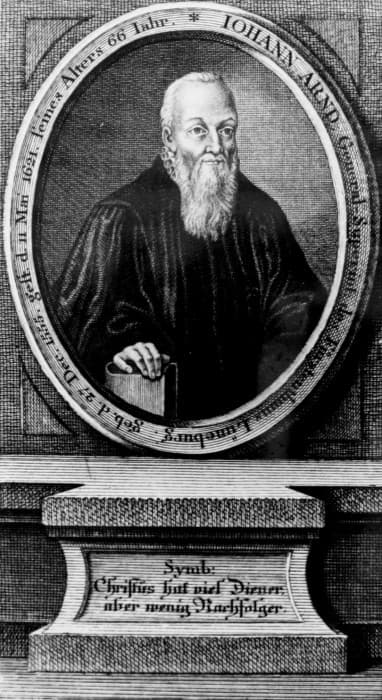
Johann Arndt
Johann Arndt was a German Lutheran theologian and mystic, recognized for his significant contributions to devotional literature in the early 17th century. His works, particularly 'True Christianity,' emphasized a personal and heartfelt approach to faith, reflecting the spiritual concerns of his time. Arndt's writings bridged the gap between the established Lutheran Orthodoxy and the emerging Pietist movement, which sought a more personal and experiential relationship with God. His emphasis on inner spirituality and the importance of personal faith laid the groundwork for later developments in Protestant thought. Arndt's influence extended beyond his lifetime, as his writings inspired subsequent generations of theologians and laypeople alike. He is often regarded as a precursor to Pietism, which would come to prominence in the late 17th century, advocating for a more devout and experiential Christian life. Through his works, Johann Arndt not only shaped Lutheran spirituality but also contributed to the broader landscape of Christian mysticism, leaving a lasting legacy in the realm of religious literature.
Famous Quotes
View all 3 quotes“For true conversion doth not consist in putting away great and outward sins only, but in descending deeply into your own self, searching into the inmost recesses of the heart, the secrets and closets, all the windings and turnings thereof; changing and renewing them throughout, with the grace that is given you: and so, by faith, you are converted from self-love to Divine love; from the world and all worldly concupiscences, to a spiritual and heavenly life; and from a participation of the pomps and pleasures thereof, to participating the merits and virtues of Christ, by believing his word, and walking in his steps.”
“The first help to prayer is our only Mediator and Advocate, Jesus Christ, the Son of God, 1 John 2:2. He is pleading our cause before God, when we are hardly able to express what we want; who is therefore called the Word of the Father, because God, by him, has discovered his will to us; as he is also called 'the Mediator,' because he solicits our cause before God. When Moses complained that he was of slow speech, and a slow tongue, that so he might avoid carrying the commanded message to Pharaoh, God tells him, 'Aaron thy brother can speak well, he shall be to thee instead of a mouth.' Se we also, when we shall pray, are dull, and slow of speech, and therefore must fly to Christ, our heavenly Aaron, who is to us instead of a mouth. Therefore Christ commands us to pray in his name, who is our eternal High-priest, 'having an everlasting priesthood,' (Heb. 7:24,) 'interceding for us,' (Rom. 8:34,) 'in whom we have boldness,' and access with confidence by the faith of him,' Eph. 3:12.”
“The obedience of Christ was far more acceptable to God, than the innocence of Adam; so that a thousand such as Adam could not have equalled Christ alone. For however he, had he continued in the state of innocence, would have left us an hereditary righteousness, of which we should have been possessed: notwithstanding, unspeakably greater, and more excellent, is our union with God in Christ, since he being made man, hath so purified and exalted the human nature in himself, that the primitive state of Adam is not once to be compared with it.”
Books from the author


Link to this page
Add a free, dofollow link to Lex on your blog, forum, syllabus, or reading list.

<a href="https://lex-books.com/author/johann-arndt"><img src="https://lex-books.com/badges/read-on-lex.svg" alt="Johann Arndt on Lex" width="160" height="40"></a>[](https://lex-books.com/author/johann-arndt)[url=https://lex-books.com/author/johann-arndt][img]https://lex-books.com/badges/read-on-lex.svg[/img][/url]Johann Arndt on Lex: https://lex-books.com/author/johann-arndt