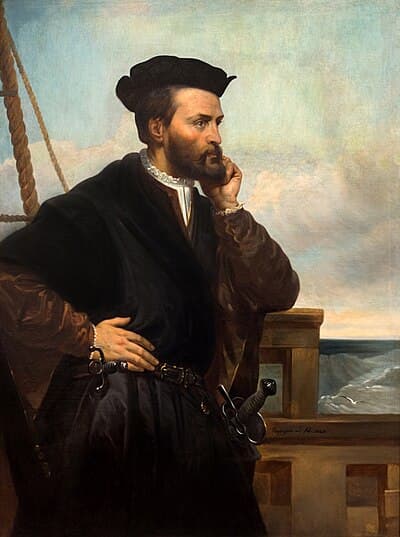
Jacques Cartier
Jacques Cartier (Breton: Jakez Karter; 31 December 1491 – 1 September 1557) was a French maritime explorer from Brittany. Jacques Cartier was the first European to describe and map the Gulf of Saint Lawrence and the shores of the Saint Lawrence River, which he named "The Country of Canadas" after the Iroquoian names for the two big settlements he saw at Stadacona (Quebec City) and at Hochelaga (Montreal Island). Jacques Cartier, author of now-lost maps and accounts of his voyages, was the first European to describe and name this region and its inhabitants—at a time when the Spanish had already settled in the Caribbean, Mexico, and Central America, and were beginning their conquest of Peru.
Famous Quotes
View all 1 quotes“The French sailed upriver as far as Stadacona, later to be called Quebec. Stadacona was at the heart of a region known as the “Kingdom of Canada,” with “Canada” being a place name of Iroquoian origin meaning a village or group of houses. After a brief visit to the large Aboriginal town of Hochelaga on the island of Montreal, Cartier and his men settled in to face the rigours of their first North American winter. Early in May 1536 before weighing anchor for France, he erected another cross with the French coat of arms and the Latin inscription, “François I reigning by the grace of God, King of the French.” This was in fact a second claim to possession of the land.””
Books from the author

Link to this page
Add a free, dofollow link to Lex on your blog, forum, syllabus, or reading list.

<a href="https://lex-books.com/author/jacques-cartier"><img src="https://lex-books.com/badges/read-on-lex.svg" alt="Jacques Cartier on Lex" width="160" height="40"></a>[](https://lex-books.com/author/jacques-cartier)[url=https://lex-books.com/author/jacques-cartier][img]https://lex-books.com/badges/read-on-lex.svg[/img][/url]Jacques Cartier on Lex: https://lex-books.com/author/jacques-cartier