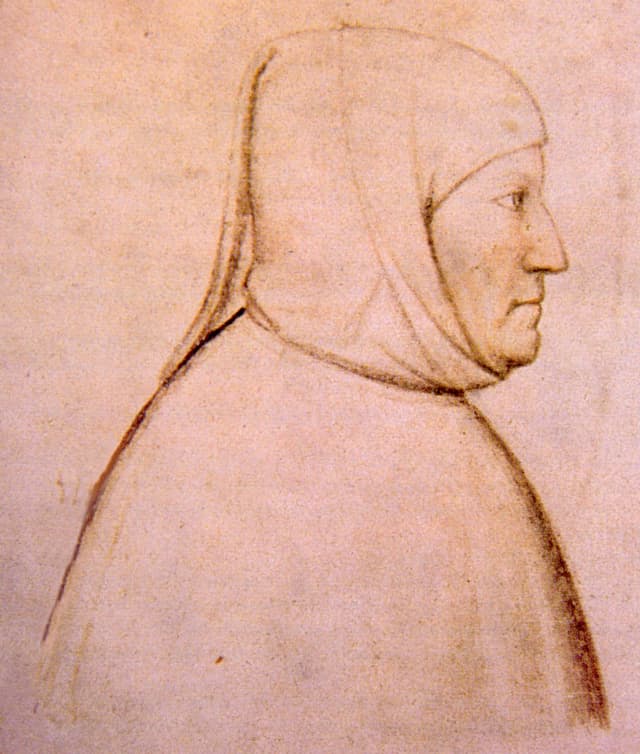
Francesco Petrarca
Francesco Petrarca, often known as the father of Renaissance humanism, was a pivotal figure in the early Italian Renaissance. Born in Arezzo, he was a scholar and poet whose rediscovery of classical texts, particularly Cicero's letters, played a crucial role in reviving interest in antiquity and shaping the intellectual landscape of the 14th century. Petrarch's work laid the groundwork for Renaissance humanism, emphasizing the value of individual experience and the study of classical literature. His influence extended beyond his lifetime, as the 16th-century scholar Pietro Bembo modeled the modern Italian language on Petrarch's writings, alongside those of Giovanni Boccaccio and Dante Alighieri. Petrarch's most notable contributions include his collection of Italian sonnets, known as the 'Canzoniere,' which not only showcased his lyrical prowess but also established a new standard for poetic expression in Europe. His exploration of themes such as love, nature, and the human condition resonated deeply with his contemporaries and inspired countless poets in the centuries that followed. Additionally, Petrarch's characterization of the Middle Ages as the 'Dark Ages' marked a significant shift in historical perspective, influencing how subsequent generations viewed this period. His legacy endures in the realms of literature and humanism, as he remains a central figure in the development of Western thought and poetic form.
Famous Quotes
View all 3 quotes“Rarely do great beauty and great virtue dwell together.”
“A short cut to riches is to subtract from our desires.”
“I freeze and burn, love is bitter and sweet, my sighs are tempests and my tears are floods, I am in ecstasy and agony, I am possessed by memories of her and I am in exile from myself.”
Books from the author




Link to this page
Add a free, dofollow link to Lex on your blog, forum, syllabus, or reading list.

<a href="https://lex-books.com/author/francesco-petrarca"><img src="https://lex-books.com/badges/read-on-lex.svg" alt="Francesco Petrarca on Lex" width="160" height="40"></a>[](https://lex-books.com/author/francesco-petrarca)[url=https://lex-books.com/author/francesco-petrarca][img]https://lex-books.com/badges/read-on-lex.svg[/img][/url]Francesco Petrarca on Lex: https://lex-books.com/author/francesco-petrarca