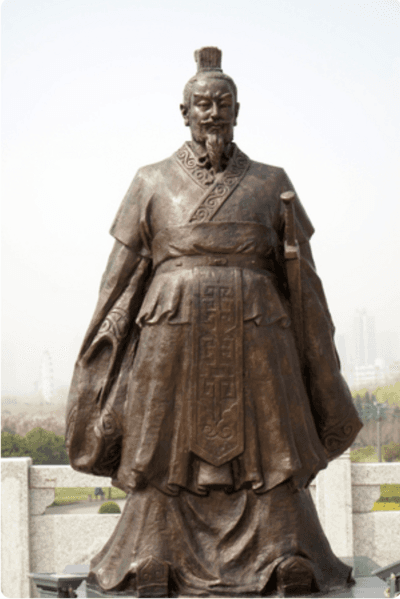
Fei,Han
Han Fei was a prominent philosopher and writer of the Warring States period in ancient China, known for his foundational contributions to Legalism, a school of thought that emphasized strict laws and governance. His most notable work, the "Han Feizi," is a collection of essays that articulate his ideas on statecraft, morality, and human nature, advocating for a strong, centralized authority to maintain order and control. Han Fei's theories were influential in shaping the political landscape of China, particularly during the Qin dynasty, where his ideas were implemented to unify the country under a centralized rule. Despite his significant impact, Han Fei's life was marked by political intrigue and personal tragedy. He faced opposition from Confucian scholars and was ultimately betrayed by his own allies, leading to his death in prison. Nevertheless, his writings have endured through the centuries, providing insight into the complexities of power and governance. Han Fei's legacy as a key figure in Chinese philosophy is evident in the ongoing discussions of his ideas in both historical and contemporary contexts, making him a pivotal figure in the study of political philosophy in China.
Books from the author












Link to this page
Add a free, dofollow link to Lex on your blog, forum, syllabus, or reading list.

<a href="https://lex-books.com/author/feihan"><img src="https://lex-books.com/badges/read-on-lex.svg" alt="Fei,Han on Lex" width="160" height="40"></a>[](https://lex-books.com/author/feihan)[url=https://lex-books.com/author/feihan][img]https://lex-books.com/badges/read-on-lex.svg[/img][/url]Fei,Han on Lex: https://lex-books.com/author/feihan