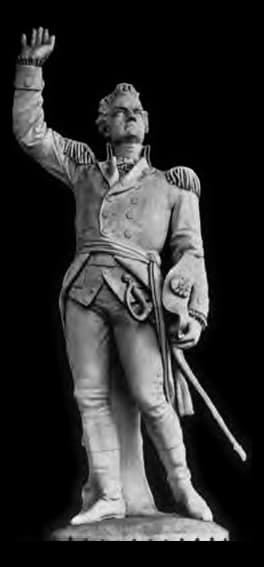
Ethan Allen
Ethan Allen was an influential American farmer, military officer, and politician, recognized as a key figure in the founding of Vermont and for his daring military exploits during the American Revolutionary War. Born in rural Connecticut, Allen grew up in a frontier environment that shaped his resilient character. He became embroiled in the land disputes of the New Hampshire Grants in the late 1760s, which led him to form the Green Mountain Boys, a militia that resisted New York's claims to the territory. Under his leadership, the Green Mountain Boys famously captured Fort Ticonderoga in May 1775, a pivotal moment that provided much-needed artillery for the Continental Army. After his capture during a failed expedition to Montreal in 1775, Allen endured imprisonment by the British before being paroled and eventually exchanged in 1778. Following his release, he returned to the New Hampshire Grants, which had declared independence as Vermont in 1777. Allen continued to advocate for Vermont's recognition as a state, navigating complex political landscapes and even engaging in negotiations with British officials regarding Vermont's status. His legacy is marked not only by his military achievements but also by his passionate commitment to the autonomy of Vermont, making him a significant figure in early American history and statehood.
Famous Quotes
View all 3 quotes“Ever since I arrived to a state of manhood, I have felt a sincere passion for liberty. The history of nations doomed to perpetual slavery, in consequence of yielding up to tyrants their natural born liberties, I read with a sort of philosophical horror; so that the first systematical and bloody attempt at Lexington, to enslave America, thoroughly electrified my mind, and fully determined me to take part with my country.”
“In those parts of the world where learning and science has prevailed, miracles have ceased; but in such parts of it as are barbarous and ignorant, miracles are still in vogue ; which is of itself a strong presumption that in the infancy of letters, learning and science, or in the world's non-age, those who confided in miracles, as a proof of the divine mission of the first promulgators of revelation, were imposed upon by fictitious appearances instead of miracles.”
“Those who invalidate reason, ought seriously to consider, 'whether they argue against reason, with or without reason; if with reason, then they establish the principle, that they are laboring to dethrone;' but if they argue without reason, (which, in order to be consistent with themselves, they must do,) they are out of the reach of rational conviction, nor do they deserve a rational argument.”
Books from the author


Link to this page
Add a free, dofollow link to Lex on your blog, forum, syllabus, or reading list.

<a href="https://lex-books.com/author/ethan-allen"><img src="https://lex-books.com/badges/read-on-lex.svg" alt="Ethan Allen on Lex" width="160" height="40"></a>[](https://lex-books.com/author/ethan-allen)[url=https://lex-books.com/author/ethan-allen][img]https://lex-books.com/badges/read-on-lex.svg[/img][/url]Ethan Allen on Lex: https://lex-books.com/author/ethan-allen