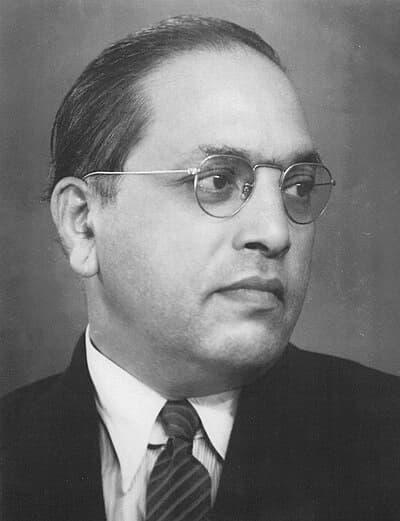
B. R. Ambedkar
Bhimrao Ramji Ambedkar was a prominent Indian jurist, economist, and social reformer who played a pivotal role in shaping modern India. He is best known for his leadership in drafting the Constitution of India, where he served as the chairman of the drafting committee, ensuring that the principles of justice, equality, and liberty were enshrined in the nation's foundational document. His contributions to law and governance were further recognized when he became the first Minister of Law and Justice in Jawaharlal Nehru's cabinet, where he worked tirelessly to promote social justice and the rights of marginalized communities. Ambedkar's legacy extends beyond his political and legal achievements; he was a fierce advocate for the rights of the Dalits, the oppressed classes in Indian society. His conversion to Buddhism in 1956 marked a significant moment in the Dalit Buddhist movement, as he sought to provide an alternative to the caste system entrenched in Hinduism. Through his writings and speeches, including works like "Annihilation of Caste" and "Thoughts on Linguistic States," Ambedkar challenged social norms and inspired generations to fight for equality and human rights. His influence continues to resonate in contemporary discussions on social justice and caste discrimination in India.
Famous Quotes
View all 20 quotes“Constitutional morality is not a natural sentiment. It has to be cultivated. We must realise that our people have yet to learn it. Democracy in India is only a top-dressing on an Indian soil which is essentially undemocratic.””
“The Hindus criticise the Mahomedans for having spread their religion by the use of the sword. They also ridicule Christianity on the score of the Inquisition. But really speaking, who is better and more worthy of our respect”
“In the Hindu religion, one can[not] have freedom of speech. A Hindu must surrender his freedom of speech. He must act according to the Vedas. If the Vedas do not support the actions, instructions must be sought from the Smritis, and if the Smritis fail to provide any such instructions, he must follow in the footsteps of the great men. He is not supposed to reason. Hence, so long as you are in the Hindu religion, you cannot expect to have freedom of thought””
Books from the author





Link to this page
Add a free, dofollow link to Lex on your blog, forum, syllabus, or reading list.

<a href="https://lex-books.com/author/b-r-ambedkar"><img src="https://lex-books.com/badges/read-on-lex.svg" alt="B. R. Ambedkar on Lex" width="160" height="40"></a>[](https://lex-books.com/author/b-r-ambedkar)[url=https://lex-books.com/author/b-r-ambedkar][img]https://lex-books.com/badges/read-on-lex.svg[/img][/url]B. R. Ambedkar on Lex: https://lex-books.com/author/b-r-ambedkar