Alexander Monro
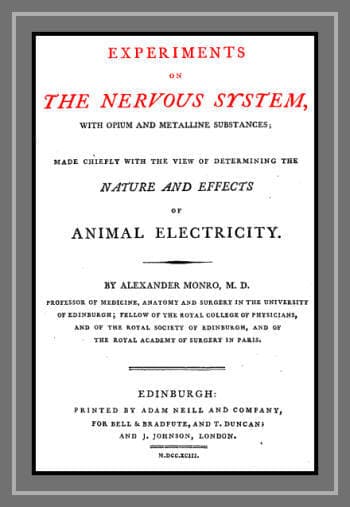
Alexander Monro was a Scottish anatomist and physician, renowned for his pioneering contributions to the understanding of the nervous system and the brain. He served as a professor of anatomy at the University of Edinburgh, where he became a prominent figure in the field of medical education during the 18th century. Monro's significant works, including 'Experiments on the Nervous System with Opium and Metalline Substances' and 'The Morbid Anatomy of the Brain,' explored the intricate relationships between the nervous system and various substances, laying the groundwork for future research in neurology and psychiatry. His investigations into animal electricity and the effects of opium on the nervous system were particularly innovative, as they challenged existing notions of physiology and opened new avenues for understanding brain function and pathology. Monro's meticulous approach to anatomical study and his emphasis on empirical research contributed to the advancement of medical science during a time when such methods were still developing. His legacy endures in the fields of anatomy and neurology, influencing generations of physicians and researchers who followed in his footsteps.
Famous Quotes
View all 3 quotes“Just as paper allowed authors a more independent voice and a higher word count, so it also enabled them to listen to the voices of many others, even those hundreds of miles away.”
“Paper has been the evangelist of many of the convictions that shaped history, carrying them to distant lands or simply to a groundswell of people who could never otherwise have absorbed them. Propagandist, tyrant, democratizer, tool, inventor, magician and technician all in one, paper’s power lies in its absence of personality. Quietly, inexpensively and often slowly, it has seeped around the world, and history’s most galvanizing ideas have hitched a lift on its surface.”
“Among the samples the author provides is one called ‘A Letter Regarding Wine’. It has been evocatively translated by Lionel Giles, who first catalogued the documents Stein sent to the British Museum in the early twentieth century. Yesterday, having drunk too much, I was so intoxicated as to pass all bounds; but none of the rude and coarse language I used was uttered in a conscious state. The next morning, after hearing others speak on the subject, I realised what had happened, whereupon I was overwhelmed with confusion and ready to sink into the earth in shame. It was due to a vessel of small capacity being filled for the nonce too full. I humbly trust that you in your wise benevolence will not condemn me for my transgression. Soon I will come to apologise in person, but meanwhile I beg to send this written communication for your kind inspection. Leaving much unsaid, I am yours respectfully…28”
Books from the author


Link to this page
Add a free, dofollow link to Lex on your blog, forum, syllabus, or reading list.

<a href="https://lex-books.com/author/alexander-monro"><img src="https://lex-books.com/badges/read-on-lex.svg" alt="Alexander Monro on Lex" width="160" height="40"></a>[](https://lex-books.com/author/alexander-monro)[url=https://lex-books.com/author/alexander-monro][img]https://lex-books.com/badges/read-on-lex.svg[/img][/url]Alexander Monro on Lex: https://lex-books.com/author/alexander-monro