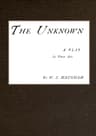
The Unknown; A Play in Three Acts
1920
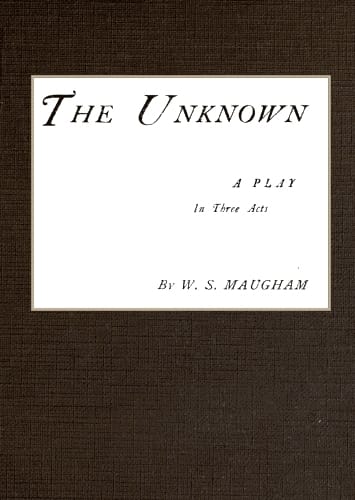
The Unknown; A Play in Three Acts, written by W. Somerset Maugham and first published in 1920, is a drama set in a country manor in post-World War I England. The play centers on Colonel Wharton, his wife, and their son John, who has returned home wounded from the war. It explores themes of faith, life, death, and the complexities of human emotions, revealing the strains within the family as they navigate the aftermath of conflict and personal expectations. Maugham's work reflects the social customs of early 20th-century England and the impact of war on familial relationships.
Editions
X-Ray
“It is an illusion that youth is happy, an illusion of those who have lost it; but the young know they are wretched for they are full of the truthless ideal which have been instilled into them, and each time they come in contact with the real, they are bruised and wounded. It looks as if they were victims of a conspiracy; for the books they read, ideal by the necessity of selection, and the conversation of their elders, who look back upon the past through a rosy haze of forgetfulness, prepare them for an unreal life. They must discover for themselves that all they have read and all they have been told are lies, lies, lies; and each discovery is another nail driven into the body on the cross of life.””
— W. Somerset Maugham
“He did not care if she was heartless, vicious and vulgar, stupid and grasping, he loved her. He would rather have misery with one than happiness with the other.””
— W. Somerset Maugham
“Oh, it's always the same,' she sighed, 'if you want men to behave well to you, you must be beastly to them; if you treat them decently they make you suffer for it.””
— W. Somerset Maugham
“People ask you for criticism, but they only want praise.””
— W. Somerset Maugham
“It was one of the queer things of life that you saw a person every day for months and were so intimate with him that you could not imagine existence without him; then separation came, and everything went on in the same way, and the companion who had seemed essential proved unnecessary.””
— W. Somerset Maugham
“You will find as you grow older that the first thing needful to make the world a tolerable place to live in is to recognize the inevitable selfishness of humanity. You demand unselfishness from others, which is a preposterous claim that they should sacrifice their desires to yours. Why should they? When you are reconciled to the fact that each is for himself in the world you will ask less from your fellows. They will not disappoint you, and you will look upon them more charitably. Men seek but one thing in life -- their pleasure.””
— W. Somerset Maugham
“There's always one who loves and one who lets himself be loved.””
— W. Somerset Maugham
“Insensibly he formed the most delightful habit in the world, the habit of reading: he did not know that thus he was providing himself with a refuge from all the distress of life; he did not know either that he was creating for himself an unreal world which would make the real world of every day a source of bitter disappointment.””
— W. Somerset Maugham
“The secret to life is meaningless unless you discover it yourself.””
— W. Somerset Maugham
Link to this book
Add a free, dofollow link to Lex on your blog, forum, syllabus, or reading list.

<a href="https://lex-books.com/book/the-unknown-a-play-in-three-acts-b55ec93a-2230-4394-a198-131318cd56b6"><img src="https://lex-books.com/badges/read-on-lex.svg" alt="Read The Unknown; A Play in Three Acts by W. Somerset Maugham free on Lex" width="160" height="40"></a>[](https://lex-books.com/book/the-unknown-a-play-in-three-acts-b55ec93a-2230-4394-a198-131318cd56b6)[url=https://lex-books.com/book/the-unknown-a-play-in-three-acts-b55ec93a-2230-4394-a198-131318cd56b6][img]https://lex-books.com/badges/read-on-lex.svg[/img][/url]Read The Unknown; A Play in Three Acts by W. Somerset Maugham free on Lex: https://lex-books.com/book/the-unknown-a-play-in-three-acts-b55ec93a-2230-4394-a198-131318cd56b6Cite this book
Reading this edition for a paper or guide? Copy a citation.
Maugham, W. Somerset. The Unknown; A Play in Three Acts. Lex, lex-books.com/book/the-unknown-a-play-in-three-acts-b55ec93a-2230-4394-a198-131318cd56b6.Maugham, W. S. (1920). The Unknown; A Play in Three Acts. Lex. https://lex-books.com/book/the-unknown-a-play-in-three-acts-b55ec93a-2230-4394-a198-131318cd56b6Maugham, W. Somerset. The Unknown; A Play in Three Acts. Lex. https://lex-books.com/book/the-unknown-a-play-in-three-acts-b55ec93a-2230-4394-a198-131318cd56b6.