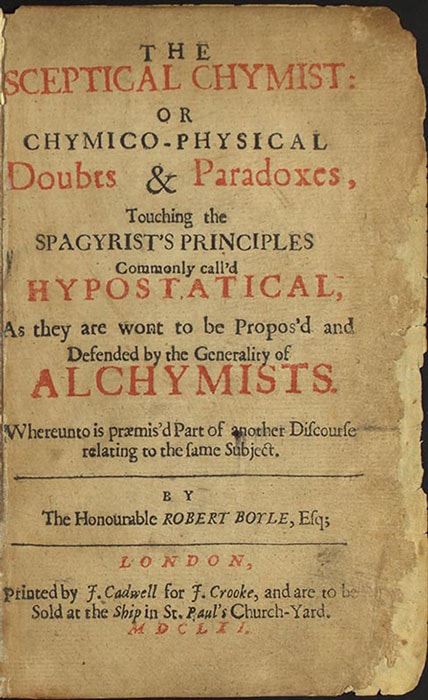
The Sceptical Chymist: Or Chymico-Physical Doubts & Paradoxes, Touching the Spagyrist's Principles Commonly Call'd Hypostatical; as They Are Wont to Be Propos'd and Defended by the Generality of Alchymists. Whereunto is Præmis'd Part of Another Discourse Relating to the Same Subject.
1661
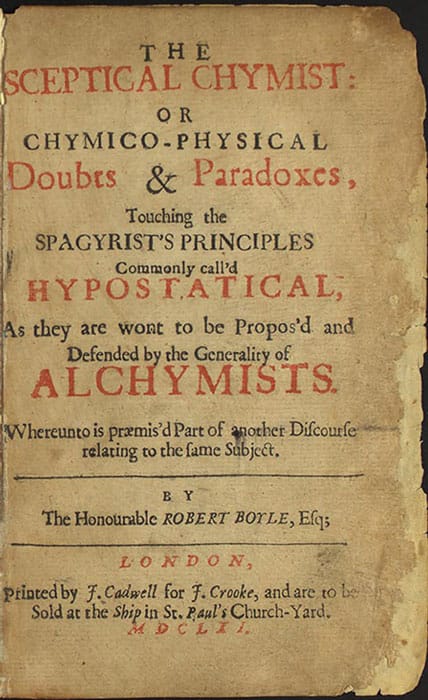
The Sceptical Chymist: Or Chymico-Physical Doubts & Paradoxes, Touching the Spagyrist's Principles Commonly Call'd Hypostatical; as They Are Wont to Be Propos'd and Defended by the Generality of Alchymists. Whereunto is Præmis'd Part of Another Discourse Relating to the Same Subject.
1661
In 1661, a young Irish aristocrat walked into a garden and quietly demolished two thousand years of received wisdom about what matter is made of. The result was "The Sceptical Chymist" - a book that didn't just challenge alchemy, but fundamentally redefined how we understand the physical world. Robert Boyle assembled four characters in a private garden to debate the nature of matter, and through their conversation, he dismantled Aristotle's four elements (earth, air, fire, water) and Paracelsus's three principles (salt, sulfur, mercury). Instead, Boyle proposed something revolutionary: matter consists of tiny particles, corpuscles, in constant motion, colliding to create every substance we observe. This wasn't mere speculation - Boyle insisted on experimental proof, on seeing through careful observation rather than deferring to ancient authority. The dialogue format lets him play both sides, mounting the strongest possible arguments for traditional alchemy before methodically dismantling them. The implications were staggering: if matter isn't what we've always been told it is, then transmutation is impossible, the alchemists' dream of turning lead to gold is finished, and chemistry must become a new science built on evidence rather than mysticism. Boyle laid the foundation for the periodic table, for atomic theory, for everything that followed. This is where modern chemistry began.
Editions
X-Ray
“Those distinct substances, which concretes generally either afford, or are made up of, may, without very much inconvenience, be called the elements or principles of them.””
— Robert Boyle
“... supposes not only all mixt bodies, but all others to be produced by the various and casual occursions of atoms, moving themselves to and fro by an internal principle in the immense or rather infinite vacuum.””
— Robert Boyle
“It is my intent to beget a good understanding between the chymists and the mechanical philosophers who have hitherto been too little acquainted with one another's learning.””
— Robert Boyle
Link to this book
Add a free, dofollow link to Lex on your blog, forum, syllabus, or reading list.

<a href="https://lex-books.com/book/the-sceptical-chymist-or-chymico-physical-doubts-paradoxes-touching-the-spagyris-34a99e7e-db7d-48fe-8f69-99c1c01cd1de"><img src="https://lex-books.com/badges/read-on-lex.svg" alt="Read The Sceptical Chymist: Or Chymico-Physical Doubts & Paradoxes, Touching the Spagyrist's Principles Commonly Call'd Hypostatical; as They Are Wont to Be Propos'd and Defended by the Generality of Alchymists. Whereunto is Præmis'd Part of Another Discourse Relating to the Same Subject. by Robert Boyle free on Lex" width="160" height="40"></a>[](https://lex-books.com/book/the-sceptical-chymist-or-chymico-physical-doubts-paradoxes-touching-the-spagyris-34a99e7e-db7d-48fe-8f69-99c1c01cd1de)[url=https://lex-books.com/book/the-sceptical-chymist-or-chymico-physical-doubts-paradoxes-touching-the-spagyris-34a99e7e-db7d-48fe-8f69-99c1c01cd1de][img]https://lex-books.com/badges/read-on-lex.svg[/img][/url]Read The Sceptical Chymist: Or Chymico-Physical Doubts & Paradoxes, Touching the Spagyrist's Principles Commonly Call'd Hypostatical; as They Are Wont to Be Propos'd and Defended by the Generality of Alchymists. Whereunto is Præmis'd Part of Another Discourse Relating to the Same Subject. by Robert Boyle free on Lex: https://lex-books.com/book/the-sceptical-chymist-or-chymico-physical-doubts-paradoxes-touching-the-spagyris-34a99e7e-db7d-48fe-8f69-99c1c01cd1deCite this book
Reading this edition for a paper or guide? Copy a citation.
Boyle, Robert. The Sceptical Chymist: Or Chymico-Physical Doubts & Paradoxes, Touching the Spagyrist's Principles Commonly Call'd Hypostatical; as They Are Wont to Be Propos'd and Defended by the Generality of Alchymists. Whereunto is Præmis'd Part of Another Discourse Relating to the Same Subject.. Lex, lex-books.com/book/the-sceptical-chymist-or-chymico-physical-doubts-paradoxes-touching-the-spagyris-34a99e7e-db7d-48fe-8f69-99c1c01cd1de.Boyle, R. (1661). The Sceptical Chymist: Or Chymico-Physical Doubts & Paradoxes, Touching the Spagyrist's Principles Commonly Call'd Hypostatical; as They Are Wont to Be Propos'd and Defended by the Generality of Alchymists. Whereunto is Præmis'd Part of Another Discourse Relating to the Same Subject.. Lex. https://lex-books.com/book/the-sceptical-chymist-or-chymico-physical-doubts-paradoxes-touching-the-spagyris-34a99e7e-db7d-48fe-8f69-99c1c01cd1deBoyle, Robert. The Sceptical Chymist: Or Chymico-Physical Doubts & Paradoxes, Touching the Spagyrist's Principles Commonly Call'd Hypostatical; as They Are Wont to Be Propos'd and Defended by the Generality of Alchymists. Whereunto is Præmis'd Part of Another Discourse Relating to the Same Subject.. Lex. https://lex-books.com/book/the-sceptical-chymist-or-chymico-physical-doubts-paradoxes-touching-the-spagyris-34a99e7e-db7d-48fe-8f69-99c1c01cd1de.