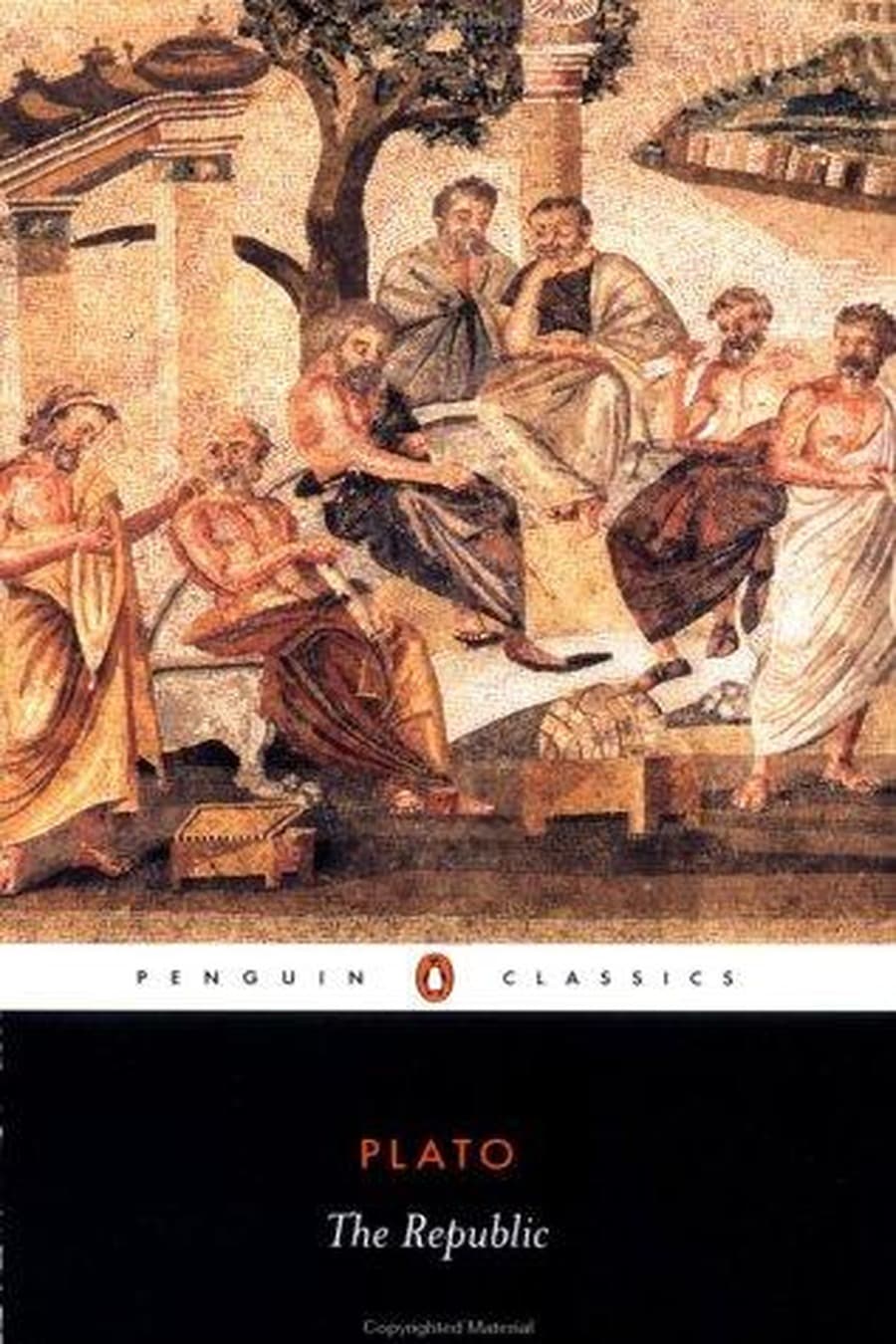
The Republic
375 BC
What is justice? The question seems simple until Socrates starts asking follow-ups. In this revolutionary dialogue, a conversation in a harbor town becomes the framework for an entire theory of how human beings should live together. Plato dramatizes the great debate between those who see justice as power and those who insist it matters for its own sake, staging it through vivid characters who demand Socrates defend his beliefs. The dialogue builds toward an audacious proposal: a society ruled by philosopher kings, educated from childhood to see beyond the shadows of opinion toward unchanging truth. Here too appears the most famous allegory in Western thought: prisoners chained in a cave, mistaking shadows for reality, one man escaping to discover the sun. The Republic doesn't just ask what is just, it demands to know whether the just person can ever be happy in a world ruled by the unjust. It is an act of radical optimism about reason, and a warning about what happens when philosophers don't rule and rulers don't philosophize.
Editions

X-Ray
“The heaviest penalty for declining to rule is to be ruled by someone inferior to yourself.””
— Plato
“I am the wisest man alive, for I know one thing, and that is that I know nothing.””
— Plato
“If women are expected to do the same work as men, we must teach them the same things.””
— Plato
“The beginning is the most important part of the work.””
— Plato
“The object of education is to teach us to love what is beautiful.””
— Plato
“Bodily exercise, when compulsory, does no harm to the body; but knowledge which is acquired under compulsion obtains no hold on the mind.””
— Plato
“Musical innovation is full of danger to the State, for when modes of music change, the fundamental laws of the State always change with them.””
— Plato
“There is in every one of us, even those who seem to be most moderate, a type of desire that is terrible, wild, and lawless.””
— Plato
“The soul takes nothing with her to the next world but her education and her culture. At the beginning of the journey to the next world, one's education and culture can either provide the greatest assistance, or else act as the greatest burden, to the person who has just died.””
— Plato
Link to this book
Add a free, dofollow link to Lex on your blog, forum, syllabus, or reading list.

<a href="https://lex-books.com/book/the-republic-858ca659-09a9-4c0c-80e3-6b01bb2d59ba"><img src="https://lex-books.com/badges/read-on-lex.svg" alt="Read The Republic by Plato free on Lex" width="160" height="40"></a>[](https://lex-books.com/book/the-republic-858ca659-09a9-4c0c-80e3-6b01bb2d59ba)[url=https://lex-books.com/book/the-republic-858ca659-09a9-4c0c-80e3-6b01bb2d59ba][img]https://lex-books.com/badges/read-on-lex.svg[/img][/url]Read The Republic by Plato free on Lex: https://lex-books.com/book/the-republic-858ca659-09a9-4c0c-80e3-6b01bb2d59baCite this book
Reading this edition for a paper or guide? Copy a citation.
Plato. The Republic. Lex, lex-books.com/book/the-republic-858ca659-09a9-4c0c-80e3-6b01bb2d59ba.Plato (375 BC). The Republic. Lex. https://lex-books.com/book/the-republic-858ca659-09a9-4c0c-80e3-6b01bb2d59baPlato. The Republic. Lex. https://lex-books.com/book/the-republic-858ca659-09a9-4c0c-80e3-6b01bb2d59ba.