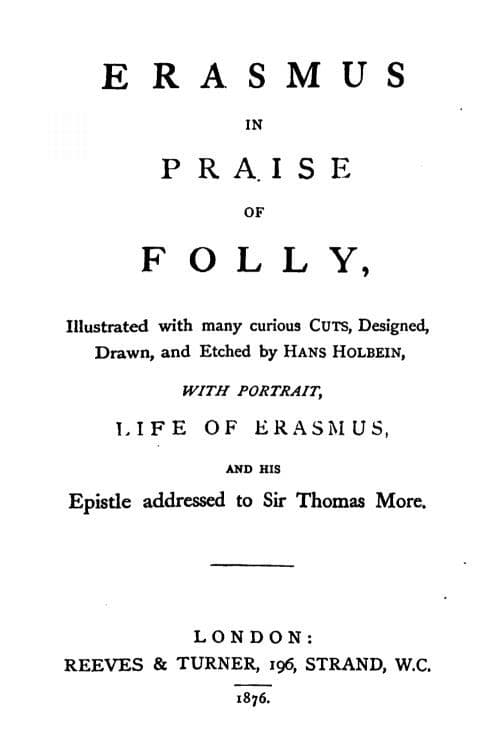
The Praise of Folly
1511
Erasmus composed this audacious masterpiece in a single week while staying with his friend Thomas More, and the wit feels effortless. The book is structured as a speech delivered by Folly herself, a personified goddess who extols her own virtues with devastating irony. But what begins as playful banter gradually becomes a razor-sharp attack on the follies of European society: pompous scholars, corrupt clergy,power-hungry monarchs, and the entire apparatus of received wisdom. Folly argues, convincingly, that the world runs on self-deception,that serious men commit the greatest absurdities, and that those who laugh may see more clearly than those who pontificate. Erasmus, writing in Latin, crafted something remarkable: a book that mocks everything from papal politics to pedantic academics while maintaining a tone of gleeful absurdity. Five centuries later, the satire still bites because human folly hasn't changed, we've only grown more sophisticated about concealing it. For readers who enjoy wit that illuminates while it wounds, this remains essential Renaissance literature.
Editions
X-Ray
“The chief element of happiness is this: to want to be what you are.””
— Desiderius Erasmus
“For anyone who loves intensely lives not in himself but in the object of his love, and the further he can move out of himself into his love, the happier he is.””
— Desiderius Erasmus
“Just as nothing is more foolish than misplaced wisdom, so too, nothing is more imprudent than perverse prudence. And surely it is perverse not to adapt yourself to the prevailing circumstances, to refuse 'to do as the Romans do,' to ignore the party-goer's maxium 'take a drink or take your leave,' to insist that the play should not be a play. True prudence, on the other hand, recognizes human limitations and does not strive to leap beyond them; it is willing to run with the herd, to overlook faults tolerantly or to share them in a friendly spirit. But, they say, that is exactly what we mean by folly. (I will hardly deny it -- as long as they will reciprocate by admitting that this is exactly what is means to perform the play of life.)””
— Desiderius Erasmus
“Almost all Christians being wretchedly enslaved to blindness and ignorance, which the priests are so far from preventing or removing, that they blacken the darkness, and promote the delusion: wisely foreseeing that the people (like cows, which never give down their milk so well as when they are gently stroked), would part with less if they knew more...””
— Desiderius Erasmus
“...it is a sneaking piece of cowardice for authors to put feigned names to their works, as if, like bastards of their brain, they were afraid to own them.””
— Desiderius Erasmus
“Yet in the midst of all their prosperity, princes in this respect seem to me most unfortunate, because, having no one to tell them truth, they are forced to receive flatterers for friends.””
— Desiderius Erasmus
“The Stoics define wisdom to be conducted by reason, and folly nothing else but the being hurried by passion, lest our life should otherwise have been too dull and inactive, that creator, who out of clay first tempered and made us up, put into the composition of our humanity more than a pound of passions to an ounce of reason; and reason he confined within the narrow cells of the brain, whereas he left passions the whole body to range in. Farther, he set up two sturdy champions to stand perpetually on guard, that reason might make no assault, surprise, nor inroad ; anger, which keeps its station in the fortress of the heart ; and lust, which like the signs Virgo and Scorpio, rules the appetites and passions.””
— Desiderius Erasmus
“Dve smetnje, uglavnom, ne dopuštaju čoveku da dođe do saznanja: stid kojim se zaslepljuje duh i strah koji u svemu vidi opasnost i obeshrabruje čoveka u njegovoj delatnosti. Ludost sjajno oslobađa svih tih teškoća. Mali broj ljudi zna koliko koristi i ugodnosti donosi preimućstvo da te nikad ničega nije stid i da te nikad nije strah!””
— Desiderius Erasmus
“Again what city ever received Plato's or Aristotle's laws, or Socrates' precepts? But,””
— Desiderius Erasmus
Link to this book
Add a free, dofollow link to Lex on your blog, forum, syllabus, or reading list.

<a href="https://lex-books.com/book/the-praise-of-folly-3f0067cd-38ad-4c26-9694-7034edde5285"><img src="https://lex-books.com/badges/read-on-lex.svg" alt="Read The Praise of Folly by Desiderius Erasmus free on Lex" width="160" height="40"></a>[](https://lex-books.com/book/the-praise-of-folly-3f0067cd-38ad-4c26-9694-7034edde5285)[url=https://lex-books.com/book/the-praise-of-folly-3f0067cd-38ad-4c26-9694-7034edde5285][img]https://lex-books.com/badges/read-on-lex.svg[/img][/url]Read The Praise of Folly by Desiderius Erasmus free on Lex: https://lex-books.com/book/the-praise-of-folly-3f0067cd-38ad-4c26-9694-7034edde5285Cite this book
Reading this edition for a paper or guide? Copy a citation.
Erasmus, Desiderius. The Praise of Folly. Lex, lex-books.com/book/the-praise-of-folly-3f0067cd-38ad-4c26-9694-7034edde5285.Erasmus, D. (1511). The Praise of Folly. Lex. https://lex-books.com/book/the-praise-of-folly-3f0067cd-38ad-4c26-9694-7034edde5285Erasmus, Desiderius. The Praise of Folly. Lex. https://lex-books.com/book/the-praise-of-folly-3f0067cd-38ad-4c26-9694-7034edde5285.
![Two Dyaloges (c. 1549): Wrytten in Laten by the Famous Clerke, D. Erasm[US] of Roterodame, One Called Polyphemus or the Gospeller, the Other Dysposyng of Thynges and Names, Translated in to Englyshe by Edmonde Becke.](/_next/image?url=https%3A%2F%2Fd3b2n8gj62qnwr.cloudfront.net%2FCOVERS%2Fgutenberg_covers75k%2Febook-14500.png&w=3840&q=75)