A Merry Dialogue Declaringe the Properties of Shrowde Shrews and Honest Wives
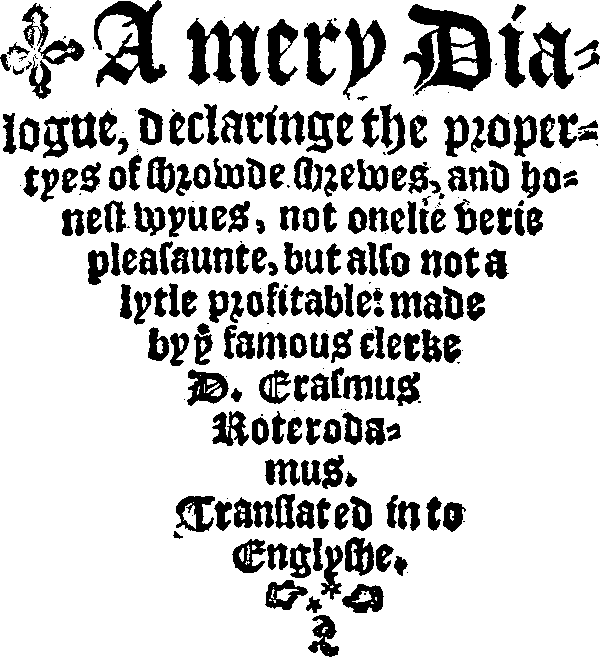
A Merry Dialogue Declaringe the Properties of Shrowde Shrews and Honest Wives
A humorous discourse written in the mid-16th century, likely around the 1550s. This dialogue fits within the genre of social commentary and satire, exploring marital dynamics and the contrasting tendencies of wives characterized as either 'shrowde shrews' or 'honest wives.' The text likely aims to entertain while also providing insights into the expected behaviors and roles within a marriage, reflecting the social norms of its time. The narrative unfolds through the conversations of two women, Eulalia and Xantippa, who exchange their experiences and perspectives on marriage and their husbands. Eulalia offers counsel to Xantippa, who complains about her husband's behavior and perceived shortcomings. The dialogue touches on themes of patience, understanding, and the dynamics of power and submission within the marital relationship. Through anecdotes and humor, the text conveys the idea that wives can influence their husbands' behavior through gentleness and domestic care while highlighting the challenges they face. It culminates in a comedic yet pointed commentary on marriage, suggesting that the ability to navigate these complexities is crucial for a harmonious relationship.
Editions
X-Ray
Link to this book
Add a free, dofollow link to Lex on your blog, forum, syllabus, or reading list.

<a href="https://lex-books.com/book/a-merry-dialogue-declaringe-the-properties-of-shrowde-shrews-and-honest-wives-fe324cf5-443c-4a25-b612-149f3c910326"><img src="https://lex-books.com/badges/read-on-lex.svg" alt="Read A Merry Dialogue Declaringe the Properties of Shrowde Shrews and Honest Wives by Desiderius Erasmus free on Lex" width="160" height="40"></a>[](https://lex-books.com/book/a-merry-dialogue-declaringe-the-properties-of-shrowde-shrews-and-honest-wives-fe324cf5-443c-4a25-b612-149f3c910326)[url=https://lex-books.com/book/a-merry-dialogue-declaringe-the-properties-of-shrowde-shrews-and-honest-wives-fe324cf5-443c-4a25-b612-149f3c910326][img]https://lex-books.com/badges/read-on-lex.svg[/img][/url]Read A Merry Dialogue Declaringe the Properties of Shrowde Shrews and Honest Wives by Desiderius Erasmus free on Lex: https://lex-books.com/book/a-merry-dialogue-declaringe-the-properties-of-shrowde-shrews-and-honest-wives-fe324cf5-443c-4a25-b612-149f3c910326Cite this book
Reading this edition for a paper or guide? Copy a citation.
Erasmus, Desiderius. A Merry Dialogue Declaringe the Properties of Shrowde Shrews and Honest Wives. Lex, lex-books.com/book/a-merry-dialogue-declaringe-the-properties-of-shrowde-shrews-and-honest-wives-fe324cf5-443c-4a25-b612-149f3c910326.Erasmus, D. (n.d.). A Merry Dialogue Declaringe the Properties of Shrowde Shrews and Honest Wives. Lex. https://lex-books.com/book/a-merry-dialogue-declaringe-the-properties-of-shrowde-shrews-and-honest-wives-fe324cf5-443c-4a25-b612-149f3c910326Erasmus, Desiderius. A Merry Dialogue Declaringe the Properties of Shrowde Shrews and Honest Wives. Lex. https://lex-books.com/book/a-merry-dialogue-declaringe-the-properties-of-shrowde-shrews-and-honest-wives-fe324cf5-443c-4a25-b612-149f3c910326.
![Two Dyaloges (c. 1549): Wrytten in Laten by the Famous Clerke, D. Erasm[US] of Roterodame, One Called Polyphemus or the Gospeller, the Other Dysposyng of Thynges and Names, Translated in to Englyshe by Edmonde Becke.](/_next/image?url=https%3A%2F%2Fd3b2n8gj62qnwr.cloudfront.net%2FCOVERS%2Fgutenberg_covers75k%2Febook-14500.png&w=3840&q=75)