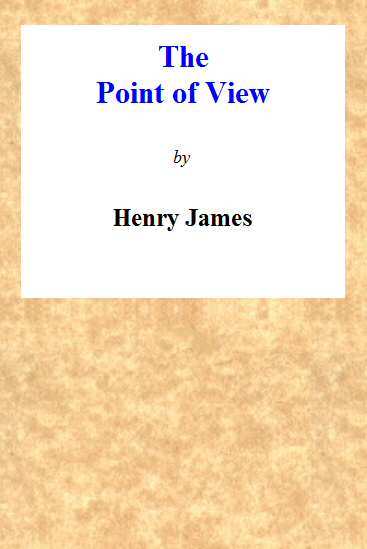
The Point of View
1882
Aurora Church writes to her mother from the deck of a ship bound for America, her letters crackling with restless joy and the promise of liberation. She mocks her fellow passengers, delights in her own rebellion, and anticipates a land where she might finally be free. Her mother writes back from a different world entirely: one of decorum, European refinement, and quiet dread about what her daughter will find in that vulgar, energetic place. Through their letters, Henry James constructs a perfect duel of perceptions, two women watching America approach from opposite ends of hope and fear. The novel runs only to about 200 pages but captures something vast: the terror and thrill of becoming, the question of whether home is a place or a judgment we carry with us. This is James at his most precise, using the epistolary form to show how every voice constructs its own truth.
Editions
Link to this book
Add a free, dofollow link to Lex on your blog, forum, syllabus, or reading list.

<a href="https://lex-books.com/book/the-point-of-view-363a5949-846f-4a4c-8e88-0a0e95516f1d"><img src="https://lex-books.com/badges/read-on-lex.svg" alt="Read The Point of View by Henry James free on Lex" width="160" height="40"></a>[](https://lex-books.com/book/the-point-of-view-363a5949-846f-4a4c-8e88-0a0e95516f1d)[url=https://lex-books.com/book/the-point-of-view-363a5949-846f-4a4c-8e88-0a0e95516f1d][img]https://lex-books.com/badges/read-on-lex.svg[/img][/url]Read The Point of View by Henry James free on Lex: https://lex-books.com/book/the-point-of-view-363a5949-846f-4a4c-8e88-0a0e95516f1dCite this book
Reading this edition for a paper or guide? Copy a citation.
James, Henry. The Point of View. Lex, lex-books.com/book/the-point-of-view-363a5949-846f-4a4c-8e88-0a0e95516f1d.James, H. (1882). The Point of View. Lex. https://lex-books.com/book/the-point-of-view-363a5949-846f-4a4c-8e88-0a0e95516f1dJames, Henry. The Point of View. Lex. https://lex-books.com/book/the-point-of-view-363a5949-846f-4a4c-8e88-0a0e95516f1d.