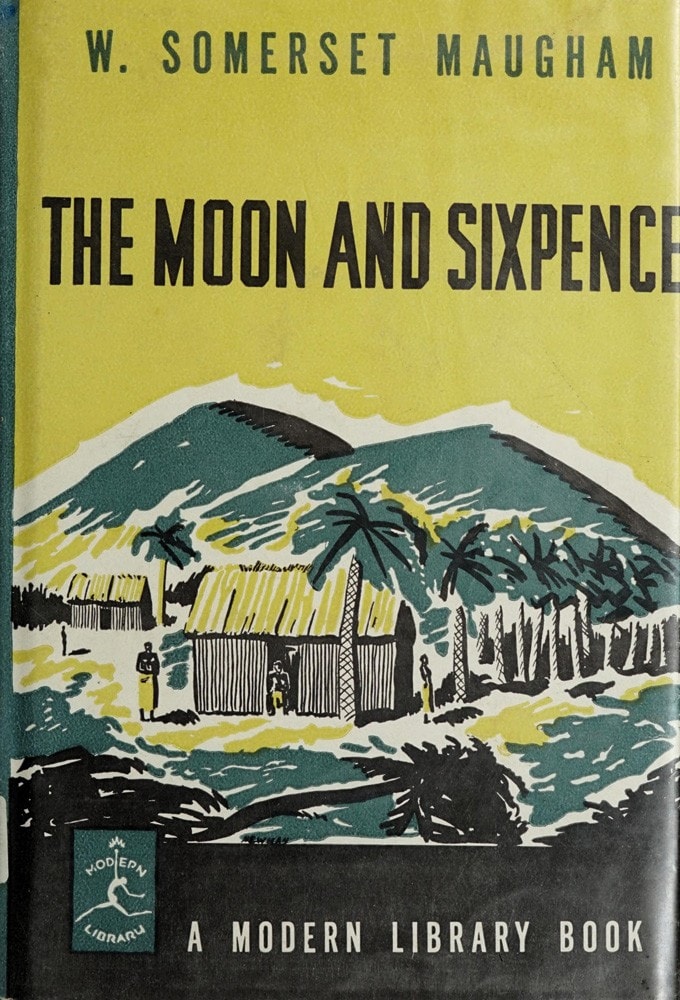
The Moon and Sixpence
1919
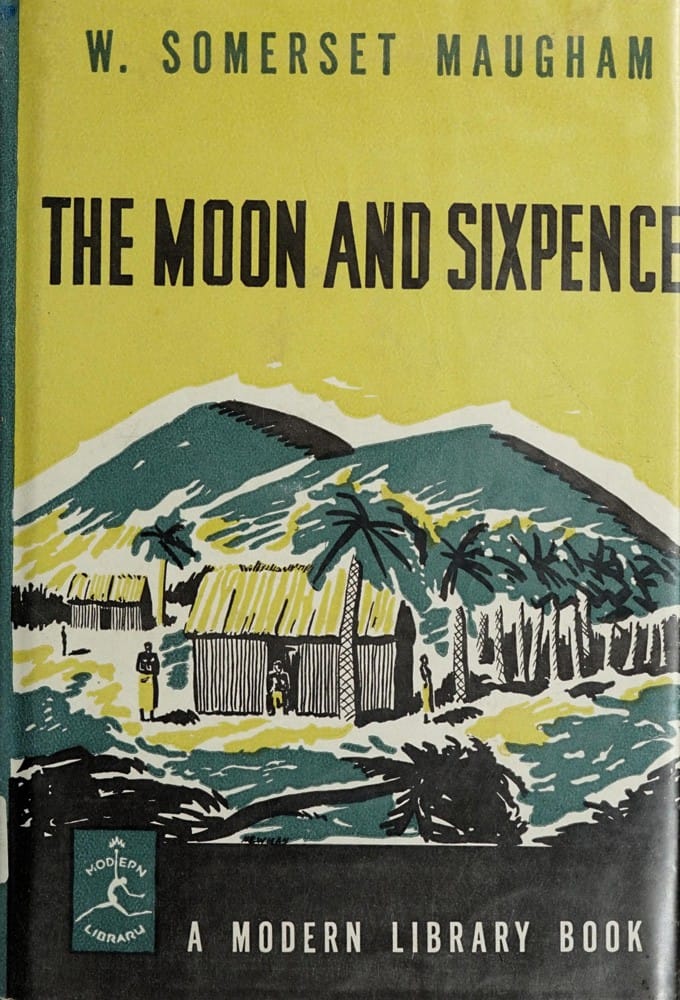
Charles Strickland has a comfortable life in London: a wife who hosts literary dinners, two children destined for respectable careers, a steady job as a stockbroker. Then, at forty, he vanishes. Not into another woman's arms, but into paint. He leaves everything behind to learn that he must paint, that he has been, as he puts it, a fool all his years. Maugham pursues his former acquaintance from London galleries to Parisian garrets to the jungled shores of Tahiti, watching a man destroy everyone who loves him in pursuit of something that cannot be shared or explained. This is not a celebration of artistic genius. It is an uncomfortable, clear-eyed reckoning with what it costs: the women abandoned, the hearts broken, the steady destruction of everything soft in pursuit of something brutal and necessary. The narrator, both fascinated and repelled, refuses to judge yet cannot look away. The question the novel leaves burning: is Strickland a saint or a monster, or simply a man who could not do otherwise?
Editions


X-Ray
“Impropriety is the soul of wit.””
— W. Somerset Maugham
“As lovers, the difference between men and women is that women can love all day long, but men only at times.””
— W. Somerset Maugham
“When a woman loves you she's not satisfied until she possesses your soul. Because she's weak, she has a rage for domination, and nothing less will satisfy her.””
— W. Somerset Maugham
“It is one of the defects of my character that I cannot altogether dislike anyone who makes me laugh.””
— W. Somerset Maugham
“I have an idea that some men are born out of their due place. Accident has cast them amid certain surroundings, but they have always a nostalgia for a home they know not. They are strangers in their birthplace, and the leafy lanes they have known from childhood or the populous streets in which they have played, remain but a place of passage. They may spend their whole lives aliens among their kindred and remain aloof among the only scenes they have ever known. Perhaps it is this sense of strangeness that sends men far and wide in the search for something permanent, to which they may attach themselves. Perhaps some deep-rooted atavism urges the wanderer back to lands which his ancestors left in the dim beginnings of history.””
— W. Somerset Maugham
“Each one of us is alone in the world. He is shut in a tower of brass, and can communicate with his fellows only by signs, and the signs have no common value, so that their sense is vague and uncertain. We seek pitifully to convey to others the treasures of our heart, but they have not the power to accept them, and so we go lonely, side by side but not together, unable to know our fellows and unknown by them. We are like people living in a country whose language they know so little that, with all manner of beautiful and profound things to say, they are condemned to the banalities of the conversation manual. Their brain is seething with ideas, and they can only tell you that the umbrella of the gardener's aunt is in the house.””
— W. Somerset Maugham
“Women are constantly trying to commit suicide for love, but generally they take care not to succeed.””
— W. Somerset Maugham
“Beauty is something wonderful and strange that the artist fashions out of the chaos of the world in the torment of his soul. And when he has made it, it is not given to all to know it. To recognize it you must repeat the adventure of the artist. It is a melody that he sings to you, and to hear it again in your own heart you want knowledge and sensitiveness and imagination.””
— W. Somerset Maugham
“Sometimes people carry to such perfection the mask they have assumed that in due course they actually become the person they seem.””
— W. Somerset Maugham
Link to this book
Add a free, dofollow link to Lex on your blog, forum, syllabus, or reading list.

<a href="https://lex-books.com/book/the-moon-and-sixpence-5312eb9e-31aa-4675-8ccd-06d504076294"><img src="https://lex-books.com/badges/read-on-lex.svg" alt="Read The Moon and Sixpence by W. Somerset Maugham free on Lex" width="160" height="40"></a>[](https://lex-books.com/book/the-moon-and-sixpence-5312eb9e-31aa-4675-8ccd-06d504076294)[url=https://lex-books.com/book/the-moon-and-sixpence-5312eb9e-31aa-4675-8ccd-06d504076294][img]https://lex-books.com/badges/read-on-lex.svg[/img][/url]Read The Moon and Sixpence by W. Somerset Maugham free on Lex: https://lex-books.com/book/the-moon-and-sixpence-5312eb9e-31aa-4675-8ccd-06d504076294Cite this book
Reading this edition for a paper or guide? Copy a citation.
Maugham, W. Somerset. The Moon and Sixpence. Lex, lex-books.com/book/the-moon-and-sixpence-5312eb9e-31aa-4675-8ccd-06d504076294.Maugham, W. S. (1919). The Moon and Sixpence. Lex. https://lex-books.com/book/the-moon-and-sixpence-5312eb9e-31aa-4675-8ccd-06d504076294Maugham, W. Somerset. The Moon and Sixpence. Lex. https://lex-books.com/book/the-moon-and-sixpence-5312eb9e-31aa-4675-8ccd-06d504076294.