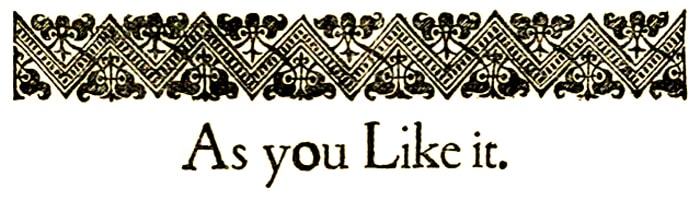
As You like It
1623
The heroine who dresses as a man who pretends to be a woman teaching the man she loves how to love her. That's the audacious premise at the heart of this Elizabethan comedy, a play that deconstructs the very nature of performance itself. When Rosalind flees her usurping uncle's court, taking refuge in the Forest of Arden disguised as a shepherd named Ganymede, she doesn't just escape persecution , she gains the freedom to orchestrate her own courtship. By coaxing Orlando to practice love letters to a fictional Rosalind, she transforms romance into theater, creating a space for honest feeling to emerge through layers of playful artifice. Yet beneath the wit and wordplay lies something genuinely radical: a woman claiming agency over desire in a world that denies her voice, an exiled duke finding unexpected wisdom among the oak trees, and brothers locked in deadly conflict over inheritance. The melancholy Jaques observes it all with weary clarity, delivering the famous 'All the world's a stage' meditation that still cuts through centuries of sentiment. Four centuries later, this play remains astonishingly alive , a comedy that knows sorrow is inseparable from joy, and that identity itself might be the greatest performance of all.
Editions


X-Ray
“The fool doth think he is wise, but the wise man knows himself to be a fool.””
— William Shakespeare
“All the world's a stage, And all the men and women merely players; They have their exits and their entrances; And one man in his time plays many parts, His acts being seven ages.””
— William Shakespeare
“Do you not know I am a woman? when I think, I must speak.””
— William Shakespeare
“I pray you, do not fall in love with me, for I am falser than vows made in wine.””
— William Shakespeare
“Love is merely a madness; and, I tell you, deserves as well a dark house and a whip as madmen do; and the reason why they are not so punish'd and cured is that the lunacy is soordinary that the whippers are in love too.””
— William Shakespeare
“And this our life, exempt from public haunt, finds tongues in trees, books in the running brooks, sermons in stones, and good in everything. I would not change it.””
— William Shakespeare
“Men have died from time to time, and worms have eaten them, but not for love.””
— William Shakespeare
“Sweet are the uses of adversity,Which, like the toad, ugly and venomous,Wears yet a precious jewel in his head;And this our life, exempt from public haunt,Find tongues in trees, books in the running brooks,Sermons in stones, and good in everything.””
— William Shakespeare
“No sooner met but they looked; no sooner looked but they loved; no sooner loved but they sighed; no sooner sighed but they asked one another the reason; no sooner knew the reason but they sought the remedy; and in these degrees have they made a pair of stairs to marriage...””
— William Shakespeare
Link to this book
Add a free, dofollow link to Lex on your blog, forum, syllabus, or reading list.

<a href="https://lex-books.com/book/as-you-like-it-eb9de8c2-b48b-4304-aa16-e534de097d04"><img src="https://lex-books.com/badges/read-on-lex.svg" alt="Read As You like It by William Shakespeare free on Lex" width="160" height="40"></a>[](https://lex-books.com/book/as-you-like-it-eb9de8c2-b48b-4304-aa16-e534de097d04)[url=https://lex-books.com/book/as-you-like-it-eb9de8c2-b48b-4304-aa16-e534de097d04][img]https://lex-books.com/badges/read-on-lex.svg[/img][/url]Read As You like It by William Shakespeare free on Lex: https://lex-books.com/book/as-you-like-it-eb9de8c2-b48b-4304-aa16-e534de097d04Cite this book
Reading this edition for a paper or guide? Copy a citation.
Shakespeare, William. As You like It. Lex, lex-books.com/book/as-you-like-it-eb9de8c2-b48b-4304-aa16-e534de097d04.Shakespeare, W. (1623). As You like It. Lex. https://lex-books.com/book/as-you-like-it-eb9de8c2-b48b-4304-aa16-e534de097d04Shakespeare, William. As You like It. Lex. https://lex-books.com/book/as-you-like-it-eb9de8c2-b48b-4304-aa16-e534de097d04.