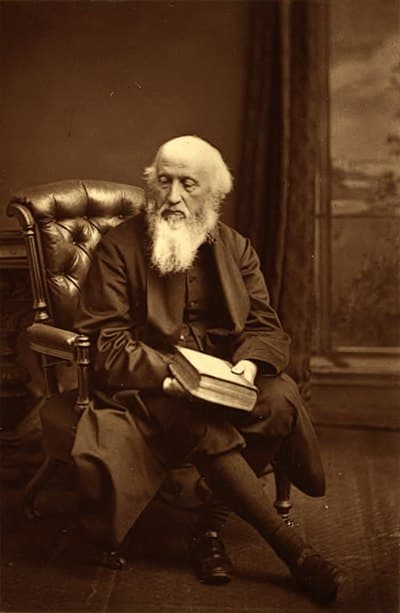
William Barnes
William Barnes was an English polymath whose diverse talents spanned writing, poetry, philology, and mathematics. Born in Dorset, he became renowned for his poetry, penning over 800 poems, many of which celebrated the local dialect and landscape. His notable works include 'Poems of Rural Life in the Dorset Dialect,' which not only showcased his lyrical prowess but also highlighted the beauty of regional speech. Barnes was a linguistic purist, advocating for the preservation of Anglo-Saxon language and resisting the influx of foreign words into English. His comprehensive English grammar, which drew from over 70 languages, further exemplified his dedication to linguistic integrity and education. Beyond his literary contributions, Barnes served as a priest and was involved in various intellectual pursuits, including engraving and invention. His work significantly influenced the appreciation of dialect poetry and the study of English linguistics. Barnes's legacy endures through his commitment to the English language and his efforts to celebrate the cultural richness of rural life, making him a notable figure in the Victorian literary landscape.
Famous Quotes
View all 12 quotes“Art thou not sorry for these heinous deeds?AARON. Ay, that I had not done a thousand more.Even now I curse the day- and yet, I think,Few come within the compass of my curse-Wherein I did not some notorious ill;As kill a man, or else devise his death;Ravish a maid, or plot the way to do it;Accuse some innocent, and forswear myself;Set deadly enmity between two friends;Make poor men's cattle break their necks;Set fire on barns and hay-stacks in the night,And bid the owners quench them with their tears.Oft have I digg'd up dead men from their graves,And set them upright at their dear friends' doorEven when their sorrows almost was forgot,And on their skins, as on the bark of trees,Have with my knife carved in Roman letters'Let not your sorrow die, though I am dead.'Tut, I have done a thousand dreadful thingsAs willingly as one would kill a fly;And nothing grieves me heartily indeedBut that I cannot do ten thousand more.””
“OctoberO love, turn from the changing sea and gaze,Down these grey slopes, upon the year grown old,A-dying 'mid the autumn-scented hazeThat hangeth o'er the hollow in the wold,Where the wind-bitten ancient elms infoldGrey church, long barn, orchard, and red-roofed stead,Wrought in dead days for men a long while dead.Come down, O love; may not our hands still meet,Since still we live today, forgetting June,Forgetting May, deeming October sweet? - - Oh, hearken! hearken! through the afternoonThe grey tower sings a strange old tinkling tune!Sweet, sweet, and sad, the toiling year's last breath,To satiate of life, to strive with death.And we too -will it not be soft and kind,That rest from life, from patience, and from pain,That rest from bliss we know not when we find,That rest from love which ne'er the end can gain?- Hark! how the tune swells, that erewhile did wane!Look up, love! -Ah! cling close, and never move!How can I have enough of life and love?””
“Ay, that I had not done a thousand more.Even now I curse the day”
Books from the author




Link to this page
Add a free, dofollow link to Lex on your blog, forum, syllabus, or reading list.

<a href="https://lex-books.com/author/william-barnes"><img src="https://lex-books.com/badges/read-on-lex.svg" alt="William Barnes on Lex" width="160" height="40"></a>[](https://lex-books.com/author/william-barnes)[url=https://lex-books.com/author/william-barnes][img]https://lex-books.com/badges/read-on-lex.svg[/img][/url]William Barnes on Lex: https://lex-books.com/author/william-barnes