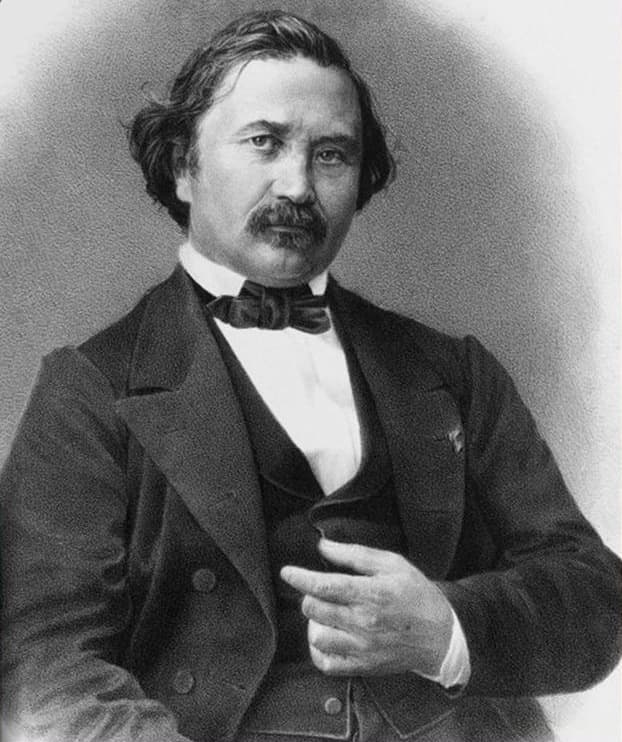
Joseph Bertrand
Joseph Bertrand was a prominent French mathematician and historian of science, recognized for his significant contributions to various fields, including number theory, differential geometry, probability theory, economics, and thermodynamics. Born in 1822, he became known for Bertrand's paradox in probability theory, which highlighted the complexities and nuances of statistical reasoning. His work laid foundational principles that would influence future generations of mathematicians and scientists, particularly in the realms of probability and statistics. In addition to his mathematical achievements, Bertrand was an ardent advocate for the history of science, emphasizing the importance of understanding scientific developments within their historical context. His writings reflected a deep engagement with the philosophical implications of mathematical concepts, bridging the gap between abstract theory and practical application. Bertrand's legacy endures in the fields of mathematics and science, where his insights continue to inspire inquiry and exploration.
Famous Quotes
View all 4 quotes“The first successes were such that one might suppose all the difficulties of science overcome in advance, and believe that the mathematician, without being longer occupied in the elaboration of pure mathematics, could turn his thoughts exclusively to the study of natural laws.””
“In the outworks of our lives, we were almost strangers, but we shared a certain outlook on human life and human destiny, which, from the very first, made a bond of extreme strength . . . . At our very first meeting, we talked with continually increasing intimacy. We seemed to sink through layer after layer of what was superficial, till gradually both reached the central fire. It was an experience unlike any other that I have known. We looked into each other's eyes, half appalled and half intoxicated to find ourselves together in such a region. The emotion was as intense as passionate love, and at the same time all-embracing. I came away bewildered, and hardly able to find my way among ordinary affairs.””
“My conclusion is that there is no reason to believe any of the dogmas of traditional theology and, further, that there is no reason to wish that they were true. Man, in so far as he is not subject to natural forces, is free to work out his own destiny. The responsibility is his, and so is the opportunity. - Bertrand Russell””
Books from the author


Link to this page
Add a free, dofollow link to Lex on your blog, forum, syllabus, or reading list.

<a href="https://lex-books.com/author/joseph-bertrand"><img src="https://lex-books.com/badges/read-on-lex.svg" alt="Joseph Bertrand on Lex" width="160" height="40"></a>[](https://lex-books.com/author/joseph-bertrand)[url=https://lex-books.com/author/joseph-bertrand][img]https://lex-books.com/badges/read-on-lex.svg[/img][/url]Joseph Bertrand on Lex: https://lex-books.com/author/joseph-bertrand