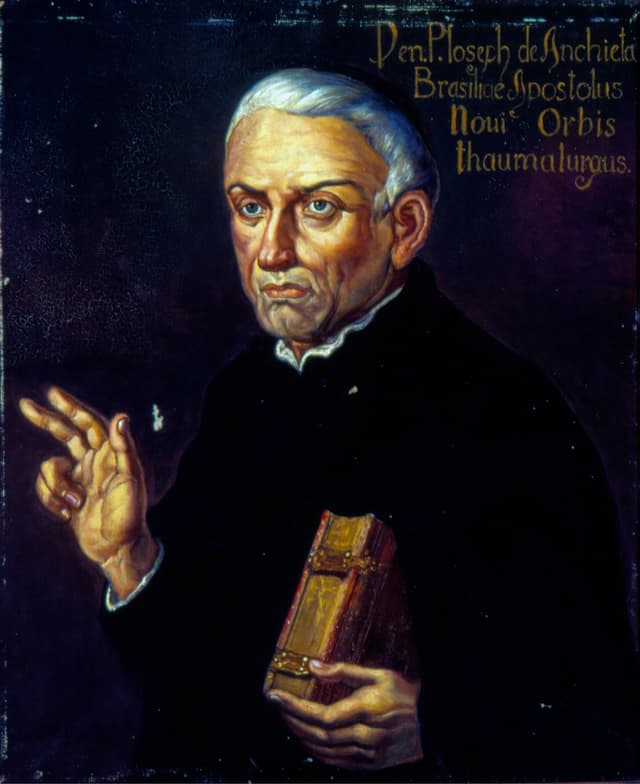
José de Anchieta
José de Anchieta was a Spanish Jesuit missionary, poet, and playwright who played a significant role in the early history of Brazil. Born in the Canary Islands, he arrived in Brazil in 1553, where he dedicated his life to evangelizing the indigenous populations and promoting education. Anchieta's contributions to the development of the Portuguese language in Brazil were profound; he is often credited with writing one of the first plays in the Portuguese language, 'A Sagrada Escritura', and his poetry reflected both his religious fervor and his deep appreciation for the culture and languages of the indigenous people. Anchieta's literary works, which include letters, poems, and plays, not only served religious purposes but also provided insights into the social and cultural dynamics of 16th-century Brazil. His writings are considered foundational in Brazilian literature, as they blend European literary forms with indigenous themes. Anchieta's legacy extends beyond his literary contributions; he is also remembered for his efforts in education and his advocacy for the rights of indigenous peoples. His life and work exemplified the complexities of colonialism and the cultural exchanges that shaped Brazil's identity.
Books from the author












Link to this page
Add a free, dofollow link to Lex on your blog, forum, syllabus, or reading list.

<a href="https://lex-books.com/author/josé-de-anchieta"><img src="https://lex-books.com/badges/read-on-lex.svg" alt="José de Anchieta on Lex" width="160" height="40"></a>[](https://lex-books.com/author/josé-de-anchieta)[url=https://lex-books.com/author/josé-de-anchieta][img]https://lex-books.com/badges/read-on-lex.svg[/img][/url]José de Anchieta on Lex: https://lex-books.com/author/josé-de-anchieta