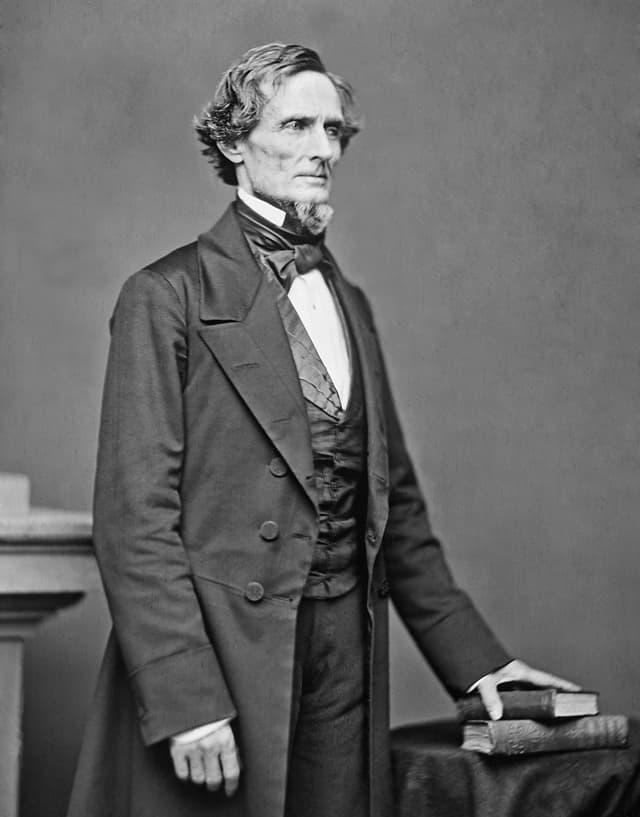
Jefferson Davis
Jefferson Davis was an American politician best known for serving as the only president of the Confederate States during the American Civil War from 1861 to 1865. Born in Fairview, Kentucky, and raised in Mississippi, Davis was the youngest of ten children. His early career included roles as a U.S. Congressman and Senator, as well as Secretary of War under President Franklin Pierce. His military background was established at the United States Military Academy, followed by service in the U.S. Army and participation in the Mexican-American War as a colonel. Davis's political career was marked by his staunch support for states' rights and slavery, which ultimately led him to resign from the Senate when Mississippi seceded from the Union. As president of the Confederacy, Davis faced numerous challenges, including military defeats and economic hardships. His leadership style and decisions, such as the emphasis on a centralized government, were often criticized, and he struggled to maintain unity among the Confederate states. After the Civil War, Davis was imprisoned for two years and later became a symbol of the Lost Cause narrative, which romanticized the Confederacy. His writings, including 'The Rise and Fall of the Confederate Government,' reflect his perspectives on the war and his vision for the South. Davis's legacy remains controversial, as he is viewed both as a defender of Southern rights and as a figure representing the institution of slavery.
Famous Quotes
View all 3 quotes“His captors asked why he, a nonslaveholder, was fighting to uphold slavery. He replied: “I’m fighting because you’re down here.”7”
“Not surprisingly, South Carolina acted first. “There is nothing in all the dark caves of human passion so cruel and deadly as the hatred the South Carolinians profess for the Yankees.” wrote the correspondent of the London Times from Charleston. The enmity of Greek for Turk was child’s play “compared to the animosity evinced by the ‘gentry’ of South Carolina for the ‘rabble of the North.’ … The State of South Carolina was,’ I am”
“The difficult we can do immediately; the impossible will take a little longer.”
Books from the author


Link to this page
Add a free, dofollow link to Lex on your blog, forum, syllabus, or reading list.

<a href="https://lex-books.com/author/jefferson-davis"><img src="https://lex-books.com/badges/read-on-lex.svg" alt="Jefferson Davis on Lex" width="160" height="40"></a>[](https://lex-books.com/author/jefferson-davis)[url=https://lex-books.com/author/jefferson-davis][img]https://lex-books.com/badges/read-on-lex.svg[/img][/url]Jefferson Davis on Lex: https://lex-books.com/author/jefferson-davis