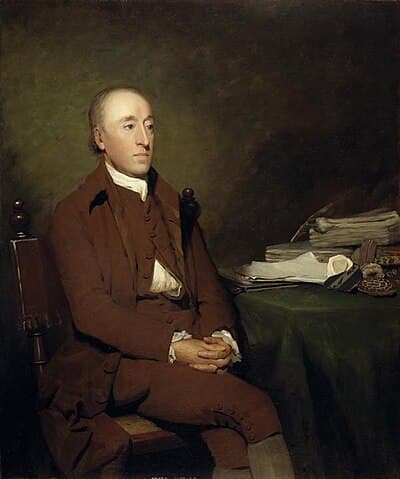
James Hutton
James Hutton was a Scottish geologist, agriculturalist, and physician, widely recognized as the 'Father of Modern Geology.' His groundbreaking work in the late 18th century laid the foundation for geology as a scientific discipline. Hutton's innovative theories emerged from his meticulous observations of the Scottish landscape, particularly at sites like Siccar Point, where he demonstrated that geological formations were not static but rather the result of continuous processes over vast periods. This insight led him to challenge the prevailing notion of a young Earth, advocating for the principle of uniformitarianism, which posits that the same natural laws and processes observed today have always operated in the same way throughout Earth's history. In addition to his geological contributions, Hutton proposed a 'system of the habitable Earth,' a deistic framework suggesting that the Earth was designed to remain suitable for human life. His ideas, while initially met with skepticism, significantly influenced subsequent scientific thought and laid the groundwork for future geologists. Hutton's legacy endures in the field of geology, where his principles continue to inform our understanding of Earth's processes and history, marking him as a pivotal figure in the evolution of natural sciences.
Famous Quotes
View all 5 quotes“To a naturalist nothing is indifferent; the humble moss that creeps upon the stone is equally interesting as the lofty pine which so beautifully adorns the valley or the mountain: but to a naturalist who is reading in the face of the rocks the annals of a former world, the mossy covering which obstructs his view, and renders indistinguishable the different species of stone, is no less than a serious subject of regret.””
“There is no vestige of a beginning, no prospect of an end.””
“...if an organised body is not in the situation and circumstances best adapted to its sustenance and propagation, then, in conceiving an indefinite variety among the individuals of that species, we must be assured, that, on the one hand, those which depart most from the best adapted constitution, will be the most liable to perish, while, on the other hand, those organised bodies, which most approach to the best constitution for the present circumstances, will be best adapted to continue, in preserving themselves and multiplying the individuals of their race.””
Books from the author



Link to this page
Add a free, dofollow link to Lex on your blog, forum, syllabus, or reading list.

<a href="https://lex-books.com/author/james-hutton"><img src="https://lex-books.com/badges/read-on-lex.svg" alt="James Hutton on Lex" width="160" height="40"></a>[](https://lex-books.com/author/james-hutton)[url=https://lex-books.com/author/james-hutton][img]https://lex-books.com/badges/read-on-lex.svg[/img][/url]James Hutton on Lex: https://lex-books.com/author/james-hutton