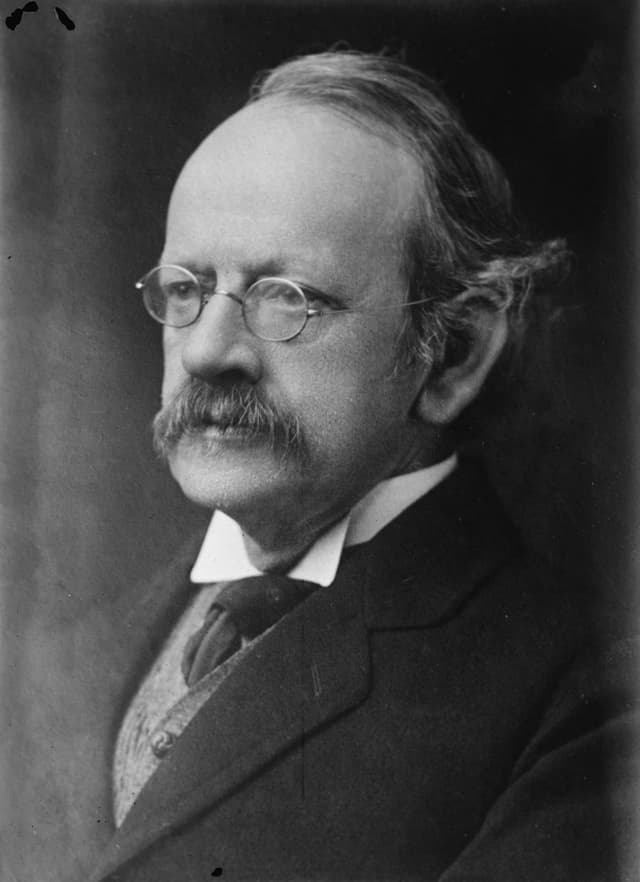
J. J. Thomson
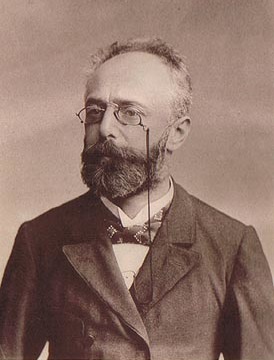
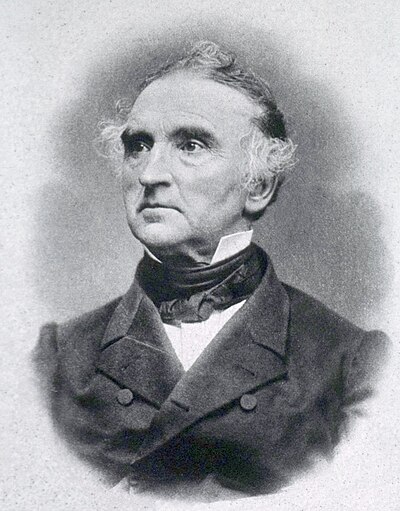
J. J. Thomson was a British physicist renowned for his groundbreaking work in atomic structure and the discovery of the electron. Born in 1856 in Manchester, he pursued his education at the University of Cambridge, where his curiosity and intellect flourished. Thomson's experiments with cathode rays in the late 19th century led to the revolutionary conclusion that these rays were composed of negatively charged particles, which he named electrons. This discovery not only transformed the field of physics but also laid the foundation for modern atomic theory, challenging the previously accepted notion of indivisible atoms proposed by Dalton. In addition to his work on the electron, Thomson made significant contributions to the understanding of the nature of matter and the development of the field of particle physics. He introduced the 'plum pudding model' of the atom, which suggested that electrons were embedded within a positively charged 'soup.' Though later disproven, this model was pivotal in guiding future research. Thomson's legacy extends beyond his discoveries; he was a mentor to many prominent scientists, including Ernest Rutherford, and served as the Cavendish Professor of Physics at Cambridge. His influence on both theoretical and experimental physics solidified his place as a key figure in the scientific community, and he was awarded the Nobel Prize in Physics in 1906 for his work on conduction of electricity in gases.
Famous Quotes
View all 8 quotes“There is a massive, irreconcilable conflict between science and religion. Religion was humanity's original cosmology, biology and anthropology. It provided explanations for the origin of the world, life and humans. Science now gives us increasingly complete explanations for those big three. We know the origins of the universe, the physics of the big bang and how the basic chemical elements formed in supernovas. We know that life on this planet originated about 4 billion years ago, and we are all descendants of that original replicating molecule. Thanks to we know that natural selection is the only workable explanation for the design and variety of all life on this planet. Paleoanthropologists and geneticists have reconstructed much of the human tree of life. We are risen apes, not fallen angels. We are the most successful and last surviving African hominid. Every single person on this Earth, all 7 billion of us, arose 50,000 years ago from small bands of African hunter-gatherers, a total population of somewhere between 600 and 2,000 individuals.””
“To kill an error is as good a service as, and sometimes even better than, the establishing of a new truth or fact.””
“Genuine morality is doing what is right regardless of what we may be told; religious morality is doing what we are told.””
Books from the author



Link to this page
Add a free, dofollow link to Lex on your blog, forum, syllabus, or reading list.

<a href="https://lex-books.com/author/j-j-thomson"><img src="https://lex-books.com/badges/read-on-lex.svg" alt="J. J. Thomson on Lex" width="160" height="40"></a>[](https://lex-books.com/author/j-j-thomson)[url=https://lex-books.com/author/j-j-thomson][img]https://lex-books.com/badges/read-on-lex.svg[/img][/url]J. J. Thomson on Lex: https://lex-books.com/author/j-j-thomson